Strait of Magellan
ShōgunThe Strait of Magellan is a passage whose importance in the novel lies not in a description of its shores, but in the dangerous routes and guarded knowledge associated with it. Its seaways are part of the maritime intelligence that Portugal and Spain protect as national treasure, while rival powers seek to acquire it. For John Blackthorne, the Strait is at once a prize of navigation and a measure of the ordeal required to return home: he imagines crossing it again through freezing danger, after a voyage that would test ship and crew for hundreds of days.
The Strait and the Limits of Navigation
The Strait belongs to a world in which voyaging beyond sight of land remains perilous. Charts are scarce and vague, and navigators have no reliable way to determine longitude. A ship may know its general direction yet still be lost in the open ocean; safe passage depends on accumulated practical knowledge as much as on maps. In this setting, the Strait is not simply a line across a chart. It is a difficult maritime route whose successful passage depends on knowing how to approach and negotiate unfamiliar waters.
Blackthorne’s former teacher, Alban Caradoc, impressed on him the stakes of that uncertainty. Caradoc described the navigator out of sight of land as lost unless he possessed a rutter. The guide did not solve the longitude problem, but it offered a working alternative to abstract certainty: observations gathered by pilots who had already sailed the route. That distinction makes the Strait’s navigational knowledge valuable without implying that any book could remove the danger. A pilot still had to judge whether the instructions were trustworthy and whether they matched the conditions at sea.
Rutters and Restricted Knowledge
A rutter is a compact sailing book built from a pilot’s observations. It can record compass courses between ports and capes, soundings and depths, water color and seabed, winds and currents, the duration of a particular tack, and where to find shelter, water, or a place to careen a ship. It may also mark shoals, reefs, tides, harbors, friends, and enemies. Its value lies in bringing dispersed, experience-based details together into instructions for getting somewhere—and finding the way back.
Such books are fallible. Their usefulness depends on the pilot who made the observations, the scribe who copied them, any printer who reproduced them, and any scholar who translated them. Errors could enter the text, and could even be deliberate. No pilot could know for certain whether a rutter was accurate until he had personally tested it at sea. The Strait’s reputation therefore rests on both the promise and the uncertainty of written navigation: a guide can disclose a route, but cannot make the reader’s passage safe by itself.
The secrecy surrounding these guides gives the Strait geopolitical weight. English, Dutch, and French pilots possessed rutters for their own waters, but the wider routes had been sailed by Portuguese and Spanish captains. Those powers guarded the guides to the New World, the Strait, and the Cape of Good Hope, and the onward seaways to Asia. Their rivals pursued the same information with comparable intensity. The Strait thus appears within a contest over who can navigate, trade, and move between distant regions—not as an isolated geographic feature, but as part of a protected system of maritime knowledge.
Blackthorne and the Contested Route
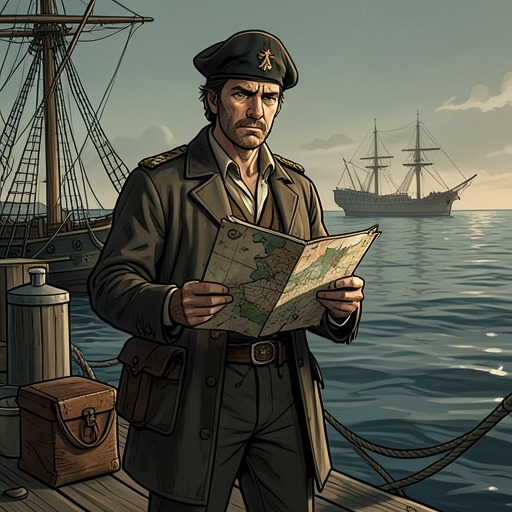
The Strait enters Blackthorne’s career through the Dutch East India Company’s first expedition to the New World. The Company had secretly acquired, at great cost, a contraband Portuguese rutter that supposedly revealed the secrets of the Strait, and wanted to test whether its directions were true. Though the merchants would have preferred a Dutch pilot, they chose Blackthorne, whose English training and fluent Dutch made him a strong candidate for the expedition. His agreed fee was fifteen percent of the profits, and he swore to take the fleet out and bring it home again.
That commission makes the Strait part of a larger wager: whether stolen navigational knowledge can be converted into a viable voyage. Blackthorne’s appointment links the passage to the competition between Iberian secrecy and Dutch efforts to find or use alternative routes. It also establishes the pilot’s responsibility as more than technical expertise. At sea, the pilot is the ship’s leader and final arbiter; his knowledge determines whether the crew can move between ports and whether the promised return is possible.
The Strait is also associated with competing valuations of navigational intelligence. In recounting an earlier encounter with an English privateer, Blackthorne remembers being offered a reward for the rutter of Magellan’s Pass or the Cape of Good Hope. He did not have the sought-after guide, and the privateer eventually put him ashore with his own rutters. The episode reinforces the difference between a pilot’s personal papers and the state-protected route books his rivals hope to obtain. A rutter’s contents could command a price precisely because so much depended on access to routes that Portugal and Spain tried to keep secret.
Loss, Return, and Narrative Meaning
When Blackthorne discovers that his charts and rutters have been taken in Japan, the loss becomes a practical crisis. The Portuguese rutter for the expedition is gone too. Without charts or route books, he fears that he cannot pilot his way home from a distant country where he is in enemy hands. He tries to correct that despair by telling himself that careful sailing and enormous luck might still be enough, but the uncertainty is real: the Strait’s importance is sharpened by how much more difficult a return becomes when the knowledge needed to navigate has vanished.
Later, Blackthorne measures the prospect of departure against the full hardship of another voyage. He imagines returning to the Strait through its freezing dangers, enduring storms, scurvy, and mutiny, then making a second landfall in Japan after 698 days. The passage is therefore not merely a route out of the story’s Japanese setting. It represents the hazardous life to which he might return, set against the people and responsibilities that now make that return uncertain.
The Strait’s narrative force comes from this double role. It is a guarded strategic passage in the contest for global navigation, but it is also an intensely personal threshold: the way home exists in Blackthorne’s plans, yet reaching it would demand a return to the same hostile ocean that made the voyage possible and dangerous. The novel gives the route power through what must be known to attempt it, what can be lost, and what the possibility of crossing it again asks of its pilot.