Japan
ShōgunJapan is both the destination that John Blackthorne struggles to locate and a political landscape whose rules determine who may move, fight, worship, and command. The country’s geography is never merely a backdrop: uncertain sea routes shape arrival and escape, fortified roads make authority visible, and obligations to lords bind households as well as warriors. Its contested identity as the Land of the Gods also gives political conflict a religious and national dimension.
Landfall and the problem of finding Japan
When Blackthorne’s ship is driven ashore, he asks whether the place is Japan. A priest confirms that it is, also calling it Nippon. The landfall answers one question but opens another: Blackthorne has reached the country he sought without possessing the knowledge or security to understand it. Before the arrival, while hungry and suffering from scurvy, he has forced himself to check the compass and estimate his position. He writes the plot in his rutter, the sea manual on which he depends to make a small, precarious patch of ocean navigable.
That uncertainty reflects the conditions of navigation described in the novel. Existing charts are too vague to be dependable, and longitude cannot be fixed. A rutter compensates not with an abstract map but with a pilot’s accumulated practical observations: courses between ports and headlands, soundings, water and seabed, winds and currents, storm seasons, safe places to careen and take on water, and the locations of shoals, reefs, havens, allies, and enemies. Such knowledge can make a voyage safer, but it is local, laboriously gathered, and never a guarantee. Japan enters the story through this tension between the desire to reach it and the fragile means of getting there.
Coasts, passages, and maritime power
The Japanese coast gives naval movement a precise and consequential geography. On a voyage along the east coast of the Izu Peninsula, a galley first runs south with the help of a large sail. After passing Cape Ito, it turns west-southwest across open water toward Cape Shinto, a landfall about two hundred miles away. The change from a coast-protected passage to an open-sea crossing makes route choice a matter of exposure as well as direction.
The same dependence on wind and room to maneuver governs later movement near a harbor entrance. The Santa Theresa, a frigate, must tack against the wind to reach the harbor, while the galley can turn more freely; the frigate is nevertheless faster. Near the cliffs there is scarcely any sea room, so a mistaken estimate could end in disaster. The ships’ differing abilities make the coast a tactical constraint rather than a neutral setting.
Blackthorne also recognizes how foreign ships protect themselves in a hostile harbor. A frigate slips its moorings when its escort moves away, sends out a longboat to warp it from the jetty, and anchors in deeper water a few cables offshore, broadside to the shore. The maneuver keeps the vessel ready to respond to danger. Its guns, muskets, and other weapons are prepared, armed men take positions aloft, and lookouts search the surrounding waters. In Japan, control of the anchorage and the ability to leave it can matter as much as possession of a ship: a vessel is at once a route home, a military asset, and a bargaining position.
Fortifications and the geography of rule
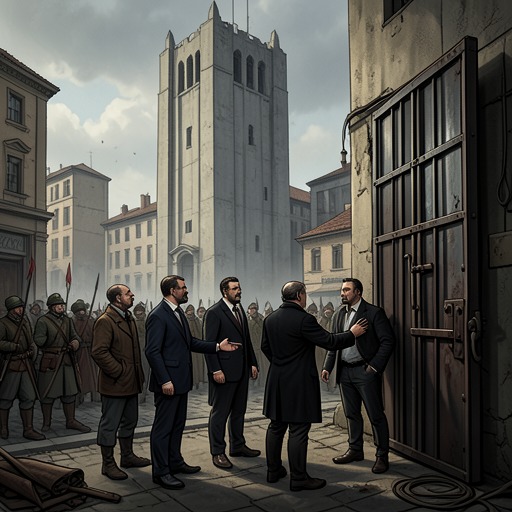
At Osaka Castle, movement inland becomes a passage through successive defenses. A vast, iron-plated gate stands in a thirty-foot wall; beyond it, a broad wooden bridge spans the moat and reaches another immense drawbridge and gate. Papers are checked at each threshold. Roads then run past fortified houses and defensive walls, doubling back through steps and passages before reaching further gates, portcullises, and moats. The route is deliberately difficult to read. Even Blackthorne, an unusually attentive observer with a strong sense of direction, loses his way in the maze.
The defenses turn the city’s built environment into an instrument of surveillance and control. Armed guards watch from ramparts and bastions, while others patrol, train, or tend horses. The impression is not simply of a castle protected at its perimeter, but of a political center surrounded by layers of military presence. Entry is checked, movement is channeled, and a visitor can be made to feel watched and disoriented before reaching the center of authority.
Distance and force also define the political geography beyond the castle. When Toranaga is in danger of being isolated, his position is described in terms of the armies and routes around him: fewer than a thousand men are with him, while Yabu has more than eight thousand within twenty ri and another six thousand closing the borders. A fleet is said to be waiting to sink Toranaga if he tries to escape by galley, and a carrier pigeon could carry a message that would make Yabu’s intervention possible. The threat is therefore not only a matter of hostile intent. Troop concentrations, borders, ships, and communications determine which choices remain open.
Law, allegiance, and the Land of the Gods
Japan’s social order is presented as a chain of legally defined possession and responsibility. A person explains that the household belongs by law to its liege lord: the father possesses the lives of his children, wife, consorts, and servants, while his own life belongs to his lord. The formulation makes clear how political obedience extends into family life. The same nested authority that binds a retainer to a lord also gives the household head power over those below him.
The country’s physical vulnerability reinforces the force of law. Because homes, warehouses, and even palaces are largely built of wood and paper, fire threatens entire communities. Arson carries an exceptionally severe punishment: the guilty person’s family may be publicly burned across generations. When setting fire to a street is proposed as a tactic, a samurai protests that the plan is impossible under this law. The danger is not abstract; the materials of ordinary life make a single fire capable of becoming a communal catastrophe, and the law makes its consequences collective.
Japan is also claimed as a distinct sacred territory. One speaker argues that the Land of the Gods must be protected by any means and that the emperor alone is divine. From this perspective, the foreigner should be silenced, but kept alive in permanent isolation at Anjiro so that his knowledge can be extracted. The proposal joins national and religious exceptionalism to political calculation: exclusion is presented as protection, while the foreigner’s knowledge is treated as a resource.
Foreign presence and political contest
Foreign religious and commercial influence is subject to routes as well as political permission. A Papal Order, agreed to by the King of Spain, requires priests traveling to Japan to pass through Lisbon, Goa, and Macao; it forbids a direct journey from Manila on pain of excommunication and orders priests outside the Jesuit order to leave Japan for Manila. The order makes access to the country an international institutional question, linking Japanese religious life to distant authorities and controlled maritime passages. Its uncertain reception also shows that a decree does not settle the political situation: those handling it prepare for the possibility that the Pope, the Church’s General, or the King of Spain may already be dead.
Within Japan, the competing claims of the lords make the country’s future inseparable from the succession struggle. Toranaga says that his possession of Kwanto and long military record make others fear him; he believes his enemies will unite to destroy him before turning against one another. He rejects the assumption that he seeks to become Shōgun and describes the war as unnecessary, while acknowledging that others see him as the principal threat to Yaemon. Japan is thus not presented as a unified political actor but as a realm whose rival centers of power interpret one another’s strength as danger.
That contest reaches beyond the question of who commands an army. Toranaga’s supporters see his access to trade and his comparatively non-hostile stance toward Christianity as reasons to favor him over Ishido and Lady Ochiba. One Christian convert appeals for help in protecting the Church and identifies Ishido as the real enemy. The Church’s prospects, like the security of the lords, depend on political alignment; foreign faith and trade become part of the struggle for authority within Japan.
Japan’s significance lies in the way these pressures converge. A ship’s course can decide whether its crew reaches shore or remains exposed; a castle’s gates can turn arrival into confinement; a lord’s authority can reach into family life; and religious claims can justify either exclusion or alliance. The country is the destination of Blackthorne’s voyage, but it is also the system of landscapes, laws, and competing loyalties that transforms his arrival into a continuing political problem.