Portuguese Black Ship
ShōgunThe Portuguese Black Ship is the great annual carrack whose cargo and route make it both the richest commercial venture in Japan and a strategic instrument in the contest between Toranaga and his opponents. Carrying silk and bullion through a trade system mediated by Portuguese merchants and Jesuit interpreters, it connects local politics to a far-reaching maritime economy. To Ferriera it is a fortune and a command; to Blackthorne it is prey; to Toranaga it may become the lever by which trade, religion, and sea power can be turned toward his cause.
Identity and Maritime Function
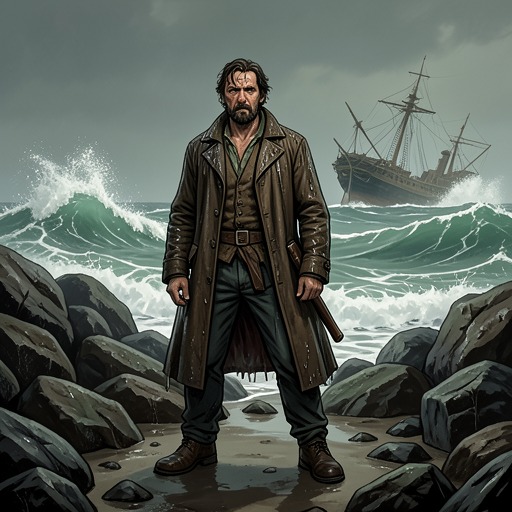
The Portuguese Black Ship is described as a carrack of almost two thousand tons, requiring as many as two hundred men and boys to sail it. With passengers added, its complement may approach a thousand people. Father Domingo explains that it sails well before the wind but is lumbering when the wind comes abeam. The ship is therefore not merely a large merchant vessel: its scale, crew, and sailing qualities shape what it can carry and how it can move through the waters on which the trade depends.
The voyage takes place in a world where navigation remains precarious. Existing charts are vague, and there is no way to establish longitude. A Rutter, by contrast, records practical knowledge accumulated by pilots: compass courses between ports and headlands, depths and seabed, winds and currents, storm seasons, safe anchorages, watering places, reefs, tides, and the routes out and home again. English, Dutch, and French pilots possess such guides for their own waters, but the Portuguese and Spanish guard knowledge of the wider seaways as a state secret. The Black Ship’s movement depends on precisely the kind of navigational knowledge its rivals seek and its Portuguese operators protect.
The ship’s annual route gives it importance beyond its size. It sails from Macao to Nagasaki, then heads south with the monsoon in November for Goa and onward toward home. The voyage binds Asian ports into a commercial circuit, while its timing makes any delay or danger consequential. In a separate passage, Blackthorne recalls Rodrigues taking a galley west-southwest from Cape Ito toward a landfall two hundred miles away; the contrast underscores how much the movement of ships depends on route knowledge, wind, and the judgment of pilots.
Cargo, Finance, and Portuguese Influence
The Black Ship’s cargo represents an immense concentration of wealth. Ferriera reports that the traders have already bought a million ducats’ worth of the best silks at the February Canton Fair and expect to carry at least a hundred thousand ounces of Chinese gold. He says that the venture has absorbed the available cash in Macao, Malacca, and Goa, along with money borrowed by Macao’s traders and civic leaders. The ship is thus the culmination of investment across several ports, not an isolated commercial expedition.
The scale of the expected return helps explain the pressure on those responsible for the voyage. Ferriera has spent eleven years in the King’s service and has been granted the captain-generalship of the annual Black Ship for one year. The office brings him a tenth of the silk, gold, silver, and profits from each transaction. He regards the appointment as wealth enough for a lifetime, but only if the voyage succeeds. He insists that the ship must sail on schedule from Macao to Nagasaki, then leave for Goa with the November monsoon. The certainty of his boast contrasts with the vulnerability of the plan: war, delay, or interference could undo the investment on which his reward depends.
Within Japan, the commercial system also gives the Jesuits political weight. In Blackthorne’s account to Toranaga, they control the silk trade and the trade with China, act as traders and lenders, and use their command of Portuguese and Japanese as interpreters and negotiators. Father Domingo likewise spends three days and nights answering Blackthorne’s questions about Japan, trade, religion, war, and the Black Ship that sails each year from Macao. The ship’s value is consequently inseparable from the network of people who finance, interpret, arrange, and profit from its voyage.
Ferriera knows that he cannot operate effectively without Jesuit interpreters. His dependence makes the ship a point of connection between commercial power and religious authority, even when their interests conflict. Alessandro dell’Aqua proposes offering Toranaga maps and information about spheres of influence, while asking for time to verify other matters in Macao. In the same negotiation, he announces that the Black Ship will sail three weeks early with its largest cargo of silk and gold yet, and proposes that at least thirty percent of the cargo assigned for sale pass through a broker appointed by Toranaga. The promised cargo and early departure function as bargaining terms: the ship’s commerce is being negotiated alongside political information and access.
Port Controls and Political Exposure
The Black Ship’s value makes its route a matter of public power as well as private profit. Foreign vessels in port are kept under perpetual surveillance; only at Nagasaki can Portuguese shipping move in and out freely. When Blackthorne observes the Portuguese frigate Santa Theresa, it lies offshore in deep water after quietly leaving its berth, with its guns and small arms prepared against danger from the shore. These details show the precautions required when a European ship lies in a hostile or uncertain harbor. A merchant vessel’s safety depends not only on its cargo and crew but also on its anchorage, escort, and ability to get to sea.
The political crisis around Toranaga threatens the voyage directly. Ishido controls Osaka, Kyoto, and most of the Regents; through Onoshi and Kiyama, his influence extends over much of Kyushu, including Nagasaki, the principal center of trade. That means the faction holding the port can exert pressure on the trade and on the Black Ship expected there that year. Ferriera fears that war would damage or ruin the voyage. The commercial venture’s dependence on a few ports turns local military alignments into a danger to an enterprise financed across a much wider region.
The negotiations reveal that the ship can be used to manage risk as well as carry goods. Father Alvito tells Ferriera that Toranaga is offering him a chance to carry ten thousand ducats of gold to Goa for investment, with half the profit promised to him. The Jesuits calculate that, by the time the Black Ship returns in six months, Toranaga may have regained the presidency of the Regents and be willing to permit the transaction. The offer ties Ferriera’s personal profit to a possible political reversal, making the ship’s future voyage part of a wager on who will control the government.
Blackthorne’s Proposal and the Ship as Prey
Blackthorne eventually makes the Black Ship the explicit object of a naval plan. After saving Toranaga’s life, he decides that the moment may give him the standing to propose it. He asks for letters of marque and offers to seize the ship and divide its silks and bullion. His plan is conditional, not an accomplished action: he says he would take Erasmus to Nagasaki, display his battle flags, and wait until the Black Ship had finished trading and was preparing to sail home. He believes Erasmus could outsail it, attack it a few leagues from port, and use its cannon to force it to strike its colors. A prize crew would then bring the captured vessel to Yedo.
Blackthorne estimates that the Black Ship could have nearly three or four hundred tons of gold bullion aboard by the time it left. This estimate belongs to his proposal, not to Ferriera’s earlier account of the planned cargo, which specifies silk and at least a hundred thousand ounces of Chinese gold. Blackthorne also considers catching the ship in international waters, where it would be easier to attack, while recognizing that a heavily laden vessel would be harder to bring back to Yedo. His scheme rests on the combination of speed, cannon, timing, and the target’s cargo: maritime maneuver is presented as a means of converting commercial wealth into political force.
He later explains the political purpose more directly. If the Black Ship were taken this year and again the next, he argues, the Jesuits would lose money for their work and the Portuguese would lose income elsewhere. The threatened interruption, he believes, could force the priests to bend and help bring Kiyama or Onoshi to Toranaga’s side. He distinguishes the Church from its priests and names Father Alvito as an exception among them, but he treats the commercial network as vulnerable because it needs the ship’s revenue. The plan therefore seeks leverage rather than cargo alone: the threat of denying future voyages is meant to change political allegiance.
Strategic Meaning and Unresolved Pursuit
The Black Ship also becomes the prey through which Toranaga tests Blackthorne’s purpose and usefulness. Toranaga later identifies the ship as Blackthorne’s secret objective and tells him to pursue it whether or not war comes. He gives the instruction in terms of prey, then sets a larger condition: first the Black Ship, then Blackthorne is to go home and bring Toranaga a navy. The ship is thus both a particular target and a step toward a maritime force that Toranaga does not yet possess.
That intention remains distinct from an accomplished capture. Blackthorne’s seizure plan is described as a proposal, and Toranaga’s later command confirms that the Black Ship remains a future objective. The ship’s decisive significance lies in this unresolved possibility. Its cargo can enrich its captors, its regular voyage sustains a powerful trading network, and its dependence on ports exposed to political control makes it vulnerable to conflict. In the contest over Japan, it stands where commerce, navigation, foreign influence, and naval ambition meet.