Spain
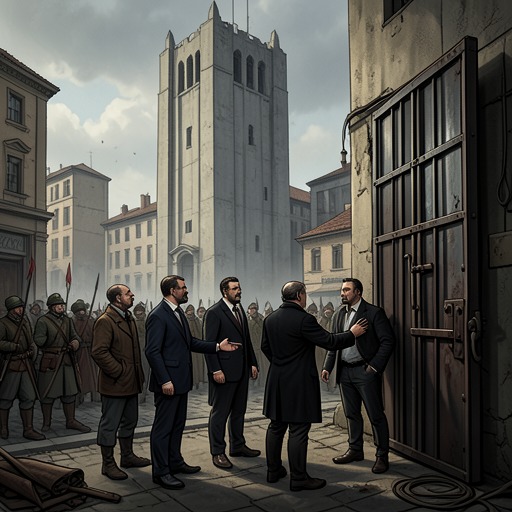
ShōgunSpain is portrayed as both a conquering power in Europe and a leading claimant to overseas territories, with its religious and imperial ambitions tied to control of land, wealth, and maritime knowledge. In Blackthorne’s explanations to Toranaga, Spain’s rise frames the danger of joining modern weapons, religious conversion, and political division in the work of conquest.
Spain in European Conflict
Blackthorne explains that Portugal became a vassal state of Spain after Spain conquered it in 1580, twenty years before the events he describes. England’s war is therefore directed against Spain as well as Portugal, and has lasted almost thirty years. He attributes the conflict partly to Spain’s drive to conquer the world and England’s refusal, alongside its ally the Netherlands, to be conquered, and partly to religious difference. The distinction between Portugal and Spain has not disappeared, but Portugal’s subordination places it within the wider struggle Blackthorne describes.
Overseas Claims and Conquest
When Blackthorne draws a map in the sand for Mariko to translate to Toranaga, he explains that legal documents give the kings of Spain and Portugal the right to claim non-Catholic lands discovered by their subjects and replace existing governments with Catholic rule. He traces the division across Brazil: Portugal claims the land east of the line, while Spain claims the lands west of it. In his account, Portugal’s possession of Brazil followed Pedro Cabral’s discovery in 1500, and Spanish claims encompass Mexico, Peru, and nearly all of the South American continent known to Europeans.
Blackthorne describes the consequences of Spanish expansion in stark terms. He says the conquistadores have modern guns while the peoples they conquer have none; priests follow the soldiers, and the conversion of a few princes is used to inflame existing rivalries. Princes are turned against one another as realms are absorbed piecemeal. He tells Toranaga that Spain has become the richest nation in their world through gold and silver taken from the Inca and Mexico. His account makes imperial power a process of armed invasion, religious intervention, and the exploitation of political divisions, not merely a claim drawn on a map.
Maritime Knowledge and Imperial Rivalry
Spain’s reach is also associated with the guarded knowledge needed to cross oceans. Blackthorne’s former teacher, Alban Caradoc, taught him that a rutter could make an otherwise uncertain voyage possible: the compact manual recorded compass courses, depths, seabed, winds, currents, storms, safe anchorages, supplies, reefs, and hazards. Because charts were vague and longitude could not be fixed, such accumulated observations were valuable practical knowledge rather than a substitute for a reliable position at sea.
The English, Dutch, and French had rutters for their own waters, but Portugal and Spain controlled much of the knowledge of routes elsewhere. Their pilots had sailed waters leading to the New World, through the Strait of Magellan and around the Cape of Good Hope, and onward to Asia; the two empires guarded these books as national treasures. Their rivals sought them just as fiercely. Yet a rutter could contain copying, printing, or translation errors, even deliberate ones, and remained uncertain until a pilot had tested it at sea. Spain’s maritime advantage thus rests in part on information that could be protected, contested, and put to practical use—but not trusted blindly.
Spain in Toranaga’s Wider World
The map lesson gives Toranaga a picture of a world whose coastlines are known unevenly and whose interiors remain largely unexplored. Blackthorne presents Spain’s overseas power within that partial geography: legal claims extend across distant territories, while ships, guns, priests, and navigational intelligence make those claims consequential. Toranaga recognizes the political significance of the explanation, and the map turns Spain from a distant European name into an example of how outside powers may use religious authority and local rivalries to acquire control.