Yedo
ShōgunYedo is Toranaga’s capital, a port city shaped by his ambition to make it both a center of government and a stronghold for trade and military power. Once described as a fishing village, it becomes the hub of a growing city whose streets radiate from the castle, while its harbor and position in the Kwanto connect Toranaga’s political authority to the movement of ships, armies, and information.
Strategic Setting and Intended Capital
Yedo occupies a decisive place in the novel’s political geography. Toranaga rules the Kwanto from the city, while Ishido’s power is centered on Osaka Castle to the west. The Tokaido, the Great Coastal Road, links the two capitals across three hundred miles; the road is not just a route between cities but the expected passage for the armies whose confrontation threatens the country. Setting Yedo against Osaka gives the political conflict a visible geography: rival authorities command from separate centers, and the corridor between them is where their forces must eventually meet.
Toranaga’s choice of Yedo is also presented as a practical calculation. In discussing where to establish a capital, he rejects Kamakura: its seven passes would make it difficult to defend, and it is not on the sea. Yedo, by contrast, offers a seaport, potential protection, and prospects for trade. At that point it is still a fishing village, but Toranaga is advised that it could become a great city. The proposal joins commerce and defense rather than treating them as competing aims: a port can open routes for trade while also strengthening the position of the power that controls it.
A Capital Under Political Pressure
Yedo’s importance is clearest when Toranaga is absent. While he is in Osaka for a confrontation with Ishido, he has invited Yabu and neighboring daimyos to wait in Yedo for his return. The invitation cannot safely be refused. Yabu understands that the gathered lords and their families function as hostages, even though no one would use that word, because their presence helps ensure Toranaga’s safe return from an enemy fortress. The capital therefore serves not only as a seat of rule but also as a place where political loyalty is enforced through the presence of powerful families.
The crisis reaches Yedo through messages and uncertainty. After news arrives that a foreign ship has appeared at Anjiro, Yabu sees the need to investigate it, but Toranaga’s absence and the political risks of acting without permission constrain him. A warning urges Yabu not to disobey Toranaga or leave Yedo himself, recommending instead that he send a representative to Anjiro. The exchange shows how authority radiates from the capital: even an urgent matter on the coast must be handled in a way that preserves obedience to the absent ruler.
Yedo is also the base for reports about conditions across Toranaga’s domains. Yabu’s wife, Yuriko, sends word of extensive mobilization throughout the Kwanto, describing preparations that are largely concealed from view but suggest that Toranaga may be preparing a sudden attack, perhaps against Osaka itself. Later, Omi observes that Toranaga seems to have drawn a blanket over the whole Kwanto, possibly because he knows the identities of Yabu’s spies. The image makes the capital’s power feel less like a single visible command than a system of controlled information: reports arrive, disappear, or become inconclusive as Toranaga manages what others can know.
Castle, City, and Port
The city’s physical growth is measured against the castle at its center. Mariko explains that the castle is the hub of Yedo, with streets angling outward to form the city. Ten years earlier, the site had been only a small fishing village; now its population is discussed in estimates ranging from two hundred thousand to three hundred thousand or four hundred thousand, although Toranaga has not yet counted his people. The uncertain figures convey scale without turning the city into a settled statistic. Its growth is presented as an ongoing consequence of the castle’s pull: people have gathered around the center of government and protection.
That account also gives the city a clear functional order. The people are there to serve the castle, which protects the port and the plains that feed the armies. Yedo thus binds together the institutions and resources on which Toranaga’s rule depends. The port links the city outward by sea; the surrounding plains supply the forces gathered for war; and the castle organizes both within a single political center. The city’s expansion is not described as growth for its own sake, but as a transformation directed toward service, defense, and military capacity.
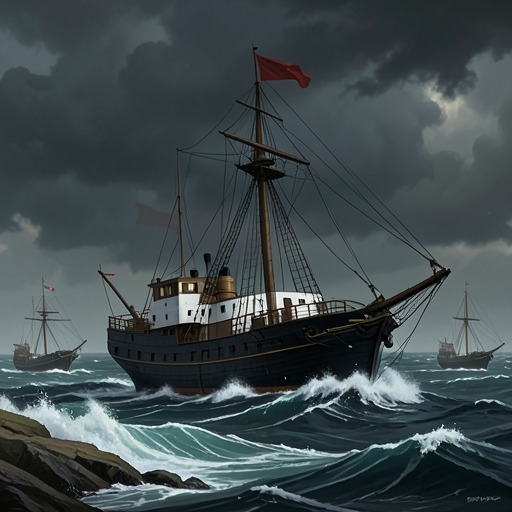
The harbor makes those ambitions concrete. The Erasmus is seen glittering beside the Yedo wharf in the high-noon sun, but it lies beyond closed barriers, moored with new ropes in an area heavily guarded by samurai. Signs mark the place as forbidden without Toranaga’s personal permission. The ship’s presence therefore reveals both the port’s value and the limits placed on access to it: Yedo can receive foreign vessels, but entry into its harbor does not mean freedom of movement. The guarded wharf turns control of the port into a visible extension of Toranaga’s authority.
Yedo in the Wider Struggle
The city remains a destination and reference point even as the conflict shifts elsewhere. When news reports that Toranaga has escaped Osaka with Yabu and is travelling by galley, preparations are made to welcome them at Anjiro. At another moment, an urgent order sends a captain to Yedo quickly, underscoring the city’s continuing role as a place from which action and communication are directed. Later, when Yabu orders a galley to put to sea before the Gray forces on the dock can change their minds, he initially directs it toward Nagasaki; Kiri insists that it go first to Yedo. The sudden correction makes Yedo a political priority even amid a hurried departure from Osaka.
By the time Blackthorne sees the castle as the hub of a city that has grown from a fishing village, Yedo represents the material form of Toranaga’s rule: a fortified center, a protected harbor, and a population organized around the castle and the resources that sustain armies. Its significance lies in the conjunction of those functions. Yedo is at once a capital exposed to hostage politics, a communications center whose information is carefully managed, and a port whose barriers regulate access. It is the city Toranaga chose because it could be made to serve trade and defense—and whose growth shows how that choice has reshaped the political landscape.