Banfield Garage and Petrol Station
ShrineBanfield Garage and Petrol Station is the site where an ordinary village service stop becomes the center of a catastrophic collision and an apparent miracle. A tanker is unloading fuel into underground tanks when a bus and a car collide beside the forecourt; the resulting fire spreads through the garage and nearby vehicles. Gerry Fenn sees the crash and the blaze, then witnesses Alice Pagett walk through the smoke as the flames die. The site’s practical details—the pumps, tanker, showroom, and underground fuel—make the disaster materially specific, while the unexplained end of the fire gives the location lasting significance in the claims surrounding Alice.
Setting and approach
The garage stands beside the small roundabout at the end of Banfield’s High Street, near the convent. As the pursuit enters this junction, the setting is crowded with ordinary village activity: shoppers move between the grocery shop and the street, a green single-decker bus negotiates the roundabout, and cars travel through the narrow road. On the garage forecourt, a large yellow-and-green tanker is transferring fuel into the underground tanks beneath the pumps. The adjacent showroom has broad windows beside a service bay, and new cars are displayed behind the glass.
These details establish how little room there is for error. The vehicles converge on a small junction already occupied by the bus, while the tanker and its fuel supply place a hazardous installation directly beside the road. The garage is not introduced as an isolated setting for an accident; it is part of the village’s everyday traffic and commerce. That ordinary proximity is what makes the collision’s consequences so immediate.
Collision and fire
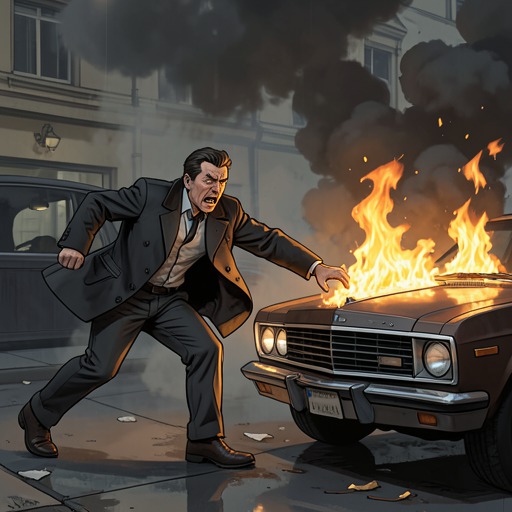
As the cars approach the roundabout, the Capri ahead begins to weave across the road. Gerry Fenn attempts to avoid it, but his car skids, and the bus turns into the forecourt to escape the Capri’s path. The Capri strikes the front of the bus. In the confusion, the bus continues toward the tanker, and the impact shears the tube carrying fuel into the underground tanks. Sparks fall into the spilled, volatile liquid, and the tanker explodes. Fenn’s own car crashes through the showroom window as the blast erupts.
The fire does not remain confined to the initial explosion. Leonard Pagett is caught in the burning Capri, and the car’s fuel tank later explodes. People flee from the bus and the area around the garage, while vehicles within the garage begin to explode and cans of oil and gasoline flare. Fuel remains on the ground, and the danger extends to the tanks beneath the pumps: as their contents heat, further combustion appears possible. The forecourt’s equipment, initially part of routine refuelling, has become the means by which the fire threatens to intensify.
Alice Pagett and the apparent extinguishing
From the ground, Fenn sees the flames begin to shrink and disappear. Through smoke repeatedly driven across and away from the scene, Alice Pagett walks among the wrecked vehicles in a yellow dress, holding out her hands. The remaining flames cool and go out. The account places her arrival after the collision and explosion, and before the fire has run its natural course; it presents no mechanical explanation for the sudden change.
The contrast is central to the garage’s meaning in the story. The tanker, severed fuel line, underground reserves, and burning vehicles establish a fire with several continuing sources of fuel. Yet the reported outcome is not a gradual containment operation: the flames diminish as Alice appears, leaving the vehicles as burned shells and the garage as a blackened ruin. Fenn is an eyewitness to both the danger and its abrupt reversal, making the forecourt the setting for a claim he can report from direct experience.
Investigation and public significance
Later broadcasts recount the incident as the event that drew renewed attention to Alice Pagett. They identify Leonard Pagett as a passenger in the car and report that he had been killed before Alice reached the scene. Witnesses said that she quelled a fire threatening a large part of Banfield; accident and fire-prevention officers, after examining the wreckage, found no logical explanation for how it had stopped.
The reported physical evidence sharpens the puzzle. There had been little rain, and investigators found no further explosion large enough to account for the fire being blown out. They also found timber only partly burned where a natural course of events should have charred it completely, as well as petrol still on the ground that had not burned. Only scattered, relatively harmless fires remained when the local brigade arrived. The garage therefore serves both as the location of the supposed intervention and as the material evidence against an easy account of it.
Narrative role
The forecourt connects the pursuit involving Gerry Fenn and Leonard Pagett to the public emergence of Alice’s alleged power. Its layout creates the chain of danger: the roundabout funnels the vehicles together, the tanker’s transfer line is damaged, and fuel at the garage sustains the blaze. The same place then becomes the scene of an unexplained cessation, observed by Fenn and subsequently investigated by officials.
As reports of the event circulate, the garage is no longer merely a local business beside the High Street. The fire becomes part of the evidence cited for Alice’s reputation as a miracle worker and for the growing attention to Banfield. Its significance depends on the collision between mundane infrastructure and an outcome the investigation cannot account for: the petrol remains, the damage is visible, but the expected continuation of the fire does not occur.