Banfield shrine
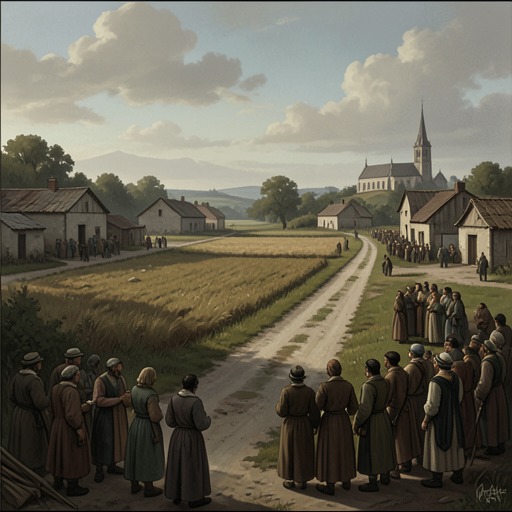
ShrineBanfield shrine is the open-air pilgrimage site in the field beside St. Joseph’s Church, where an altar platform and an oak tree become the focus of public devotion to Alice Pagett. Its transformation from a local field into a destination for thousands makes it both a place of shared religious expectation and the setting of the disaster remembered as Black Sunday.
Setting and transformation
The shrine occupies a field associated with St. Joseph’s Church. As the gathering grows, the site is arranged for large services: a new entrance gate admits the congregation, benches extend around a central altar platform, and separate seating is reserved for Church and other dignitaries and religious associations. The oak stands behind the altar, becoming a dominant feature of the ceremonial setting. The preparations accommodate a crowd, but the churned soft earth makes passage difficult, especially for wheelchairs; ushers recognize that future services would need a designated area for invalids.
The field acquires a sacred identity as its public use changes. By the candlelight procession, it is called the Field of the Holy Virgin, and a broadcast describes it as an open-air temple. The altered name gives the site a significance beyond its practical function as a place for services: pilgrims have come not only to attend Mass but to be near Alice and to experience what they understand as her holiness. The location’s new religious meaning develops alongside the scale and organization of the crowds gathering there.
Pilgrimage and expectation
The shrine’s crowds include local people and visitors from farther away, believers and people with less settled religious commitments. On the Sunday associated with Alice’s reported promise that the Lady wished to see her again, activity on Banfield’s High Street is unusually heavy, and traffic and footfall converge on the church grounds. Gerry Fenn arrives with Sue and Ben, carrying an Olympus camera and a microcassette recorder in case something occurs. At the gate, they are pressed among an eager crowd; Fenn notices both the excitement and the sick people being helped through the entrance. Their presence makes the occasion more than a spectacle: families arrive with hope that the gathering may bring relief, while Fenn anticipates that many may instead be disappointed.
At a later service, people arrive hours before Mass to find seats close to the altar. Some want to see Alice; others hope that proximity to her will bring them nearer to holiness. The crowd spreads outward as the benches fill, and conversation takes on a hushed, reverential quality. Invalids have difficulty crossing the softened ground, while stewards, ushers, and young priests attempt to marshal the swelling congregation. The collective atmosphere affects even those responsible for managing the event. The shrine thus depends on both organized arrangements and a shared expectation that the place and its central figure may offer an encounter unavailable in ordinary life.
Ceremony and competing meanings
During a major service, Monsignor Delgard looks out over thousands of expectant faces, including invalids whose expressions convey hope. He fears that the event will disappoint them and questions whether the Church should participate in what he considers a delusion. Yet his own earlier experience of Alice complicates that judgment: he cannot simply dismiss her as insincere, and he wonders whether his doubt reflects a failure of humility. His conflict gives the shrine’s ceremonial setting a divided meaning. To pilgrims, it promises access to a miracle; to a Church official, it is also a gathering whose religious claims remain uncertain and whose emotional force may exceed what the institution can responsibly affirm.
That tension persists as the shrine becomes a public enterprise. George Southworth sees its success as a source of money and renewed prosperity for Banfield, and recognizes that those who invested early stand to benefit. The site’s devotional purpose and commercial value therefore grow together. The people who arrive seeking healing are not the only ones invested in what the shrine represents: its popularity offers material rewards to local promoters, while Church participation gives the gathering additional authority. The same field can be experienced as a sacred destination, managed as a mass event, and treated as an economic opportunity.
Black Sunday and destruction
During the final gathering, the shrine becomes the center of a catastrophe. After Alice rises again and reveals her connection to Einor, Molly Pagett approaches the figure and dies in the ensuing fire. Gerry Fenn tries to reach Molly with his coat but cannot save her. The ground then opens, panic spreads through the congregation, and the altar platform is engulfed. Sue and Ben pull Fenn away from the platform as the oak catches fire and falls; the shrine structure collapses into the flames, and the tremors stop. The change is decisive: a place assembled to concentrate hope and religious expectation is destroyed amid flight, loss, and the breakdown of the service.
Aftermath and significance
More than 20,000 pilgrims had come to the shrine on Black Sunday. The disaster leaves 158 dead, many others seriously injured, and some invalids in worse condition. People who had been cured by Alice at earlier visits find their illnesses or infirmities have returned, as though her death had ended the cures. Some witnesses, including clerics and nuns, say they saw the ground split open; others later remember only the storm and their flight. The accounts divide between sensational explanations and more restrained scientific or psychological theories.
The explanations remain unsettled. One widely circulated account attributes the destruction to an electrical storm, while acknowledging that the interference reported by film, radio, television, camera, and police communications equipment is difficult to explain. Other suggestions invoke Alice’s supposed mental powers, an underground eruption, or a bomb. The competing accounts do not restore the shrine or resolve what happened there. Fenn leaves his newspaper job and declines to answer questions, believing that a definitive account might have to be presented as fiction to be believed. In the novel, the shrine’s rise and destruction bind together pilgrimage, hope, commercial ambition, and mass catastrophe: the field first gathers people around the promise of extraordinary healing, then exposes how fragile that shared expectation is when the gathering turns into disaster.