Banfield
ShrineBanfield is a small village in West Sussex whose transformation from a community facing gradual decline into an international pilgrimage destination drives the novel’s collision of faith, publicity, and commercial ambition. The reported healings at St. Joseph’s Church bring visitors, press, and new business; as the village’s fortunes rise, the pilgrimage site also becomes the setting for a catastrophe that exposes the danger of turning belief and spectacle into a mass attraction.
Origins and a Village in Decline
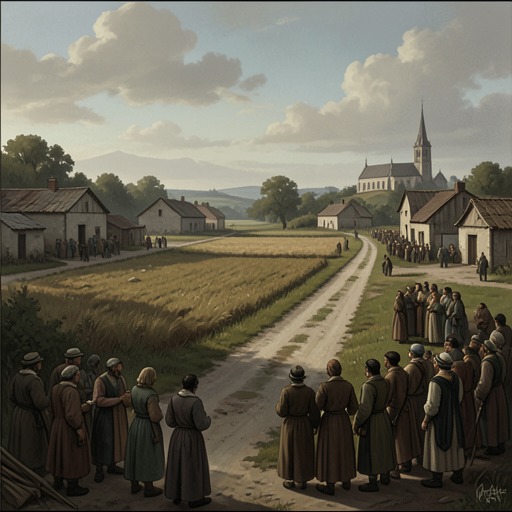
Banfield’s history is traced to the fourteenth century, when a community known as Banefeld formed from people fleeing the Black Death in more densely populated towns. The settlers prospered on the area’s agricultural land and remained there as England changed around them. For centuries, the village was remembered as a place where little of wider consequence happened. Its settled past becomes important when the reported miracles offer residents a sudden chance to make Banfield known beyond the local area.
By the time Gerry Fenn speaks with George Southworth, the village is struggling. Southworth describes local businesses as dying and warns that Banfield itself is slowly declining, even while conceding that his account may overstate the immediate danger. He proposes reversing that trend by drawing visitors with accessible attractions, including inexpensive restaurants for families on day trips, and by developing available land so the village can expand into a town. Fenn recognizes that Southworth and his associates could profit from such development, an interest that later proves more than incidental.
The Miracle and the First Influx
News of Alice Pagett’s reported vision and the healings at St. Joseph’s Church gives Banfield the attention its residents had long lacked. On the Sunday following the reports, unusually heavy traffic and crowds make the change apparent even before visitors reach the church grounds. The first cures are treated as consequential evidence by their supporters: the five people said to have been healed had documented illnesses, though two still had limitations. A man whose cataracts had cleared did not yet have perfect sight, and a boy whose ability to walk had improved still needed to rebuild weakened leg muscles. Claims that Alice had levitated circulate alongside the healings, but George Southworth acknowledges that he could not clearly see that part of the service.
The story rapidly travels beyond the village. Press, television, and radio arrive, and the stream of visitors brings new activity to Banfield’s streets and businesses. Broadcast reports describe a two-mile queue of cars and coaches, extra police called in from the surrounding area, and thousands gathering at St. Joseph’s Church. Pilgrims include devout Catholics, people seeking help for illness, and curious sightseers. Some residents welcome the attention; others would rather preserve the village’s privacy. The change is therefore not simply an increase in visitors: it alters how Banfield is seen by outsiders and how its residents imagine the village’s prospects.
The Field as Shrine and Commercial Opportunity
The open field beside St. Joseph’s Church becomes the focal point of Banfield’s new public identity. After the healings and reports of Alice’s levitation, George Southworth expects the church and field to draw pilgrims even if the Roman Catholic Church does not formally recognize the site as a shrine. Bishop Caines is willing to discuss cooperation with the parish council, but stresses that the claims need examination and that the Church has not declared the events holy. The distinction between popular certainty and institutional caution remains part of the village’s religious life as the crowds grow.
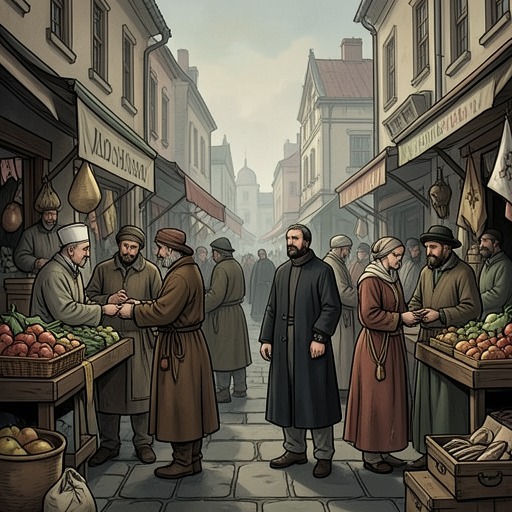
For Southworth, the transformation is also an economic opening. Within less than two months, businesses are receiving new trade, pubs and restaurants are busy, and his hotel is overbooked. He plans a more modern hotel and negotiates with the village’s travel agent to establish St. Joseph’s Tours, with buses serving visitors from across Britain and connections to foreign travel companies. His private property dealings reveal the harder edge of that ambition: he has secretly acquired shops through a company and plans to raise their rents as demand increases. The public prospect of shared prosperity thus coexists with a private strategy to capture the gains for himself.
The scale of the pilgrimage keeps expanding. At a later Sunday gathering, estimates put attendance at St. Joseph’s at eight to ten thousand, many unable to enter the field for the service. On the night of the procession, Fenn encounters traffic backed up toward Banfield, a separate searchlight illuminating the shrine, and pilgrims arriving in vehicles ranging from coaches to bicycles. Some sing hymns or pray; others come for curiosity, novelty, or entertainment. The field is presented as an open-air religious space, but its growing audience is never made up of worshippers alone.
Black Sunday and the Village’s Reversal
At the later candlelight pilgrimage and open-air Mass, the procession approaches a field that many now call the Field of the Holy Virgin. Thousands have travelled from Banfield and farther afield, and Alice is expected to accompany the Bishop of Arundel, priests, and nuns. More than twenty thousand pilgrims arrive that day. The gathering ends in disaster: 158 people die, many others are seriously injured, and some of the sick people Alice had previously been said to have cured find their conditions returning. Accounts also describe the ground opening, though witnesses remain confused about what they saw.
The disaster makes Banfield’s new fame inseparable from loss. News reports offer competing explanations, including an electrical storm, a disturbance beneath the ground, mass hysteria, and Alice’s alleged paranormal powers; none resolves the conflicting accounts. The village’s prominence, once imagined as a rescue from obscurity, now carries the burden of the deaths and injuries that occurred at its pilgrimage site. Its earlier economic decline had made renewed attention seem like deliverance; the catastrophe demonstrates how quickly the crowds and expectations attached to that attention could overwhelm the place.
Narrative Significance
Banfield is both a community with a long, comparatively uneventful past and a stage on which religious claims acquire public and material force. Its history of agricultural endurance contrasts with the speed of its transformation: a reported series of healings brings international coverage, new trade, development plans, and a mass pilgrimage in a matter of weeks. The same attention that promises to revive the village also creates incentives to profit from sacred claims and draws crowds whose motives range from devotion to simple curiosity.
The village’s rise is therefore not a straightforward story of economic recovery. George Southworth’s plans show how quickly local revival becomes entangled with private ownership and commercial calculation, while the Roman Catholic Church’s caution underscores the difference between a popular shrine and an officially recognized one. The final disaster overturns the hope that Banfield can secure a prosperous future simply by attracting ever larger numbers. Its transformation leaves the village famous, but fame becomes an ambivalent inheritance rather than an uncomplicated escape from decline.