Field beside St Joseph’s Church
ShrineThe Field beside St Joseph’s Church is the ground where Alice Pagett’s reported visitation, levitation and healings turn an ordinary field beside a churchyard into the center of a public religious crisis. A twisted oak stands at its center; a low wall separates it from the graveyard behind St. Joseph’s Church. In the rain, that wall first serves as a boundary between watchers and the sick, then as a precarious platform from which Gerry Fenn witnesses events he cannot reconcile with his scepticism. The field’s transformation—from wet pasture to a place associated with miracles and an anticipated pilgrimage—also makes it the focus of plans for Church ownership.
Setting and Approach
The field is reached from the churchyard by way of a narrow path between the graves and a low dividing wall. When word spreads that Alice is there, people crowd against the wall, anxious to see what is happening but hesitant to enter. Fenn runs through the sacristy after Father Hagan, Monsignor Delgard and a youth, then takes a clear section of the wall where he can look over the gathering. Damp grass makes his footing uncertain; he climbs onto the rough, uneven top and fumbles for his camera as rain falls on the field.
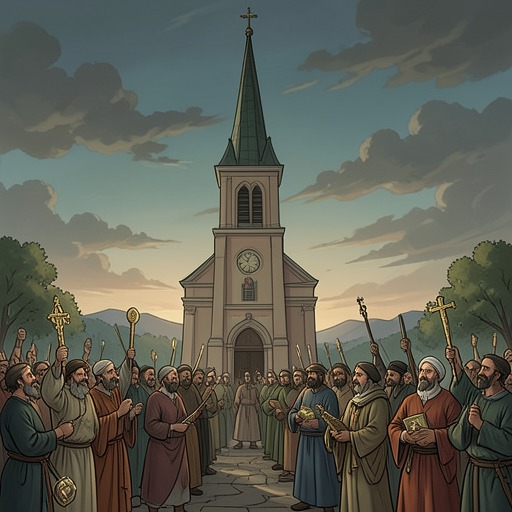
Alice, wearing a blue plastic raincoat, stands before the oak and looks up into its twisted branches. The people keep their distance from both the girl and the tree. More climb over the wall, some carrying children or supporting sick adults, while others remain behind it as if it were a shield. Among those brought forward are a frail boy who had received Holy Communion earlier and a girl Fenn recognizes from the church gate, where he had seen her suffering from chorea. The sick are laid on the wet grass despite the chill. Fenn estimates that at least three hundred people are present, with some inside the field and others still gathered beyond the wall.
The Gathering and the Apparition
The crowd’s silence and tension build as more people arrive. At first Fenn tries to explain the atmosphere as the excitement of a football match or pop concert, but the comparison weakens as the scene changes. The rain continues while other sounds disappear: Fenn hears neither birds nor sheep nor traffic from the nearby road. A colder gust rises into a strong wind, and the oak’s deformed limbs sway and howl. Clothes are whipped by the wind; some people retreat, while others stay, and many kneel. Father Hagan tries to move toward Alice, but Monsignor Delgard holds him back.
When the wind subsides, Alice remains before the tree, arms extended and lips moving, though those watching cannot hear her words. The crowd sees no visible figure at the oak. Alice laughs, and then her feet are no longer on the ground: she hovers a few inches above the grass. Fenn initially resists what he sees, thinking of conjuring and hallucination, but the field offers none of the contrived conditions he associates with a trick. He is so absorbed that he cannot bring himself to reach for his camera. The other witnesses are similarly transfixed; many are no longer standing, and Fenn himself sinks to one knee, weakened and cold. The priests remain upright, though Monsignor Delgard grips Father Hagan’s arm as if supporting him.
Alice descends slowly, the grass bending beneath her feet before she touches the ground. Her return to earth marks the transition from the extraordinary spectacle of levitation to the recoveries that follow. The field is not presented as a place where the crowd can clearly see the being Alice appears to address: there is nothing discernible at the oak. The gap between her unseen encounter and the visible responses around her leaves the event open to competing interpretations even as the witnesses experience it together.
Healings in the Field
After Alice lands, a small boy runs toward her with gray-black lumps covering his hands. As he holds them up, the blackish verrucae fade; his mother breaks free from her husband and embraces him, crying. The incident makes the crowd’s hope immediate and bodily: the boy’s altered hands can be inspected, and his mother’s response is visible to everyone nearby.
A teenage girl whose facial muscles and limbs had twitched uncontrollably is next seen standing without trembling. She examines her hands and legs, then approaches Alice and kneels at her feet, weeping. A man with cataracts is guided through the crowd. Before reaching Alice, he falls and sobs; the opacity in his eyes begins to clear, and he sees colours and shapes again for the first time in five years. Another young girl, who has attended the same hospital as Alice and had not spoken during her seven years of life, asks her mother why the man is crying. Her words are unclear, but her mother understands them. These episodes are among the six cures later described as witnessed in the field, alongside the possible levitation and visitation.
From Open Ground to Pilgrimage Site
The field’s significance extends beyond the people who gather there. In a discussion of the event’s likely consequences, the prospect of the Church exploiting the reported cures is raised against Father Hagan’s expected opposition. Bishop Caines, described as the governor of the diocese, has already sought authorization to buy the field adjoining the church, and its farmer-owner is willing to sell after falling on hard times. The stated practical argument is that Church ownership would allow the site to accommodate the visitors expected to flood the area; a press conference has also been arranged for the following day.
The proposed purchase changes the meaning of the wall and field in retrospect. During the gathering, the wall divides those who dare enter from those who watch anxiously from outside. In the aftermath, the field is considered in terms of access, capacity and ownership, as a destination whose crowds may need to be managed. The same ground that held the sick on rain-soaked grass is thus poised to become an organized pilgrimage site. Its narrative importance lies in that collision: the reported miracle is intimate in its encounters between Alice and individual sufferers, yet its location immediately becomes the basis for a much larger public and institutional enterprise.