St. Joseph’s Church in Banfield
ShrineSt. Joseph’s Church in Banfield is both the center of a modern religious and media spectacle and a place increasingly associated with spiritual unease. Its proximity to the field where Alice Pagett is seen beside the oak makes it the threshold between parish worship and the rapidly growing pilgrimage. Yet the church does not simply serve as a backdrop for claims of healing: its history, its records, and the deterioration of its Madonna statue bind the present crisis to older accounts of religious conflict and concealed wrongdoing.
Setting and History
Gerry Fenn’s research traces Banfield’s first official mention to 770, when a charter attributed to Osmund, King of the West Saxons, assigned fifteen hides of land to endow a church in Banefelde. The surviving account does not establish beyond doubt that the present building is that original church, but Fenn finds no record of another church there at the time. The village’s name changed in spelling over the centuries before settling into Banfield.
The church’s religious foundation is described as a deliberate layering of sacred places. According to the history discussed by Monsignor Delgard, Sussex remained a stronghold of pagan practice for longer than other parts of England, and the first Christian church in Banfield—presumed to be St. Joseph’s—was built over a pagan place of worship and burial ground. Delgard notes that churches were often placed over earlier sacred sites as a symbolic rejection of what had preceded them. The site therefore carries a long-standing tension between religious meanings rather than a history beginning with the current Catholic parish.
The Church and the Pilgrimage
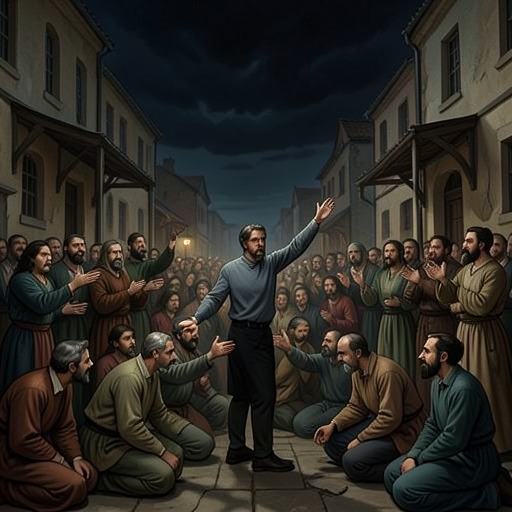
The church stands beside the field where Alice is reported to have appeared near the twisted oak. When a boy hurries into the church to tell the priests that Alice has returned and people are going into the field, Fenn follows them through the church grounds and graveyard. He reaches the boundary wall and sees Alice standing before the tree as people gather behind her. The sick are brought forward and laid on the damp grass; among them are a boy who had received Communion earlier and a girl Fenn recognizes as suffering from chorea. The gathering grows until Fenn estimates that at least three hundred people are present.
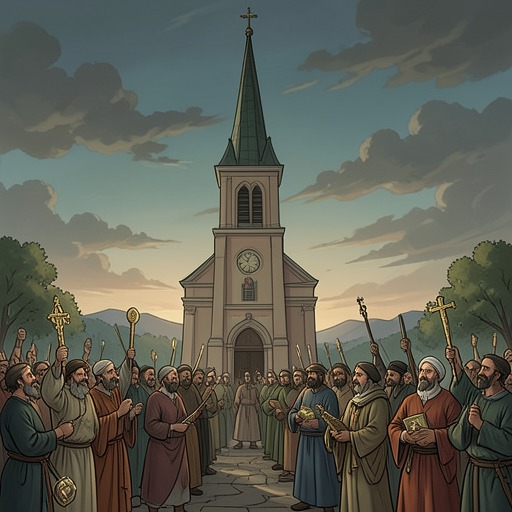
As attention spreads, the church becomes the organizing point for a pilgrimage that increasingly exceeds the scale of ordinary parish life. News broadcasts describe crowds arriving at St. Joseph’s, with thousands gathering on a Sunday and a queue of cars and coaches extending for miles. Some visitors are devout pilgrims; others come as sightseers. Reports also describe fainting, weeping, and prayer, while noting that the feared mass hysteria does not occur. On a later Sunday, an estimated eight to ten thousand people travel to the church, although many cannot enter the field for the service. The church’s immediate surroundings thus change from a local parish setting into a crowded public destination, watched by reporters and managed by police and Church officials.
The Catholic authorities respond cautiously. Monsignor Delgard argues that the six people apparently cured at the earlier gathering, including Alice, should each be interviewed and that their doctors should be asked for access to their medical records. He proposes an independent medical commission rather than an immediate official declaration. The response distinguishes the church’s growing public importance from proof that the reported cures are miraculous: the gathering may develop on its own, but the authorities should not encourage belief before investigation.
Spiritual Emptiness and Threat
Fenn’s first impression inside the church is one of dimness and stillness. When he examines the white Madonna statue, he sees its downward-reaching hands and carefully formed expression as an artwork without personal meaning. He also notices a fine crack running from beneath its chin down one side of its neck. The image that is meant to signify welcome and compassion appears to him instead as a crafted object, and the small flaw foreshadows the statue’s later physical collapse.
The more serious diagnosis comes from Father Hagan and Delgard. Hagan describes the church as spiritually empty, not merely quiet or without people; in his view, an empty church should offer a priest tranquillity and a place for prayer, but St. Joseph’s offers desolation. Delgard explains the condition through the image of a container drained of its contents, arguing that the church has been depleted of spiritual presence. He connects this perception with Hagan’s weeks of distress and declining vitality. The explanation makes the building’s atmosphere part of the plot’s danger: the church is not simply old or deserted, but understood by the priests as a sacred structure whose spiritual substance has been lost.
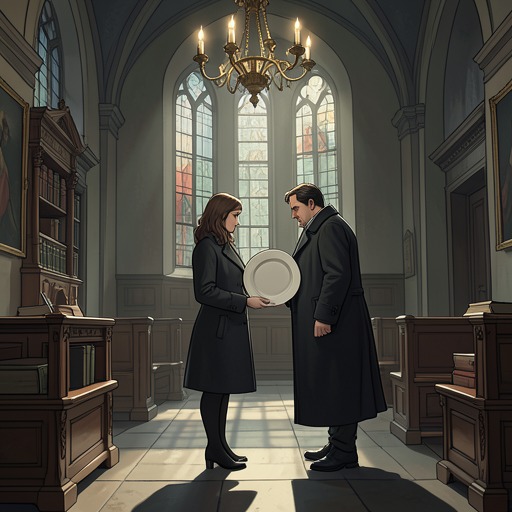
The threat becomes unmistakable when Fenn returns at night to warn Delgard. From outside, the church appears unnaturally black to him, and he feels compelled to turn away even as he continues toward the priest. Inside, he finds Delgard near the Madonna statue and sees a small, hooded figure in a pew behind him. The statue’s cracks deepen and pieces fall away; it then explodes, killing Delgard with its fragments. Fenn sees the figure disappear, leaving the church empty except for himself and the dead priest. The scene turns the church’s most recognizable devotional object into an immediate physical threat and confirms that its spiritual unease has become lethal.
Records, Memory, and Changing Use
St. Joseph’s also holds the material record of Banfield’s past. In a chronicle attributed to Thomas Woolgar, the church and parish are described as the writer’s former community, while the text recounts allegations involving Sister Einor, missing children, and the villagers’ violence against her. The account presents Woolgar as a compromised witness who admits to a part in wrongdoing while attempting to explain and partly excuse his actions. Its claims are not neutral documentation: the manuscript is shaped by guilt, fear, and the writer’s effort to have future readers believe his warning.
The church’s old chest becomes central to the search for that history. After Woolgar is removed from Banfield, his father has parish belongings and the chest transferred to St. Peter’s on his estate. Woolgar believes the chest held the records of St. Joseph’s and Banfield parish, and that his father hoped to find material that could damage the family’s reputation. He says the manuscript he is writing is hidden for a later reader to find. In the present, Delgard tells Fenn that locating the chest is vital, linking the contemporary investigation directly to the church’s displaced archive and the buried account of Einor.
Meanwhile, the church’s surroundings are visibly adapted for the new crowds. In the field, workmen install rows of benches, a more elaborate wooden altar, seating for the congregation, banners, and a raised platform for Communion. Later, the pilgrimage site is arranged as a large arena with lighting, public-address equipment, and platforms for cameras. The Church’s participation remains carefully qualified: religious symbols are present, but the staging does not amount to an unequivocal declaration that the field is holy ground. St. Joseph’s therefore stands at the junction of parish history, institutional investigation, commercial-scale public attention, and a mystery that its own depleted atmosphere seems unable to contain.