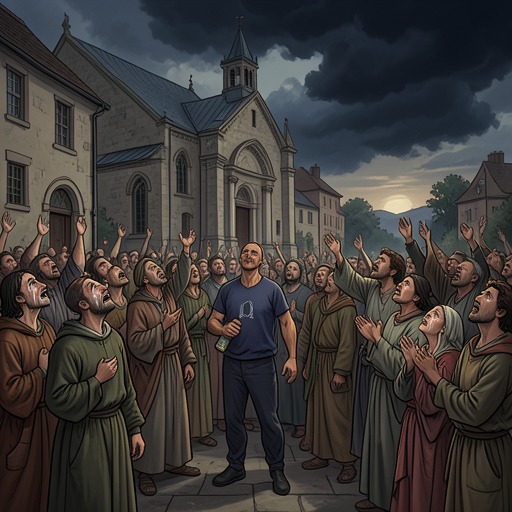
Collective human evil as a power source
ShrineCollective human evil as a power source is the principle behind EITHER-NOR’s presence at the altar: it draws power from the evil within the living, turning the congregation’s own moral failings into the force that sustains it. The idea makes the crisis more than an encounter with an external monster. Those gathered are confronted with what they carry within themselves, and their capacity to resist becomes part of the struggle.
Exposure and Recognition
At the altar, the entity’s presence is experienced as an invasive judgment. It seems to know each person’s cruelty and desires, forcing individuals to recognize themselves in what it reveals. The resulting terror is not simply a response to the trembling ground: people are also repelled by the creature’s personal knowledge of them and the intimacy with which it exposes their failings.
George Southworth’s flight gives this principle a specific human example. As he escapes, he recognizes that the entity has perceived the greed in his heart. The shrine had become a successful moneymaking venture, and he had expected the rewards to grow as Banfield prospered. His recognition links the creature’s power not only to spectacular violence or overt cruelty, but also to the self-interested ambition that helped make the shrine a commercial success. Southworth understands that his greed belongs to the evil sustaining the entity, though he cannot explain how he came to know this.
The Source of EITHER-NOR’s Power
The narrative presents EITHER-NOR as a manifestation of the people’s own evil, drawing strength from their corrupted souls. This makes its revelation double-edged: the entity discloses their culpability while depending on what it discloses. The religious teaching that people bear guilt is, in Southworth’s sudden understanding, grounded in actual human wickedness; even children are not wholly outside this account, although the story has also established Alice Pagett’s innocence as a consequential contrast.
Gerry Fenn’s experience develops the idea into a more explicit account of how the power operates. He understands the entity’s strength as accumulated from those present: a negative force drawn from the positive and producing an imbalance over them. Its existence depends on the living’s kinetic energy. The power is therefore collective without being impersonal: the assembled people contribute to a shared force, while the entity can make each person feel individually exposed by it.
Resistance and Limits
The same dependence that empowers EITHER-NOR also imposes a limit. Fenn hears an insistent call to resist and understands that the entity cannot govern those who oppose it. This is not an easy or automatic defense: he struggles to act and cannot immediately turn his attention away from the creature. The scene makes resistance a contested possibility within an overwhelming force, rather than proof that the entity’s power is harmless or readily defeated.
The concept thus connects moral recognition to the mechanics of the supernatural conflict. EITHER-NOR draws on collective human evil, but the living are not represented as merely passive fuel; opposition can withhold the submission on which its control depends. Southworth’s recognition of his greed and Fenn’s effort to resist mark two different consequences of the same revelation: awareness can expose a person to the entity’s power, yet Fenn’s understanding also identifies a way to challenge it.