St. Joseph’s Spiritual Depletion
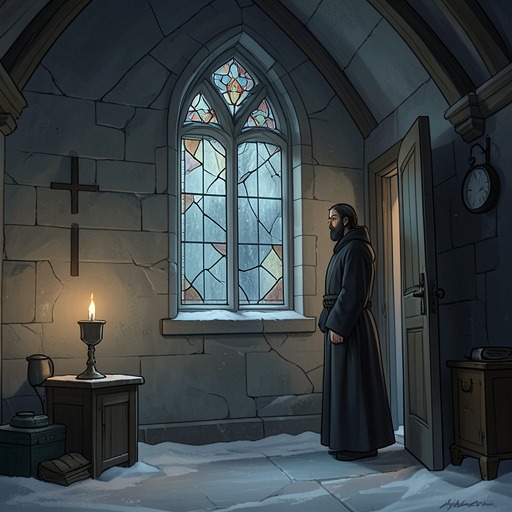
ShrineSt. Joseph’s Spiritual Depletion is Monsignor Delgard’s interpretation of the hollowness experienced inside St. Joseph’s Church: not an absence of people, but a loss of the spiritual presence that should make the church a place of prayer. The idea begins as Father Hagan’s difficulty naming what feels wrong, becomes a point of conflict when Bishop Caines rejects it, and takes on a more unsettling force when Delgard connects the church’s condition to the decline of Father Hagan himself.
A Felt Emptiness
Father Hagan first describes the church as somehow “empty,” while acknowledging that he cannot explain what has changed. His uncertainty matters: the depletion is introduced as an impression before it becomes a theory. He senses a disturbance in a place whose meaning should be familiar to him, but has no clear cause to offer. Monsignor Delgard recognizes the description as one he has been trying to understand for several days and gives it a sharper name: the church has become “spiritually devoid.”
Bishop Caines immediately challenges that formulation. To him, calling the House of God spiritually empty is sacrilegious and incompatible with belief. The disagreement is therefore not simply over whether the building feels bleak. It concerns whether a church’s sacred character is guaranteed by what it is, or whether that character can be experienced as absent. Caines treats the latter possibility as impossible; Delgard treats it as an observation that the disturbing circumstances require him to take seriously.
Delgard’s Explanation
Gerry Fenn initially explains the unease in ordinary terms: an empty church can feel cold and creepy. Delgard draws a distinction between that atmosphere and what a priest should find there. An empty church, he argues, should offer tranquillity, prayer, and meditation; what he and Fenn encounter instead is desolation. The contrast makes the emptiness more than a matter of vacant space. The building remains present, but its expected spiritual effect has failed.
Delgard frames that failure through the idea of a container. A church may be a physical structure, but its spiritual contents can, in his account, be drained away. If Alice Pagett truly experienced a visitation, he reasons, the presence of the Holy Spirit ought to be overwhelming inside St. Joseph’s Church. Its present desolation therefore sits uneasily beside the claim that the church is the centre of a genuine sacred event. Delgard does not present the emptiness as proof that Alice’s experience was false; rather, he uses the discrepancy to suggest that something has happened to the church’s spiritual condition.
Fenn’s Recognition and Father Hagan’s Decline
The explanation gains force when Fenn recognizes the feeling for himself. He recalls that the church seems empty even when he does not mean empty of people, and connects the sensation to Delgard’s earlier description. Delgard answers that Fenn has felt what he has been trying to identify. The scene thus moves from Father Hagan’s private unease, through Delgard’s interpretation, to Fenn’s own experience: the depletion is not established by a visible change to the building, but by a shared perception of its lack of peace.
Delgard also links this spiritual emptiness to Father Hagan’s physical decline. He says the priest had been enduring the same trauma for weeks, with a stronger perception and more intense feelings, and recalls that Fenn had noticed his changing appearance and sapped vitality. Fenn points to Father Hagan’s illness and heart trouble as an ordinary explanation. Delgard rejects that as sufficient, arguing that Father Hagan’s life-force was being drained just as the spiritual essence of his church was being drained. The parallel is Delgard’s interpretation, not an independently established diagnosis, but it makes the church’s condition personal: the building’s depletion and the priest’s weakening appear as connected losses.
Alice Pagett and the Meaning of the Depletion
Delgard’s account also places the church’s condition within the history of Alice Pagett’s alleged miracles. Father Hagan had known Alice since before her birth, watched her grow, gave her First Communion, and encouraged her to play with other children despite her deafness and muteness. Delgard recalls that the priest had regarded her as innocent and helpful, yet had become afraid of her in the final weeks. The contrast between that long familiarity and his late fear marks a change in both his relationship to Alice and his confidence in what was happening around her.
Father Hagan had doubted that the cures were miraculous and doubted that Alice had seen the Blessed Virgin; at first, he had not been sure. Delgard’s description of depletion therefore does not arise from a simple declaration of faith in every claim surrounding Alice. It emerges alongside uncertainty, doubt, and a troubling change in a priest who had once cared for her. The church’s emptiness becomes a way of gathering those tensions into one image: a sacred building that no longer gives its priest the peace he expects, a priest whose vitality is failing, and alleged miracles whose spiritual meaning remains unsettled. The concept’s force lies in that unresolved contradiction between the church as the House of God and the desolation its occupants say they feel.