Collective psychic energy
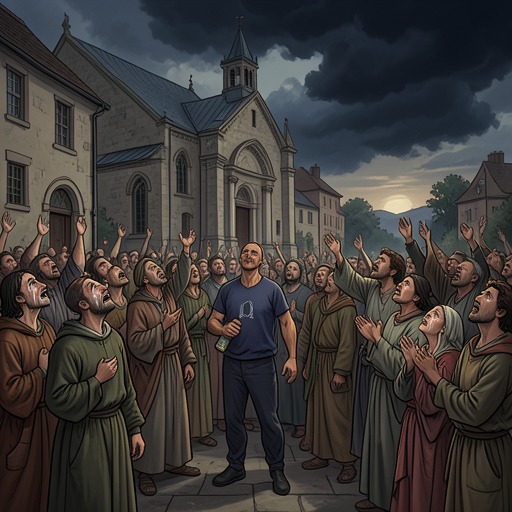
ShrineCollective psychic energy is the novel’s proposed force by which human minds, beliefs, and wills can gather into a shared power and be directed toward an effect. The idea connects the children’s reactions around Alice Pagett, the healings attributed to her, and the charged crowds at St. Joseph’s Church. Yet it remains an interpretation advanced by characters rather than a settled explanation: the book repeatedly places observable group behavior beside ordinary possibilities such as mass hysteria and environmental exposure.
The Proposed Mechanism
In Monsignor Delgard’s developing account, collective psychic energy is not simply a crowd’s shared emotion. It is a resource that can be drawn from people and directed through a person with unusual psychic capacity. Delgard comes to believe that those apparently cured have not been healed by Alice in a conventional sense; instead, they have used their own mental powers, with Alice acting as a director of the energies released by belief. In this model, faith does not merely accompany a cure. It helps make the group’s power available and gives it direction.
Delgard’s theory also gives the energy a cost. He connects the weakness he has felt since the onset of the apparent miracles with the strange atmosphere around the church and interference affecting electrically operated machinery. He imagines that existing energy is being drained to create a new form. Alice, in his view, is the physical and spiritual catalyst for this process. The model therefore links the reported benefits to depletion elsewhere: collective force can produce an effect, but its gathering and use may leave people or their surroundings weakened.
Group Reactions and Competing Explanations
The first children’s gathering supplies an early, visible instance of behavior spreading through a group. Gerry Fenn observes children smiling, praying, or responding as though absorbed in an experience, while Alice remains apart near the oak. Afterward, several children fall, and others begin to cry. Fenn interprets their reactions as a form of hysteria transmitted from Alice’s mental state. His account is a hypothesis made in the moment, not proof of a psychic mechanism; what he can observe is a sequence of shared responses whose cause remains uncertain.
The novel makes that uncertainty explicit through the earlier mass collapse at the Marching Bands Festival in Mansfield. Fenn cites the incident as a precedent for mass hysteria: more than three hundred children collapsed together while waiting for a contest, and authorities attributed the episode to that explanation after investigation. But the conclusion was disputed. Some investigating doctors proposed organic poisoning, and traces of malathion were found in the soil, though not in quantities considered sufficient to account for the outcome. The episode therefore complicates any easy distinction between collective psychological influence and physical exposure.
Sue Gates describes the children’s experience as dreamlike and almost hypnotic. Fenn answers with hysteria as a familiar explanation, but his recollection of Mansfield includes unresolved medical disagreement. The exchange shows how the same group event can invite different causal accounts: an atmosphere of suggestion, an environmental factor, or, in the novel’s more uncanny interpretation, a psychic connection. The text records these possibilities without making the evidence for mass contagion equivalent to proof of Delgard’s supernatural theory.
Faith, Alice, and the Historical Link
Delgard’s explanation grows beyond the present-day crowd. In his reading of Thomas Woolgar’s manuscript, he connects the force associated with Alice to Einor, a sixteenth-century woman destroyed as a witch. Delgard believes that the religious fervor surrounding the accusation and the mental energy of the people involved helped release a power that could outlast her death. He further speculates that Alice’s conception in the same field where Einor was killed provides a link between the earlier violence and the present events. These are Delgard’s inferences from the manuscript and his observations, not independently confirmed facts.
The historical account gives faith an ambivalent role. Religious belief can organize minds into a force capable, in Delgard’s theory, of directing healing; the same capacity can also be entangled with persecution and destructive power. He sees Alice as central to the present transformation, but his reasoning does not reduce the process to her individual will. She is the focus through which a collective resource is gathered and directed, while the people’s beliefs supply the force that makes the gathering possible.
The Shrine as a Concentrating Point
As the pilgrimage grows, Gerry Fenn comes to understand the gathering at the shrine as a concentration of the same energy. He compares the atmosphere around St. Joseph’s Church with the public excitement surrounding the 1981 Royal Wedding and Pope John Paul II’s 1982 visit to Britain, but judges the current gathering to have a distinctive potency centered on the shrine. In his revised account, Alice draws on the energy of believers, and faith-healers direct the psychic resources of those who believe. His conclusion depends partly on Woolgar’s manuscript and on experiences that have altered Fenn’s former skepticism; it does not amount to evidence that would persuade the Church authorities he approaches.
The crowd’s behavior during the later service keeps the question tangible. As the hymn rises, people faint or collapse, and Fenn himself becomes dizzy and weak. When Ben touches his cheek, Fenn’s dizziness immediately passes, though Ben shows no visible distress. The moment resembles the novel’s larger pattern of weakness and apparent recovery, but it also remains open to interpretation: the narrative presents a bodily change and its timing, while Fenn and Delgard supply theories about what that change means.
At the same service, the congregation’s shared attention is presented as both devotional and potentially perilous. The hymn unifies the gathering; later, the crowd’s reactions to violence and upheaval become sharply divided, with grief, shock, anger, and panic appearing among different people. The novel thus does not portray a crowd as one mind with one uniform response. A shared atmosphere may enable coordinated belief or collective disturbance, but individual reactions remain consequential. In Delgard’s reflections, evil belongs to individuals even when a larger power gathers people’s energy, and a single person’s actions can disrupt the purpose of the whole.
Narrative Significance and Limits
Collective psychic energy gives the novel a connective explanation for otherwise separate phenomena: children reacting together, cures attributed to faith, Fenn’s episodes of weakness, and the charged atmosphere around the shrine. It also allows characters to interpret faith as an active force rather than merely a private conviction. At the same time, the Mansfield episode and the competing explanations for the children’s collapse prevent the concept from functioning as a simple scientific answer. The distinction between what witnesses see and what they infer remains central.
Fenn’s shift is especially important to that structure. He begins by treating the children’s response as a possible case of hysteria and later adopts a psychic account after encountering the manuscript and the extraordinary events around the church. Yet he cannot turn conviction into accepted proof. Bishop Caines does not heed his warning, and Fenn’s efforts to reach other church authorities and his own profession also fail to establish the explanation publicly. The concept therefore operates both as a theory within the story and as a measure of the distance between experience, interpretation, and proof. Its force lies not in closing every question, but in binding belief and bodily consequence together while leaving the source of that power contested.