Prayer and faith as resistance
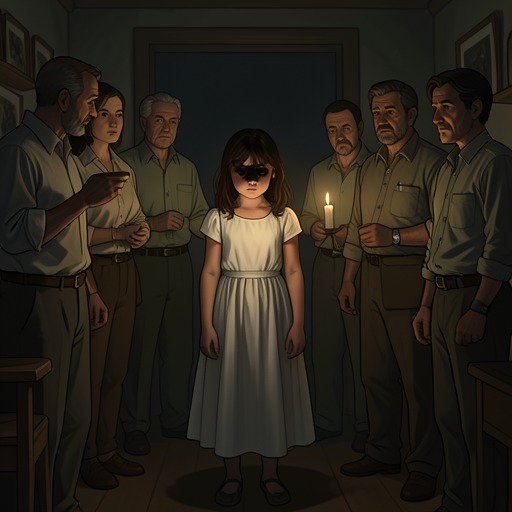
ShrinePrayer and faith as resistance emerge most clearly in the final confrontation at St. Joseph’s Church, where Gerry Fenn struggles against EITHER-NOR and the force accumulated from the people around him. The novel sets this resistance against a crowd drawn together by hope for Alice Pagett: collective belief can offer comfort, but the congregation’s shared energy also becomes a resource for evil. Prayer is neither an easy escape nor a complete explanation of what happens. Fenn’s prayer coincides with a radiant presence at the oak and the creature’s retreat, leaving faith newly possible without resolving whether he has witnessed a divine intervention.
Pilgrimage and the Pressure of Shared Hope
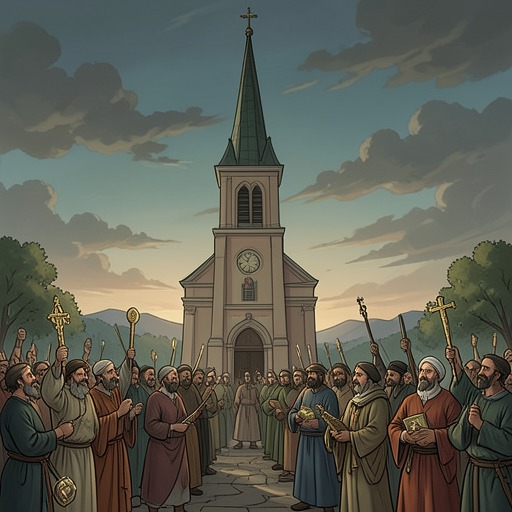
The field beside St. Joseph’s Church changes from a local setting into a destination for people seeking a miracle. On the damp Sunday when Fenn arrives with Sue and Ben, unusual traffic and activity in the village signal the gathering before they reach the church grounds. At the entrance, the crowd presses together; among those arriving are people with visible illnesses and family members who have brought them in hope of help. Fenn initially approaches the gathering as a potential follow-up story, but the scale of the turnout and the expectation around him draw him into its atmosphere.
The crowd’s growth is more pronounced at the later open-air Mass. Hours before the service, people fill the benches around the altar, while others spread into the field. Some want to see Alice; others hope that closeness to her will bring them within reach of holiness. Church stewards, ushers, and young priests attempt to manage the congregation, and the practical difficulty of moving wheelchairs across churned ground exposes the strain between ritual expectation and the actual needs of those attending. The gathering is both organized and emotionally volatile: its participants form a temporary community of hope, but their hopes depend on an event that the Church cannot promise to repeat.
Doubt Within the Church
The mass expectation does not produce uniform certainty. Monsignor Delgard looks out over thousands of faces and worries about the sick and invalids who have come expecting help. He fears that disappointment will damage their faith and hopes the service will end the expectation of further miracles. His doubts are sharpened by his institutional position: the Church should not lend its authority to what he regards as a possible delusion, yet he cannot simply dismiss Alice, whose sincerity he believes in and whose earlier power he has witnessed.
During the service, Delgard sees the congregation’s emotion as a force directed toward him. Bishop Caines is present below him, and George Southworth watches the crowd, while the priests’ presence lends the event religious credibility. Delgard recognizes the tension between that public authority and his private uncertainty. His concern is not merely whether a miracle will occur; it is whether the assembled people can retain faith if it does not. The scene therefore treats faith as vulnerable to spectacle and expectation as well as capable of sustaining people.
Fenn’s Struggle Against EITHER-NOR
At the shrine, Fenn’s resistance becomes a direct, inward struggle. The voices in his mind urge him to resist EITHER-NOR and connect her strength to the negative force gathered from the people present. The force is described as dependent on the living: it draws power from the evil of others and cannot govern those who oppose it. This gives resistance a collective dimension, but not a simple one. The same gathering that began in hope has become a source of power for the threat confronting Fenn.
Fenn cannot immediately act on the instruction to resist. He is held by the sight of the creature and recognizes the difference between this confrontation and an earlier occasion at the church in Barham, when he ran from his nightmares rather than face them. At the shrine, fear and physical weakness leave him unable to turn away. Bishop Caines is also near collapse, making a faltering gesture associated with prayer while his lips continue to move. The scene places religious practice amid helplessness: prayer persists, but neither rank nor ritual automatically frees those present from the force bearing down on them.
Prayer, the Oak, and an Uncertain Deliverance
When the platform begins to shake and the threat advances, Fenn calls on God and Jesus Christ for help. His attention then follows EITHER-NOR’s gaze to a glow at the base of the oak. The voices in his mind urge him to pray; he closes his eyes and does so. Lightning strikes the tree, which catches fire, and the creature moves away from it. Sue and Ben pull Fenn from the platform as the burning oak falls, destroying the shrine and the figure beneath it. The sequence gives prayer a decisive place in Fenn’s experience of resistance, while leaving the precise cause of the creature’s retreat bound up with the light and the burning tree.
The deliverance does not settle what Fenn saw. Later, he remembers the glow as the image from the night that most haunts him, though it brings courage rather than only fear. He wonders whether a white-gowned woman stood within it, but suspects that the terrors of the night may have distorted his perception. Ben complicates that explanation: although he did not see Alice’s radiance, her levitation, EITHER-NOR, or the shaking earth, he later asks about the lady in white by the tree. Fenn also considers whether Ben’s innocence shielded him from the horrors and helped restore strength to Fenn and Sue when they touched him. These remain questions rather than established rules, but they connect protection to a quality the crowd’s desperate expectations cannot manufacture.
Faith After the Disaster
Fenn’s response after the shrine’s destruction is not an immediate declaration of certainty. The possible vision troubles him precisely because it offers a different kind of memory from the night’s terror: one associated with calm and courage. His questions about the woman in white and EITHER-NOR’s fear of the glow remain unanswered, yet the experience prompts him to consider faith again. He hesitates outside the church, then joins Sue and Ben as they enter Our Lady of the Assumption.
That final movement gives prayer and faith a modest, consequential role. They do not erase the disaster or explain every event, and the account does not establish beyond doubt that the glow was supernatural. Instead, resistance begins in Fenn’s effort to oppose EITHER-NOR, passes through prayer when his own will fails, and ends with his willingness to return to a religious space. The contrast is central: collective hope can be exploited, institutional confidence can falter, and prayer can coexist with uncertainty, yet the possibility of faith survives the collapse of the spectacle built around Alice.