Blackthorne's Rutter
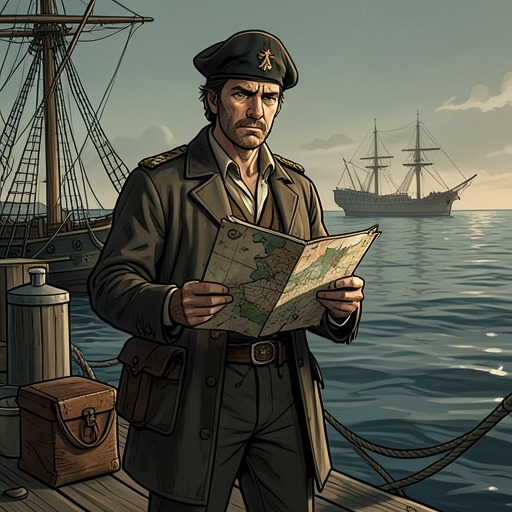
ShōgunBlackthorne's Rutter is John Blackthorne’s navigational record and a source of practical authority at sea. In a world where charts could be useless and longitude impossible to determine, the book preserves the observations a pilot needed to find routes, judge conditions, and bring a ship between ports. Its value is both professional and political: it contains knowledge coveted by rival powers, as well as evidence that could condemn its owner as a pirate.
A Pilot’s Working Record
A rutter is a compact book built from a pilot’s experience of waters already sailed. It records compass courses between ports and capes, soundings and depths, the color of the water and the nature of the seabed. It also gives the practical sequence of a passage: how to make a route and return, how long to hold a particular tack, which winds and currents to expect, when storms or fair weather are likely, where to careen and take on water, and where to find friends or enemies. Shoals, reefs, tides, and havens belong to the same working inventory. The rutter’s purpose is not simply to describe the sea, but to make a voyage navigable.
That record addresses a basic uncertainty of Blackthorne’s profession. Existing charts are too vague to be relied upon, and there is no way to fix longitude. His old teacher, Alban Caradoc, taught him that a pilot was lost out of sight of land unless he had a rutter. Blackthorne learned the book’s importance young: at thirteen, after a year apprenticed to Caradoc, he understood it as the collected experience that could extend a navigator’s reach beyond familiar coasts.
Making, Use, and Limits
Blackthorne’s own entry demonstrates how observation becomes a navigational record. On April 21, 1600, the 133rd day out from Santa Maria Island, Chile, he noted the time, latitude, dusk, high sea, strong wind, the ship’s course, and its speed of about two leagues in an hour. He described the water as dull gray-green and apparently bottomless, marked triangular reefs to the northeast at half a league, and recorded that cloud cover had again prevented him from taking the sun’s declination at noon. His estimate that the ship remained on course and that landfall in Japan should be near sits beside the measurements and uncertainties on which that estimate depends.
The same entry records the human cost of the passage. Blackthorne listed the deaths of the sailmaker Joris, the gunner Reiss, and second mate de Haan from scurvy, followed by the boatswain Rijckloff. With the Captain-General still sick and no one available to make shrouds, Blackthorne committed the dead to the sea after commending their souls to God. The Rutter thus joins navigation to the daily work of command: it charts a route while preserving the deaths and conditions encountered along it.
A rutter is not infallible. Its usefulness depends on the pilot who made the observations, the scribe who copied them, any rare printer who reproduced them, and any scholar who translated them. Errors, including deliberate ones, can enter at each stage; a pilot cannot be certain of a written route until he has sailed it himself. The book is therefore an instrument of accumulated experience, not a substitute for judgment. That distinction matters aboard ship, where the pilot serves as leader, guide, and final arbiter.
Secrecy and Mortal Risk
The routes beyond their own waters were especially contested because Portuguese and Spanish pilots had sailed much of the rest of the world. Portugal and Spain treated their rutters as national treasures; their enemies in England and the Dutch Republic sought the knowledge with equal determination. A book that disclosed passages to the New World, the Strait of Magellan, or the Cape of Good Hope could give its possessor access to routes that Iberian powers tried to keep exclusive.
Blackthorne carries a Portuguese rutter as well as his own, and he fears what discovery of either book would mean. His Rutter records dates, places, and the amounts of plunder taken, the dead at the landings in the Americas and Spanish Africa, churches sacked, and towns and shipping burned. The Portuguese book is stolen, though Blackthorne believes it was bought from a Portuguese traitor; under the law he describes, a foreigner found possessing a Portuguese rutter can be put to death. If such a book is discovered aboard an enemy ship, the ship is to be burned and everyone aboard executed. The record that makes distant navigation possible can therefore also function as a confession and a death warrant.
When samurai guard him, Blackthorne tries to get below for both rutters, fearing that they may be taken and handed to priests or Japanese authorities. His concern reveals the books’ double exposure: one holds evidence of his own expeditions, while the other violates the secrecy surrounding Portuguese routes. Their danger does not arise from their physical size but from the knowledge and history they contain.
Navigation as Power
The Rutter belongs to a wider struggle over who can move safely and independently across the sea. In a galley carrying Toranaga along the coast of the Izu Peninsula and then westward toward Cape Shinto, Rodrigues explains that the safer coastal route would cost too much time. The voyage leaves the coast for open water, a choice made under pressure of speed and political urgency. In another harbor, Blackthorne recognizes the European frigate’s precautions: it has moved into deep water, prepared its cannon and muskets, and can bring its stern chasers to bear. During the ensuing escape, he estimates the frigate’s necessary tack and the galley’s limited sea room as the faster ship closes in. These scenes show the practical world in which a pilot’s judgments operate: routes, wind, vessel type, harbor position, and time determine which ships can pass, pursue, or escape.
Blackthorne’s sand map of the world makes the same knowledge legible in another form. He explains that a map can flatten the globe and that navigation can use such a projection or globes, while emphasizing how much of the interiors of Africa, the Americas, and Asia remains unknown. The map and the Rutter serve different purposes, but both distinguish recorded knowledge from the vast spaces still beyond it. The Rutter’s significance lies in that distinction made operational: it turns particular observations into a route, yet leaves every passage dependent on a pilot who must test what the book claims.