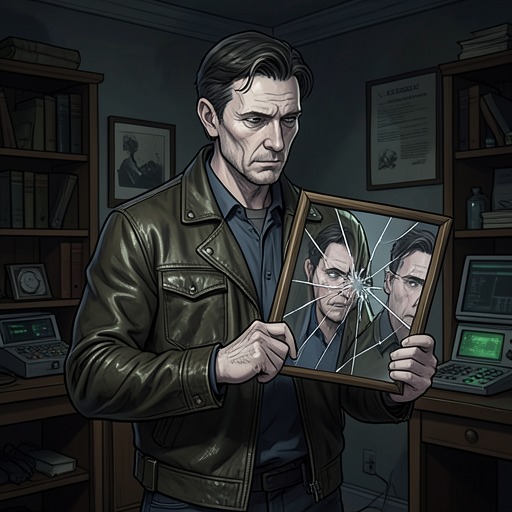
Calvin Sharkle’s siege and the resulting explosion
StrangersCalvin Sharkle’s siege and the resulting explosion are a turning point in which private terror becomes public catastrophe. In Evanston, a once-peaceful man barricades himself against a threat he cannot explain; when the police try to force their way into his fortified house, an explosion kills Sharkle and others. Father Stefan Wycazik sees the tragedy not as an isolated breakdown but as a possible consequence of the same mysterious forces affecting the witnesses in Nevada.
Background and Escalation
For months, Sharkle had been changing. A cheerful, well-liked bachelor who lived alone on O’Bannon Lane, he grew brooding and grim, telling neighbors he had “a bad feeling about things” and that something important and terrible was coming. He read survivalist literature, spoke of Armageddon, and suffered vivid nightmares, though he could not identify what he feared. On December 1, he quit trucking, sold his rig, and told his sister, Nan Gilchrist, that there was no time to move to remote property: he would prepare his existing house for a siege. A doctor found him fit and attributed his condition to work-related stress, but after Christmas his sociable manner gave way to suspicion. In early January, he had his telephone disconnected because, he suggested, his pursuers might reach him through it.
Sharkle’s fear soon acquired a target, though not a clear identity. He told his neighbor Edward Wilkerson that he had prepared his house and wanted the Wilkerson family to hide there when “they” came. He did not know what the attackers would look like or what they would call themselves, but feared they might turn people into zombies. He had guns, ammunition, and a fortified home. Wilkerson, alarmed but not convinced Sharkle was dangerous, called Nan Gilchrist; she and her husband went to the house, and Wilkerson and another neighbor, Frank Krelky, followed to provide backup.
When the door opened, Sharkle was armed with a 20-gauge semiautomatic shotgun and nearly hysterical. He accused Wilkerson and Krelky of already having been changed, then fired. The first blast killed Krelky at close range. Wilkerson was shot in the legs as he fled, but survived by falling and pretending to be dead. Sharkle retreated into the house, leaving the authorities to contend with an armed man, possible hostages, and a structure he had prepared to withstand an assault.
The Siege and the Blast
With the block evacuated and Sharkle unreachable by telephone or bullhorn, the police feared his sister and brother-in-law might be hostages and delayed a direct assault. When officers finally entered the house, they encountered traps: thin wires brought them down, and a deadfall injured one officer. Sharkle, waiting in a gas mask, opened fire, killing one officer and wounding another before retreating into the cellar. He had reinforced both cellar entrances with steel doors and covered the cellar windows with heavy metal shutters, turning the house into a fortified deadlock.
Father Stefan Wycazik heard the police plan over a radio in a recreational van. Officers would use carefully gauged charges to blow both cellar doors and storm the basement from opposite sides. He became convinced the attack would cause a slaughter and ran back toward the barricade, intending to reach Sharkle and talk to him. The surging crowd and police barriers kept him from getting through in time. Two small blasts announced the breach; a third, far larger explosion tore sections of the house into the winter sky. A police officer cried that Sharkle had a bomb. The blast left Father Stefan certain that Sharkle, his sister and brother-in-law, and many members of the SWAT team had been killed, though he could not tell how many.
Aftermath and the Wider Mystery
The blast ended the siege but did not settle what had driven it. As Father Stefan Wycazik moved through the stunned crowd, he asked Roger Hasterwick to repeat what Calvin Sharkle had shouted from the cellar window earlier that day. Hasterwick recalled the words with relish, treating them as the ravings of a madman; Stefan, however, heard them in the context of the events at the Tranquility Motel, including the miraculous cures and telekinetic phenomena. He concluded that Sharkle might have been confused and terrified rather than insane, his mind damaged by brainwashing and by memory blocks collapsing. The account withholds the exact content of Sharkle’s shouted declarations here, preserving their force as a revelation Stefan must interpret rather than a neatly explained answer.
Stefan had already been drawn toward Nevada by the events involving the Mendoza and Halbourg families. After the explosion, that curiosity became an urgent responsibility: if even part of Sharkle’s warning was true, the people gathered at the Tranquility Motel were in danger, and Stefan believed he might be needed to protect both their minds and their lives. He left Evanston without returning to the rectory to pack, driving directly toward O’Hare to take the first available flight west. The catastrophe thus changes the direction of his journey: what had been a search for understanding becomes an attempt to reach people who may be threatened by the same hidden forces that left Sharkle terrified.
The siege also gives the novel’s otherwise hopeful account of extraordinary powers a lethal counterpoint. A man who had once been kind and peaceful armed his home against an unnamed enemy, mistook neighbors for transformed threats, and died in an explosion that also killed others. Stefan’s interpretation connects that private disaster to the suppressed history surrounding the Nevada witnesses, where a supposed toxic emergency had brought military roadblocks, a quarantine, and the use of specially cleared DERO personnel to guard what they might see. Against that background, Sharkle’s breakdown suggests the human cost of concealed contact and manipulated memory; the event turns the mystery from a question of marvels into a question of who can be harmed when fear and secrecy reinforce one another.
The Official Emergency and the Secrecy Around It
The Nevada emergency supplied the public explanation against which the siege’s hidden implications could be measured. At the Tranquility Motel, Faye Block recalled that the interstate had closed on Friday, July 6, after a truck carrying dangerous chemicals toward Shenkfield was said to have spilled its load; the motel remained closed until Tuesday while guests were evacuated. By the Wednesday, July 11, edition, the Elko Sentinel announced that I-80 had reopened, the quarantine had been removed, and the first evacuees had been located and had seen nothing. Yet the Army had closed a ten-mile stretch of the highway and established roadblocks before informing the Elko County sheriff or Nevada State Police, keeping civilian officials outside both the quarantine operation and contingency planning. The contrast between the reassuring headlines and the military’s extraordinary control of the scene sharpened the novel’s central unease: the danger surrounding Sharkle’s warnings could not be separated from the authorities’ determination to control what witnesses were allowed to know.