Thunder Hill incident of July 6
StrangersThe Thunder Hill incident of July 6 is the concealed event around which the Tranquility Motel witnesses’ fractured memories, recurring nightmares, and growing investigation converge. Its full sequence remains hidden, but evidence gathered afterward points toward an emergency at Thunder Hill, a military effort to isolate and control witnesses, and a secret whose disclosure could reach the highest levels of the United States federal government.
The incident behind the erased memories
The summer before last, a group of people encountered something during the July 6 crisis that they could not later recall clearly. The Army imposed a temporary quarantine around the area where witnesses were being dealt with and, at the same time, enlarged the security zone around the Thunder Hill Depository in the mountains. The witnesses’ emerging interpretation is that the first measure contained them while the second protected the source of what had happened. Dom Corvaisis suspects that the real explanation lies in the Army’s activities at Thunder Hill, not in the public account of a toxic spill at the Shenkfield Army Testing Grounds.
The crisis left its mark in fragments rather than a coherent recollection. When the witnesses gather again at the Tranquility Motel, Dom, Ginger Weiss, Ernie Block, and Ned experience vivid nightmares of being strapped to motel beds and attended by men in decontamination suits. They increasingly understand these episodes not as ordinary dreams but as memories resurfacing in disguised form. Sandy Sarver has a less distinct, pleasant dream, while Faye Block dreams nothing. The contrast does not resolve what happened; it makes the gaps and unevenness in the group’s recollections part of the evidence.
Clues, correspondence, and the search for Thunder Hill
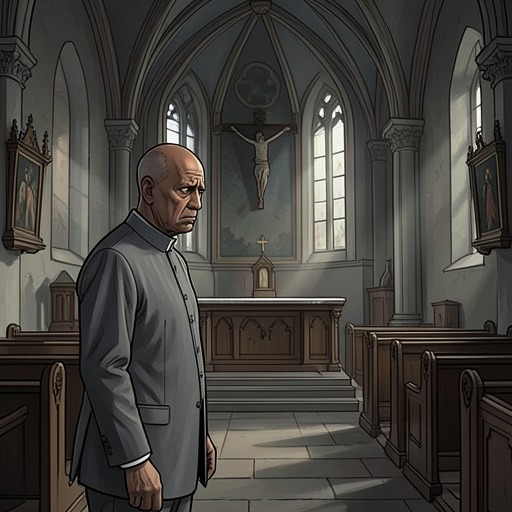
Dom’s investigation has already been shaped by anonymous messages whose origins he cannot establish. After receiving a note advising the sleepwalker to search his past, he tests whether he could have typed it himself: he reproduces its two sentences on an IBM Displaywriter, prints versions in four typefaces, and compares them with the original. Courier 10 appears to match, leaving open the unsettling possibility that he sent himself the note. A later, unmarked envelope contains only the words The moon. Still another, postmarked from New York, contains Polaroids of a young priest and a restrained young woman, both pictured with vacant expressions. Dom recognizes neither person with confidence, though the woman seems familiar. These objects do not explain July 6, but they make his lost past feel actively connected to the present.
The more direct route to Thunder Hill comes through the Elko Sentinel. Dom and Ginger Weiss search issues published in the weeks after the supposed toxic spill, then widen their reading to stories that appear unrelated to the highway closure. By looking for concealed connections rather than an explicit report, they identify Thunder Hill as a place whose appearances in the paper may point toward the real source of the crisis. Dom’s conclusion is that Shenkfield was a diversion, designed to draw attention away from Thunder Hill. Faye confirms that the Army installation lies roughly ten or twelve miles north-northeast of the motel, where limestone caves and an underground records depository sit behind guarded access.
The scale of the post-July 6 restrictions sharpens the question. As Ned observes, an underground archive would not ordinarily require a vast surface security zone. Dom reasons that the Army took two emergency measures: a temporary quarantine near the motel and an immediate expansion of the restricted area around the Depository. The second quarantine remains in force. For the witnesses, the land-grab is not proof of what occurred, but it makes Thunder Hill a more compelling investigative target than the official explanation.
The moon as a returning memory
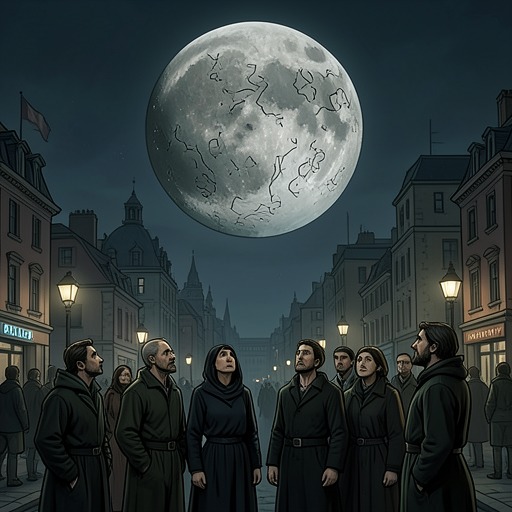
Ginger offers a theory that links the group’s different symptoms without claiming to know the whole event. Their dreams share a lunar element; their other recurring details—decontamination suits, intravenous needles, beds, and restraining straps—have proved to derive from real experiences. She therefore proposes that the moon, too, may be a memory trying to surface. Marcie’s fixation has shifted toward a scarlet moon, and Jack Twist has described ordinary moonlight turning bloody in a nightmare. Ginger interprets these red images as possible evidence that, on July 6, the witnesses saw something that made the moon appear to change color.
In her account, the strange light that sometimes fills Brendan Cronin’s bedroom and that the group witnesses in the motel office may be a reenactment of that earlier sight—a message nudging the witnesses toward recollection. This remains Ginger’s explanation, not a recovered, shared memory of the event. Its importance lies in how it joins the group’s scattered experiences: bodily memories of confinement, the recurring moon, and uncanny light become parts of a single hypothesis that they can test together.
Containment and the stakes of disclosure
The Salcoe family’s experience shows that the effort to suppress memories did not end with the original motel operation. Gerald Salcoe, his wife, and their two daughters had rented rooms at the Tranquility Motel on the night of the incident, and their memory blocks have since deteriorated. Experts in brainwashing from the Central Intelligence Agency, previously used in covert foreign operations, had been brought in to condition the witnesses. Now the Federal Bureau of Investigation and the Central Intelligence Agency are holding the Salcoes incommunicado in Monterey and subjecting them to another program of memory repression and alteration. Leland Falkirk, briefed on the operation, doubts it can preserve the secret.
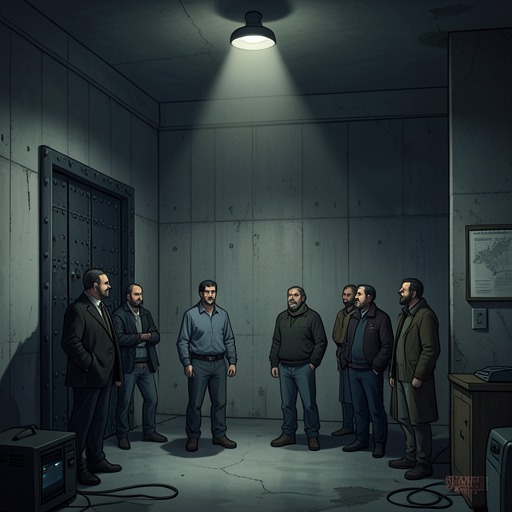
Thunder Hill’s physical design embodies the force of that secrecy. Its twin blast doors are thirty feet high and twenty feet wide; a separate, heavily reinforced pedestrian entrance leads through an interlocking concrete tunnel. Falkirk regards the installation as an ideal vault for the secret of July 6. He also understands the political stakes: the cover-up involves rival government institutions, including the Federal Bureau of Investigation, the Central Intelligence Agency, the National Security Agency, the United States Army, and the Air Force. Senior officials, he knows, are fully informed, while most personnel involved do not know what they are concealing. The silence has held for more than eighteen months, but he fears the consequences if it breaks.
The incident’s narrative force comes from this imbalance: the witnesses possess vivid traces but no complete account, while the institutions that know more have built both physical barriers and renewed psychological ones. Each clue—from Dom’s typewritten comparison and the anonymous photographs to the nightmares, newspaper stories, and expanded quarantine—narrows the field without yet disclosing the decisive event. Thunder Hill therefore becomes not only a location to investigate but the guarded center of a struggle over who may remember, speak, and establish what happened.