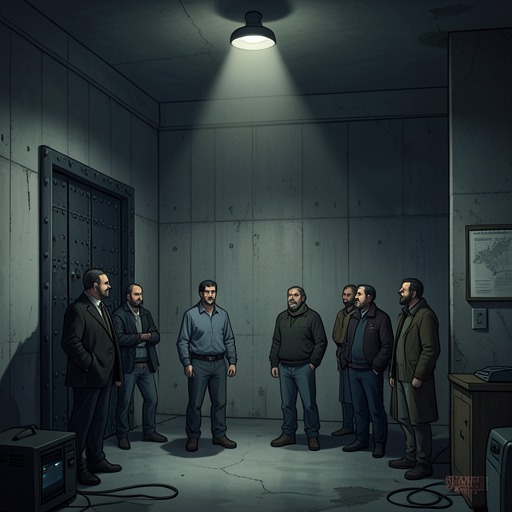
Tranquility Motel witnesses’ brainwashing
StrangersTranquility Motel witnesses’ brainwashing was a government effort to erase what the motel’s guests had seen and to make the resulting gaps appear like ordinary time. Its importance lies not only in the original coercion but in the system built to maintain it: fabricated memories, renewed confinement, surveillance, and repeated attempts to suppress memories that would not stay buried. The effort’s failures turn private uncertainty into evidence of a wider cover-up.
Origins and Design
The operation followed the extraordinary events at the Tranquility Motel two summers earlier. Gerald Salcoe, his wife, and their two daughters had rented a pair of rooms there on the wrong night. The Salcoe family was among the witnesses whose memories were later suppressed. Leland Falkirk recalls that the CIA’s brainwashing specialists, ordinarily used in covert foreign operations, had been borrowed for the motel assignment and had promised reliable results. Their task was not simply to make witnesses forget what they had seen, but to conceal the fact that time had been taken from them.
The method depended on filling the missing interval with false recollections. In a later conversation, Ginger Weiss reasons that a person held in custody for several days would notice an empty stretch in her past. Pablo Jackson explains that fabricated memories could cover those days so completely that the subject might not recognize the gap. His explanation becomes more disturbing when Ginger’s supposed recollections of her stay are examined: she can describe the Tranquility Motel in detail, but cannot remember the books or television programs she supposedly used to pass the time. Pablo concludes that she had never done those things. They were a manufactured account, installed to disguise what had actually happened.
How the False Memories Fail
The replacement memories are not equally convincing in every detail. Ginger can repeat that she ate at the Tranquility Grille each night and describe its small menu, yet she cannot say what she ate or explain how she knows the food was good. As Pablo presses for specifics, her answers remain flat and hollow while her face tightens with anxiety. The scene distinguishes a rehearsed response from a lived memory: the cover story supplies details, but those details do not carry the texture of experience.
Pablo understands that abruptly telling Ginger the truth could be dangerous. Her apparent memories have been installed as part of an Azrael Block, and the genuine memories are locked behind it. He believes that directly ordering her to discard the false account and break through the block could trigger a coma or something worse. Instead of forcing the recovery, he proceeds cautiously, expecting that finding and using small openings may take days or weeks. For the time being, he tries to establish the exact number of hours stolen from her, returning to Friday, July 6, and asking when she signed the Tranquility Motel register. The recovery process therefore exposes the brainwashing’s precision as well as its human cost: even the search for the truth must be measured against the danger of another imposed collapse.
The planted account also explains why a witness might remember the motel clearly while remaining unable to substantiate what she did there. Its details are not proof of ordinary experience; they are cover. The more insistently Pablo tests those details, the more visibly the scripted quality of Ginger’s answers emerges. The gap between what she says and what she can genuinely recall becomes a sign of the intervention itself.
Renewed Repression and the Salcoe Family
The original conditioning begins to fail. Leland learns that the Salcoe family’s memory blocks have deteriorated markedly. The specialists, embarrassed by the number of subjects whose conditioning is breaking down, argue that another three-day session will ensure the witnesses’ silence. Yet Leland judges the operation a lost cause. He believes the experience was too profound and shattering to be easily suppressed, and that its forbidden memories continue to press against the blocks. The claim of guaranteed silence is thus less a solution than another promise from experts whose earlier assurances have already failed.
At that moment, the FBI and CIA are illegally holding the Salcoe family incommunicado in Monterey, California, subjecting them to another intricate program of memory repression and alteration. Parker Faine discovers what that renewed treatment looks like from inside the house: one of the daughters lies unresponsive, wearing earphones connected to a tape recorder. A woman’s soothing voice supplies a false account of a hotel stay, describing sleeping late and walking around the grounds. The hypnotic recording is being used to cover the time consumed by the current session, with audible speech and, Parker suspects, subliminal messages working together. The image makes the operation concrete: memory control is not only a secret held in officials’ files, but a voice repeated into a child’s ear while she cannot respond.
Dom Corvaisis also disputes the public explanation that a toxic spill and evacuation account for what happened around the motel. Ernie Block recalls newspaper clippings from the Elko Sentinel and the community’s continuing questions about the supposed danger. Dom argues that visiting witnesses such as Elroy and Nancy Jamison may remember taking the Blocks away because that is what they were instructed to remember; if they were present during the motel events, he suspects they too were brainwashed. The newspaper story gives the cover a public shape, while Dom’s account suggests that even apparently corroborating memories may have been manufactured.
Surveillance and the Limits of Secrecy
The memory program is supported by an extensive, fragile surveillance operation. The FBI agent speaking with Leland says that monitoring every witness visually for four days a month and listening to only about half of the recorded phone calls requires twenty-five agents, while the unit has only twenty. Only three of those twenty know why the witnesses are being watched, because the case is so highly classified. The agent argues that secrecy leaves staff feeling untrusted and makes them careless; in the resulting gaps, a witness’s memory block can begin to break down without anyone noticing until the situation reaches crisis.
The agencies’ coordination is itself a weakness. The operation involves the FBI, the CIA, an entire DERO company, and other participants, creating what Leland sees as too many chiefs. He is responsible for the military side and intends to carry out his assignment even though he doubts the cover can last. When the FBI agent asks about moving against the motel witnesses, Leland refuses to authorize the operation until the separate crisis involving Calvin Sharkle in Chicago is clarified. The plan to seal off the motel on short notice is therefore conditional, caught between the desire to contain witnesses and the competing demands of a sprawling security response.
Jack Twist later warns the group that their conversations are not private. He explains that surveillance need not require agents to enter a room and plant a device: a rifle microphone can listen from a distance, while an infinity transmitter can activate a telephone’s microphone without making it ring. He demonstrates the implication by pointing to the extension the witnesses use themselves. His warning changes where the group can safely talk; they move their discussion to the diner and plan to unplug its phone. The brainwashing effort therefore reaches beyond the treatment sessions, shaping the witnesses’ movements and forcing them to treat even familiar rooms and ordinary communications as potential instruments of observation.
Failure and Significance
The attempted suppression becomes a contest between imposed accounts and returning experience. Leland recalls that the witnesses saw something so paralyzing, astonishing, humbling, and terrifying that he associates their response with religious encounters. The government’s label for them, witnesses, carries an unintended resonance: they are not merely people to be monitored, but people whose remembered experience threatens the official story. The more forcefully the agencies try to overwrite that experience, the more conspicuous the machinery of the overwrite becomes.
The failure is institutional as well as psychological. Leland and the FBI agent discuss the extreme possibility of killing thirty-one citizens to contain the secret, then reject that kind of barbarism as no real solution. Leland’s position is that the government should not have attempted to maintain an unlimited deception. Yet he remains a soldier assigned to carry out the operation, even while judging it hopeless. The renewed sessions, the taped false recollections, the gaps in surveillance, and the witnesses’ returning memories all point in the same direction: the state can impose a story for a time, but it cannot make that story indistinguishable from lived experience for ever.