Falkirk’s manhunt for Tranquility witnesses and the Vista Valley shooting
StrangersFalkirk’s manhunt for the Tranquility witnesses and the Vista Valley shooting expose how a quarantine once presented as a response to a chemical accident becomes a means of concealing the truth and seizing control of the people who witnessed it. At the roadblock, that secret operation turns lethal: a soldier fires on an unidentified Jeep, and Brendan’s effort to save the wounded reveals both the growing force of his healing gift and its limit in the face of death.
The Quarantine and Its Hidden Purpose
The operation’s public story reaches back to July 6, when a truck carrying dangerous chemicals toward Shenkfield was said to have spilled its load near I-80. The supposed emergency closed the interstate and forced the Tranquility Motel to shut until Tuesday. Guests evacuated in their own cars, while Ned and Sandy Sarver were allowed to go to their trailer near Beowawe, outside the quarantine area. The account gave the later manhunt an established rationale: the Army could again invoke a hazardous zone and the need to control movement.
The contemporary newspaper record, however, showed how far the Army had already gone beyond an ordinary emergency response. Army units attached to Shenkfield closed a ten-mile stretch of I-80 and established roadblocks before informing the Elko County sheriff or Nevada State Police. Local authorities complained that they were excluded from managing the crisis and from planning for the possibility that winds might carry nerve gas beyond the danger zone. The Army’s control of the perimeter, and its refusal to share responsibility with civilian agencies, made secrecy part of the emergency itself.
Dom and Ginger’s investigation sharpened the suspicion that the spill explanation was false. Ginger reasoned that a DERO team would not have been needed to guard a routine chemical accident: its presence suggested that the roadblocks gave their personnel sight of something highly classified. She also doubted that a team could have arrived and manned the perimeter so quickly without advance warning. These were deductions rather than confirmed proof, but together they recast the quarantine as a screen for a concealed event—and made the witnesses, rather than the alleged contamination, the focus of the Army’s precautions.
Falkirk’s Rationale and the Roadblock
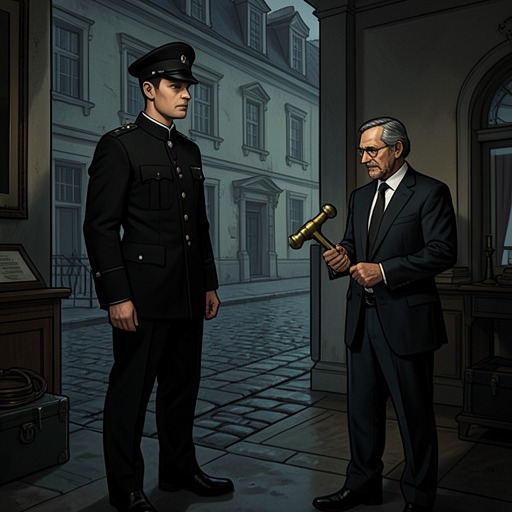
Falkirk’s decision to seize the witnesses rested on a conviction that concealment had become a matter of species survival. Foster Polnichev argued that the danger appeared less than the Army feared: he regarded Emmy Halbourg as a child, not a monster, and considered the emerging powers potentially the greatest event in human history. Falkirk answered that such hope was precisely how an enemy would make surrender seem benevolent; if the public learned of the crisis, he believed, political interference would prevent the Army from fighting what he saw as a war against extinction. That belief turned secrecy from a temporary precaution into a justification for violence. At the western end of the quarantine zone, Falkirk and Lieutenant Horner arrived with two armed DERO corporals as Army transports blocked I-80. DERO personnel, dressed for Arctic conditions, spoke courteously to motorists and described the closure as a short wait; Falkirk ordered that drivers with low fuel be given ten gallons from the emergency supply. The reassuring routine concealed his actual timetable. A prolonged closure would create a traffic backup and force him to involve Nevada State Police and the county sheriff, who might discover that he had gone rogue. He needed only about an hour to keep civilian authorities uninformed, collect the witnesses at the motel, and take them into Thunder Hill’s deep vaults. The roadblock therefore served two purposes at once: it performed the appearance of public protection while buying Falkirk the time to turn a quarantine into a mass abduction.
The Vista Valley Shooting and Brendan’s Healing
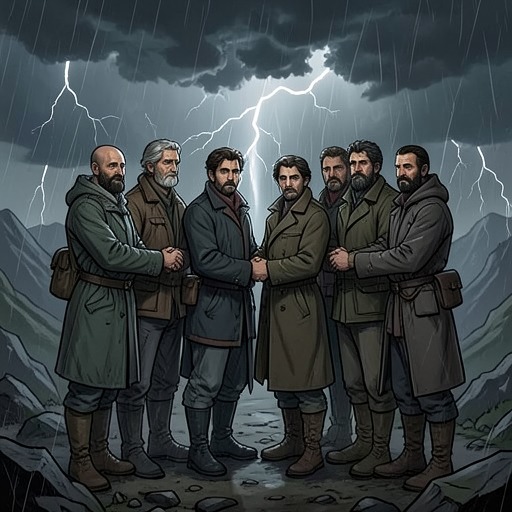
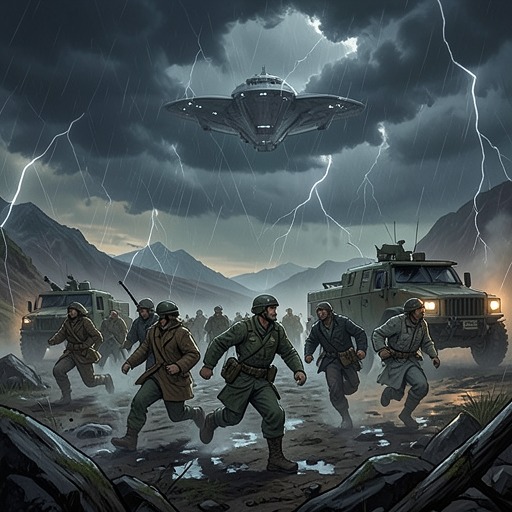
As the witnesses tried to escape through a blizzard, Falkirk ordered a corporal to fire on a Jeep approaching Vista Valley Road from the hillside. Brendan was appalled that Falkirk did not even know who was inside. The soldier, too, hesitated, judging the order improper; Falkirk menaced him and invoked national security, insisting that no innocent civilian would be driving overland around the roadblock in such weather. The corporal finally obeyed. Automatic gunfire shattered the night, bullets broke the headlights and windshield, and the Jeep continued downhill without control before slowing in the snow and stopping about forty feet from the armed men. The witnesses had already recognized that resistance would be futile against Falkirk’s heavily armed force, making the roadside encounter a trap rather than a contest they could win.
Brendan knelt beside one of the wounded men, whose blood had soaked through his clothes at the left shoulder and abdomen. He could not summon the healing that had saved Emmy Halbourg and Winton Tolk; with the stranger’s blood between his fingers, he felt the life ebbing away and raged at his helplessness and at death itself. Then he felt a tingle in both palms. For the first time, he consciously experienced his power as it flowed into the wounded man, and understood it through the image of spinning threads woven into living tissue. The healing had become perceptible to him rather than an unconscious act, and he sensed that the ability was growing: he believed he had become ten times as powerful as when he saved Winton and would be twice as capable the next day. The change was visible in the patient’s body. His eyes focused, the bleeding stopped, and a bullet pushed backward out of his abdomen as the wound closed; Brendan then felt a second bullet working free from the shoulder.
The Jeep’s driver was still inside. Brendan willed the damaged door open, pulled Father Stefan Wycazik from the seat, and laid him on the snow. He found a fatal wound at the base of the throat, alongside a furrow in the skull, and tried to heal him with the same power. But the threads could not mend the dead man. Brendan realized that healing required an empathetic, bilateral process: he supplied the life-giving power, while the patient had to provide a living structure through which it could work. Father Stefan Wycazik had died before Brendan reached the Jeep, leaving no living capacity for the healing to join. Brendan could cure the wounded and sick, but could not raise the dead. He sobbed and persisted in trying despite understanding the limit, returning to prayer as grief overwhelmed him.
The Human Cost of Containment
The shooting makes the conflict between Falkirk’s policy and the witnesses’ survival brutally concrete: his claim that violence is necessary to protect humanity authorizes fire on a vehicle whose occupants he has not identified. Brendan’s response reverses the scene’s purpose. Kneeling in the snow, he uses a power he had not previously understood to save a wounded stranger, while discovering that even this extraordinary gift cannot restore Father Stefan Wycazik. The contrast is not between power and helplessness, but between two uses of power: Falkirk’s coercion produces injury and death, whereas Brendan’s healing depends on a living person and an empathetic connection. His renewed prayer follows the recognition that compassion can mend the living but cannot undo every consequence of violence.