Zebediah Lomack's suicide
StrangersZebediah Lomack's suicide turns a local newspaper story into a disturbing point of connection for Dom Corvaisis: the dead gambler's moon fixation appears to echo Dom's own nightmares and sleepwalking, while the cause of Lomack's death remains uncertain. The discovery of his body exposes the scale of his isolation, but it does not settle whether despair, madness, or the return of a buried memory finally drove him to die.
Background and Discovery
On Christmas Day, a neighbor reported hearing shotgun fire at Lomack's house at 1420 Wass Valley Road. Reno police officers who responded found Lomack dead in the garbage-strewn kitchen. Their investigation uncovered thousands of photographs of the moon, fixed across the walls, ceilings, and furniture. His suicide thus brought a concealed private world abruptly into public view: the photographs were not a passing curiosity but evidence of an obsession that had occupied the house and, increasingly, the man who lived there.
The news reached Dom on January 7, when, after a long winter drive to Reno, he read a newspaper account in his hotel room. The article described Lomack as a fifty-year-old professional gambler and reported that his estate was worth more than half a million dollars. Most of the money was held in savings-and-loan accounts and Treasury bills; the modest house itself was appraised at only $35,000. The contrast between substantial accumulated wealth and a small, secluded home gives the report an unsettling plainness: the estate can be counted, while the private experience that preceded the suicide remains unexplained.
The Gambler's Retreat
Lomack had made most of his money playing poker. Another professional gambler, Sidney Garfork, remembered him as exceptionally gifted, with a natural aptitude for cards. Yet poker winnings did not translate into steadily increasing wealth: Lomack also lost more than half his winnings at craps, and taxes took another portion. The article presents a public identity legible through skill, money, and gambling habits, but those details cannot account for the moon-covered rooms or his death.
Neighbors described a change in his manner over time. Lomack had once been sociable; later he became a recluse. His fascination with the moon had apparently begun the summer before last, and no one besides Lomack had entered the house for more than a year before his suicide. The long absence of visitors helps explain how the images could spread across the interior without anyone intervening. It also marks a progression from withdrawal to a world sealed around a single, increasingly dominant image.
The House and Its Images
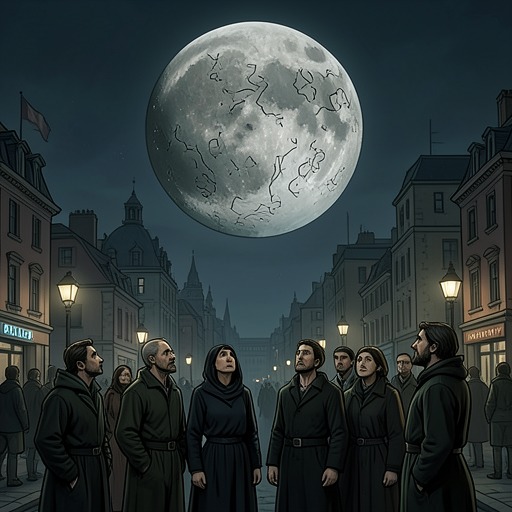
When Dom entered the house, the moon pictures made the scale of the obsession physically immediate. Large posters covered the living-room walls, ceiling, and windows; hundreds of smaller and larger images crowded the hallway and both bedrooms. They were attached with glue, Scotch tape, masking tape, and staples, overlapping until every inch seemed claimed. The variety of pictures did not lessen their force. Together, they made the house feel less like a home than a space taken over by repeated lunar faces.
Dom could not explain the behavior that had produced this display, and he did not experience the pictures as Lomack apparently had. But he recognized a troubling resemblance between Lomack's fixation and the moon imagery in his own dreams. He sensed that some experience shared by the two men had made the moon matter to both of them, whether as part of what happened or as a symbol of it. Their lives had intersected at the same place and time during the summer before last, though the precise nature of that connection was not yet known.
What the Suicide Leaves Unresolved
The account frames Lomack's deterioration as the consequence of stress caused by repressed memories. That explanation gives the moon obsession a possible psychological source without revealing what Lomack remembered or establishing the immediate motive for his suicide. For Dom, the uncertainty is frightening precisely because it leaves more than one possibility open. Lomack may have been overwhelmed by the obsession itself; Dom also considers whether he killed himself after finally remembering what had happened during that earlier summer.
That possibility changes the newspaper report's significance. Lomack is no longer merely a stranger whose eccentricity resembles Dom's symptoms; he becomes a warning that the return of memory might be more terrifying than the nightmares and sleepwalking that precede it. The suicide does not prove that Dom will meet the same fate, nor does it disclose what either man experienced. Instead, it converts a local death into a question Dom cannot dismiss: whether the moon fixation and the buried memory belong to one shared, still-unaccounted-for event.