Bridge
StrikeThe Bridge is a permanent gateway between eras, accidentally created by a nuclear test in the Mojave Desert on January 24, 1952. Its ordinary, doorway-like passage connects the past to a future three centuries later, but the connection also becomes a military supply route and the central vulnerability in the Retros’ invasion plan. When a second blast destroys it, the travelers return to 1952, where the original test is prevented and a new timeline begins without the Bridge.
Definition and Appearance
Olivia explains that the Bridge is not a conventional time machine that can be set to a chosen date, but a gateway between different ages. A rigid frame surrounds its opening in both eras; the frame gives the opening a visible boundary, but does not create or control the Bridge itself. The permanent passage is safe to cross, and travel feels as simple as stepping from one room into another. There is no sensation of motion despite the centuries between the two sides.
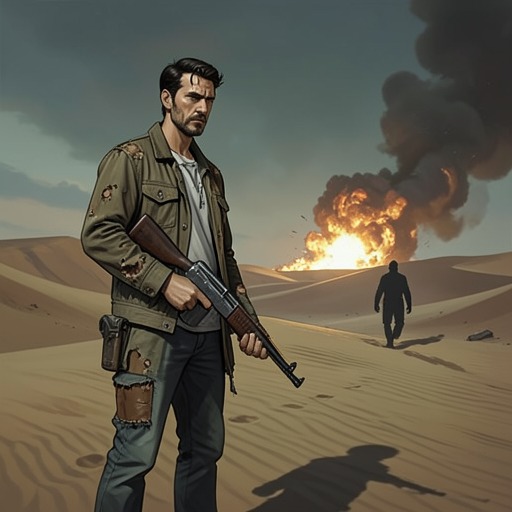
The travelers initially mistake their arrival for a journey to another planet. The desert heat, sand, rocky ridge, and enormous steel dome seem to support the idea, but Tucker recognizes the location as the Mojave Desert and the Retro camp. The revelation makes the Bridge’s strangeness more unsettling rather than less: the travelers have not gone elsewhere in space, but into a different era in the same desert. The future city beside the Bridge exists because of the gateway; Olivia stresses that the rest of the world is not like that city, and is worse.
Creation in Project Alcatraz
The Bridge originates in an effort to contain the destructive effects of nuclear testing. After above-ground detonations spread radioactive fallout, the United States conducted tests underground. Project Alcatraz was an interim experiment: a thick dome was built to contain both the force of a blast and its radioactive material. The single test took place on the morning of January 24, 1952. The dome held, and no radioactivity escaped, but the concentrated blast produced an unforeseen effect: matter accelerated so dramatically that a hole through time opened in the desert.
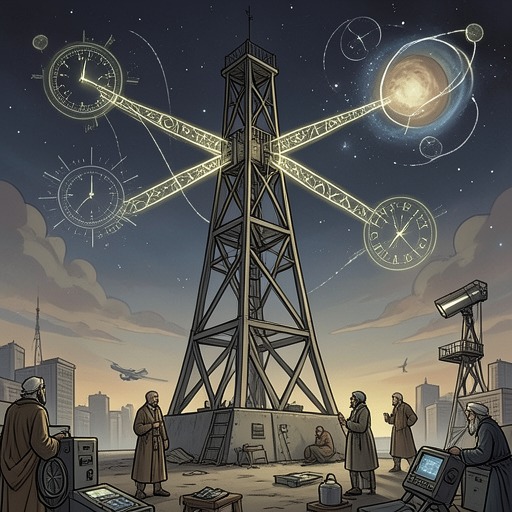
The first person to pass through emerged in the same desert three hundred years later. The Bridge was therefore not a deliberately engineered time-travel device but an unintended consequence of the test. A large frame was later built around the opening, but, as the resistance explains, this structure only defines the passage. Destroying the visible frame would not necessarily seal the Bridge itself. That distinction drives the later plan to reproduce the original kind of event rather than attack its casing.
Passage and Military Use
For the travelers, crossing the Bridge is physically unremarkable: they step through the light and emerge in the past dome, as if passing through a doorway at home. The ease of the crossing contrasts with the enormous historical distance it spans. On the future side, the same passage is embedded in an active military operation. Retro aircraft, soldiers, equipment, and supplies move through it toward the past, while guards manage the traffic like checkpoint personnel. The Bridge turns a fixed location in the Mojave into a channel for invasion.
That logistical function extends beyond the opening itself. Tori identifies an automated shipping depot as the source of the Retros’ equipment: supplies arrive there and are sent onward to the dome in the desert. She infers that plans for additional domes would let other places around the world receive equipment from the depot. The Bridge thus belongs to a larger system of supply and expansion, not merely a route used by individual travelers. In the future, duplicate nuclear devices make the ambition explicit. A domed warehouse holds ten white cylinders, each six feet tall and three feet in diameter, built to match the device used in Project Alcatraz. They were intended to create additional Bridges from the past into the future.
The Plan to Seal It
The Sounders’ plan is to blow up the Bridge, but they understand that destroying its surrounding frame may leave the passage intact. Physicists and engineers working with them theorize that the only way to seal it is to reproduce, on the future side, an event like the one that first opened it. This is a dangerous proposal: when the team enters the future dome, its doors are open, and the blast will have to be contained by closing them. If the dome is not sealed, the city could be destroyed.
The travelers cross back through the Bridge for the final time as the plan reaches its decisive moment. The future-side blast somehow reverses the passage and carries them back to the point in 1952 just before the original test. Tucker offers this as a guess, not a settled scientific explanation. The bomb does not detonate: sealing the emergency pod closes a circuit that sends an alarm to the firing room, and the countdown is stopped when the authorities realize someone is inside. In the past dome, the travelers find that the Bridge has vanished and a white cylinder like the one that exploded in the future stands where the gateway frame had been.
Timelines and Aftermath
The disappearance does not erase the events that produced the future the travelers knew. Olivia explains that the past and the twenty-fourth century are separate timelines connected by the Bridge; once events have happened, they cannot be made not to have happened. The future timeline, including the destruction wrought by the Retros, continues to exist, but its forces can no longer invade the twenty-first century through this passage. A third reality begins on January 24, 1952: the travelers’ new timeline, in which the Bridge was never opened and the Retro invasion cannot occur.
The travelers have no assured way back to their original times. Even if another Bridge were created, there would be no guarantee that it would lead to the right moment in their former lives. Their passage has therefore ended not in a return home but in permanent exile from their own realities. The Army dismantles the dome, and Project Alcatraz is abandoned rather than revived. With the Bridge gone, the route that connected the eras is closed, and the secret of the other timeline is left to die with the people who encountered it. The gateway’s final consequence is both strategic and personal: it prevents another invasion through this connection, but cannot restore the lives or histories lost on either side.