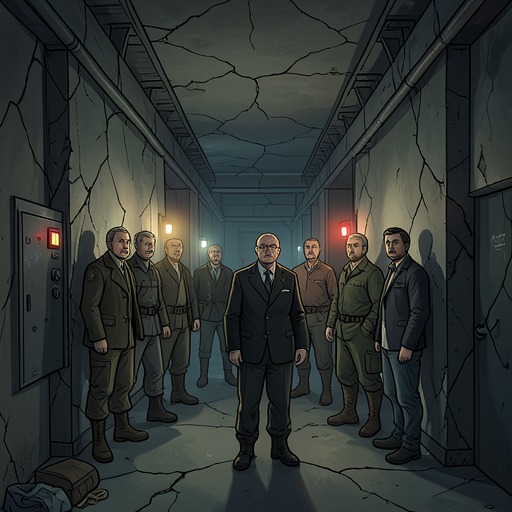
Project Alcatraz Dome
StrikeThe Project Alcatraz Dome is both a monument to an experiment that escaped its intended limits and a strategic hinge in the conflict between SYLO and the Retros. Designed to contain a nuclear explosion, it did its job physically: the blast did not rupture the structure, and radioactive material did not escape. But concentrating the explosion inside the dome produced something no one had planned for: a passage through time. In the future, the installation is no longer merely a test enclosure. It is bound to the Bridge, the movement of military supplies, and a plan to colonize the past.
Structure and First Appearance
When Tucker Pierce and his companions reach the dome, they run toward a vast steel structure while missiles strike nearby. Its curved exterior rises so high that they cannot see its top; from close by, it resembles an enormous steel igloo. Inside, the scale is more disorienting still. The cavernous space is empty, its floor strikingly clean, and heavy steel girders rise toward a peak roughly forty stories overhead. The apparent absence of soldiers, aircraft, machinery, or any clue to the purpose of the building makes the empty interior feel less like a conventional military base than a shell awaiting explanation.
Two reinforced pods are set into opposite sides of the dome. Their rounded, egg-like shapes, open hatches, walls more than a foot thick, and red emergency lettering mark them as small, heavily protected rooms within the immense open space. They are among the only visible objects inside. The contrast between these compact refuges and the huge, vacant enclosure underscores how little the group initially understands about what the dome was built to contain—or protect.
The Bridge and the Dome’s Hidden History
Olivia identifies the site as the Nevada Test Site and explains the history that gives the dome its significance. After hundreds of nuclear devices had been tested there, first above ground and later underground to limit radioactive fallout, Project Alcatraz represented an interim approach: a structure intended to contain both the force of a blast and its radioactive material. Olivia suggests that the project’s name may refer to the prison, while acknowledging that she does not know the connection.
The decisive test took place on January 24, 1952. The nuclear device detonated inside the dome without blowing it apart or releasing radiation, as intended. Yet, by containing and concentrating the explosion, the experiment accelerated matter to an extraordinary degree and opened a hole through time. Those who passed through emerged in the same desert three hundred years later. The dome’s success as a containment structure thus became inseparable from its unintended success as the site of a temporal rupture.
Olivia distinguishes that rupture from the rigid frame built around it. The frame defines the opening but does not create or sustain the Bridge; traveling between the two eras is like passing through a doorway. This distinction matters to the resistance: destroying the visible frame could leave the Bridge itself intact. The dome, the frame, and the temporal passage are connected, but they are not interchangeable parts of one mechanism.
A Military and Colonial Gateway
In the future, the installation is associated with the flow of equipment used by the Retros. Tori Sleeper interprets the Bridge apparatus as an automated shipping route: supplies pass through it and emerge at the dome in the desert. That would explain why the prisoners saw no deliveries at their camp and why the Retros were building additional domes, apparently to distribute equipment to other locations. Her account makes the otherwise empty structure legible as an outlet within a much larger logistical system, not a factory stocked with aircraft or soldiers.
That logistics serves a political project as well as a military one. Sounder leaders explain that the United States government and military have spent years preparing an invasion intended to replace the population of the twenty-first century with people from the twenty-fourth. Colonization training includes instruction in maintaining clean-water filtration systems and doing so without relying on surviving natives. Against this background, the dome’s orderly machinery and the prisoners’ imposed numbering belong to the same administrative world: the invasion is organized as a program of supply, labor, and population replacement, not simply as a battle for territory.
The Dome as a Target
The Sounders’ plan turns the dome’s original function against the invasion. Their physicists and engineers believe that sealing the Bridge may require another event resembling the one that opened it. The plan is to smuggle a nuclear device into a dome, close it, and detonate the device inside. They cannot be certain that the explosion will seal the Bridge. Even if it fails, however, the radiation trapped within the structure could delay the invasion and give SYLO time to regroup and prepare a stronger defense.
The plan depends on recognizing what the dome can and cannot do. Conventional sabotage might destroy the frame without closing the Bridge, while a contained nuclear explosion offers a chance to reproduce the conditions of the original event. The dome’s meaning therefore reverses across its history: first a device for containing a test, then the accidental birthplace of a passage between eras, and finally a potential instrument for closing that passage. Its empty interior, once a source of confusion for Tucker Pierce’s group, becomes the critical space in which the future’s invasion might be stopped.