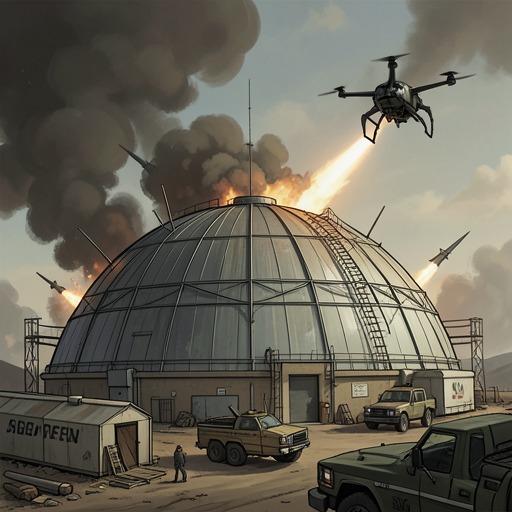
Retro combat drone
StrikeRetro combat drones are the aircraft that make Retro air power visible as both a battlefield force and a technological mystery. They hover close to the ground, move from the dome into active combat, and attack targets in the city; a smaller version can issue commands and identify people. Most strikingly, one fighter appears to emerge from a glowing screen, leading Tori Sleeper to conclude that the screen creates the aircraft rather than merely admitting them.
Form and capabilities
The drones are described as black, stingray-shaped craft with a musical engine tone. In one encounter, a fighter drifts out through the enormous opening in the dome only a few feet above the ground. It moves slowly while clearing the frame, then accelerates sharply and rises into the sky to join a dogfight. The contrast between its measured passage through the doorway and its sudden speed once outside reveals a craft capable of controlled low-altitude hovering as well as rapid flight.
Their distinctive engine sound is also a recurring identifying feature. The characters hear music before seeing an approaching craft, and Tori recognizes that a miniature drone emits the same faint tone as the larger aircraft. The sound therefore links devices of different sizes and helps announce the drones before they are fully visible. It becomes part of the characters’ practical awareness of danger, not merely a detail of their appearance.
Emergence from the screen
The drones’ role in the dome shifts from deployment to apparent manufacture. While the group watches the open entrance, a fighter’s nose appears from a glowing screen beside them—not from the doorway. The observers can see both sides of the screen, and the aircraft appears to come out of the image itself. Tori interprets this as the screen creating planes without needing parts or workers. That explanation is her inference from what they witness, but the scene presents the appearance as a rupture in their assumptions about how the Retro force supplies its aircraft.
The apparent production mechanism gives a concrete explanation for the scale of the aerial threat. Four opposing jets pass in the distance while six Retro fighters pursue them, and the characters judge the battle unlikely to last much longer against such numbers. The screen’s apparent ability to produce aircraft makes the imbalance more alarming: the drones seem not only numerous but connected to a source of supply that the group cannot explain through ordinary assembly. The scene leaves the mechanism unresolved while making its military consequence immediate.
After the group passes through the screen, the dome on the other side is crowded with drones. A long queue begins just inside the huge doorway and stretches outward beyond sight. The craft wait one behind another, hovering a few feet above the ground as they take turns moving into the dome and through the portal. Their shared engine tones fill the space, while the orderly line makes the earlier single emergence appear part of a larger process. The dome is no longer an empty structure: it has become a staging route for a continuing flow of aircraft.
Surveillance and lethal force
A smaller drone, with a wingspan of about four feet, demonstrates that the same technology operates beyond the full-sized fighters. It approaches from above and carries an amplified voice that orders an unauthorized group to drop its weapons and submit to scanning and identification. The intended targets are Retro soldiers who belong to the Sounders, rather than the newly arrived group watching from the exposed rooftop. This encounter gives the drones a surveillance and identification function as well as a combat one.
The command does not lead to detention. Another hovering craft rises above the roofline from the street and fires, killing a Retro soldier. The episode establishes the drones as lethal enforcement tools and shows that their presence can turn an exposed gathering into an immediate threat. Their capacity to locate and attack people also changes the meaning of the Sounders’ encounter with them: the aircraft are not simply instruments in a distant air battle but a danger within the city itself.
Later, two Retro attack planes hover above a building and pulverize the location of Olivia’s former apartment. The attack follows the group’s discussion of whether the Air Force knows about the Sounders; Olivia then remarks that she appears to have been dishonorably discharged. The sequence connects the aircraft’s destructive reach to the danger facing members of the resistance, although it does not establish the operators’ precise motive. The destroyed apartment makes the conflict personal and gives the drones’ violence a consequence beyond the immediate rooftop encounter.
Narrative significance
The drones are introduced through a sequence of expanding revelations. First, one fighter emerges from the dome and joins a dogfight; then another appears directly from a screen, challenging the assumption that aircraft must enter through a physical doorway. The later queue of drones shows the scale of what the characters have seen, while the miniature model and the attack in the city establish surveillance and lethal force as further aspects of the same threat. Each recurrence widens the object’s significance without fully explaining its technology.
The screen scene also turns the drones into evidence about the world around the characters. When Tori identifies the screen as a possible source of aircraft, their attention moves from counting planes to asking how such numbers are possible. The craft’s physical passage through a frame—and its apparent arrival from an image—makes the dome an active participant in the conflict rather than just its setting. Across the scenes, Retro combat drones embody an unsettling combination: familiar military purpose, conspicuous and repeatable signs of advanced technology, and a means of attack that reaches from the aerial battlefield into the places where the Sounders seek shelter.