The Mojave dome
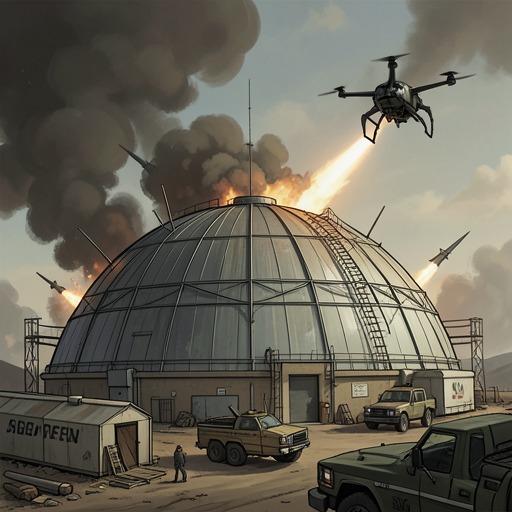
StrikeThe Mojave dome is a vast steel structure in the Mojave Desert that turns a prisoner work camp into the foreground of a larger war. Retro aircraft emerge from it, military forces protect it, and its presence is tied to new barracks intended to accommodate many more people. To Tucker, the structure is more than a fortified installation: it is the place from which the attacks are being launched and the key to discovering what the war is about.
Form and First Appearance
Tucker first sees the dome from a construction site where prisoners are building additional barracks. It stands only a few hundred yards away, looming over the new structures like a steel igloo. The recognition is immediate and chilling: the dome is the gate to hell, a name that joins its imposing shape to the destruction Tucker has already witnessed. His first view is also accompanied by the familiar music of a black Retro-style attack aircraft. The craft rises vertically beside the dome, clears its top, and then speeds away, making the structure’s connection to the Retro air force visible rather than merely suspected.
The setting sharpens that discovery. Tucker is a prisoner among workers in orange clothing, assigned a number and facing forced labor as his immediate future. The dome is not an isolated landmark glimpsed from a distance; it stands beside the expanding camp where he has been taken. Its scale makes the individual prisoner seem powerless, while the working barracks around it suggest an organized operation already preparing for more people. From the outset, the structure binds military power to the system of captivity surrounding it.
Prison Camp and the Invasion Prospect
When Tucker asks why the prisoners must build so many barracks, a guard answers that the buildings will soon be filled with many more people and that this is the point of the work. The answer does not, by itself, specify who will arrive or exactly how the expansion will proceed. But it turns the construction site into evidence of a plan larger than the imprisonment of the people already there. Tucker asks whether the plan amounts to an invasion, and later concludes that the new buildings are intended to house an invasion force.
The dome gives that prospect a military center. Tucker has already seen a Retro fighter emerge from it before the helicopter carrying his group was attacked and brought down nearby. He had believed that the destruction of the Retro fleet at Area 51 had defeated the opposing air force. The dome revises that understanding: aircraft are still coming from somewhere, and the force that attacked them may be rebuilding. Tucker’s fear that a replacement fleet could resume the purge of the population follows directly from this evidence. The installation therefore changes the meaning of the apparent victory at Area 51: destroying one fleet has not ended the threat while the dome remains active.
Strategic Importance and Attack
Tucker later studies the dome with Kent as morning light spreads over its silver shell. He argues that SYLO has tried to destroy it more than once and had reduced the Boston structure to dust; he also suspects that other domes may be under construction. In his assessment, however, this one is decisive: attacks are being launched from here, and the barracks are being built to support an invading force. He treats access to the structure and an explanation of its purpose as necessary to understanding the war. Survival and patience become the immediate means of pursuing that larger objective while the group remains imprisoned.
The dome’s apparent strength is tested when an aerial attack reaches the camp. Explosions strike its surface and the ground beyond it. Retro fighter planes lift vertically from around the structure and form a protective perimeter, while others fly to meet the attackers. Four more jets arrive over the mountains and fire missiles toward the dome. The sequence establishes that the installation is not simply a launch point: it is also defended by aircraft ready to rise from its vicinity and protect it. The camp’s prisoners are caught between the attack and the response, with no assigned shelter or clear instructions; the soldiers, by contrast, run to their posts or shelters.
The attackers have not come to rescue the prisoners. Their missiles are directed at the dome, making the strategic objective plain even as the people in the camp remain exposed. A Retro soldier knows that the strike is coming and is revealed as a Sounder. That disclosure connects the assault to resistance within the Retro forces and suggests that the dome’s defenders are not the only people who understand its importance. The attack thus exposes both the structure’s value as a military target and the possibility of opposition embedded within the force protecting it.
Narrative and Thematic Significance
The dome repeatedly reorganizes what the characters know. At first, its appearance confirms that the Retro air force survived the loss at Area 51. Later, its proximity to the construction site helps Tucker connect forced labor, incoming people, and the prospect of invasion. During the aerial attack, the aircraft rising around it show how the installation is defended, while the strike reveals that SYLO considers it worth attacking despite the danger to prisoners nearby. Each encounter adds a different dimension without fully disclosing the structure’s internal workings.
Its dramatic force also comes from the contrast between its monumental presence and the limited choices available to those beneath it. Prisoners build the barracks around it; aircraft emerge beside it; jets attack it; and people caught in the camp must seek whatever cover they can find. Tucker’s description of it as the key to everything is a judgment formed under these conditions, not a complete technical explanation of the dome. Within the evidence available to him, however, it is the visible point where military production, threatened invasion, imprisonment, and resistance converge. The dome gives the war a location the characters can see, approach, and attempt to understand, even while its power keeps their immediate fate uncertain.