Retro energy baton
StrikeThe Retro energy baton is a black, charge-firing weapon that gives the Retros a means to enforce obedience through the threat—or use—of electrical force. Its setting can make a charge merely corrective or lethal, and its presence changes how prisoners move, speak, and respond to orders. In the prison camp, the baton is not only a weapon carried by individual soldiers: its repeated use helps make coercion a public system, from a guard’s warning to the synchronized silencing of a crowd.
Appearance and Operation
The baton is identified as a black weapon carried by Retro soldiers. Tucker recognizes its capacity for harm from experience: its charge can incapacitate someone or kill, depending on the setting. The weapon therefore operates through a range of force rather than a single fixed effect. That flexibility allows soldiers to present a low charge as routine correction while retaining the threat of a far more serious consequence.
The account also describes a woman guard using an electronic device to deliver a painful jolt to Tucker after he speaks when ordered not to. The narration does not identify that device as a baton, so the two should not be treated as the same object. The incident nevertheless establishes the larger role of electrical weapons in the camp’s discipline: an order is backed by a device that makes disobedience immediately costly. The baton’s later appearances give that coercive principle a recognizable form, carried openly by guards and used in front of prisoners.
Discipline and Everyday Control
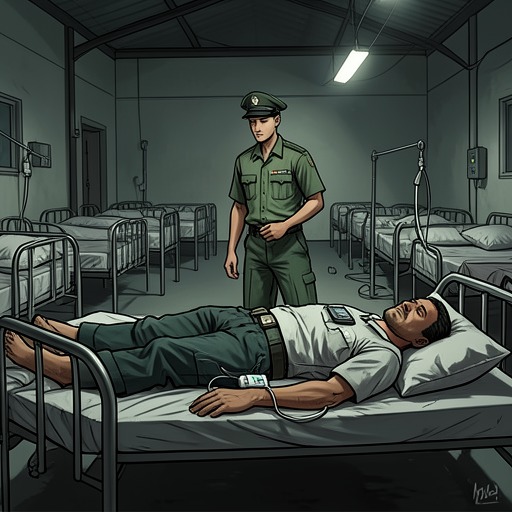
A guard escorts Tucker from the medical ward while carrying the baton. Tucker knows what it can do and follows the soldier between the rows of beds, past patients who stare blankly upward, without approaching them. The weapon shapes the passage even before it is used: the armed escort determines where Tucker walks and keeps him from lingering among the wounded. Later, after Tucker leaves a white-domed treatment unit, a guard uses the baton on a deliberately light setting. The brief charge is intended to keep a rowdy prisoner in line, illustrating how the weapon can turn physical punishment into a calibrated warning.
The baton’s power also rests on what prisoners have already seen it do. Tucker recalls using one to threaten Colonel Feit, then a senior officer in the United States Air Force. Fear of being struck helped persuade Colonel Feit to turn a large attack craft away from a mission that would have wiped out the remaining population of Los Angeles. The recollection gives the weapon significance beyond the camp: even a threat, without a shot being fired, can redirect the actions of a powerful opponent. In the prison, that same capacity for intimidation is brought down to daily scale, where a soldier’s possession of the weapon can discipline one captive at a time.
Major Bova and the Weapon as Spectacle
Major Bova makes the baton part of a deliberate ritual of humiliation. When a kneeling prisoner reaches for a canteen, Major Bova violently kicks the prisoner’s hand away. The prisoner falls, and Major Bova points out that he has not said the required word, turning access to water into a test governed by his arbitrary rules. A soldier then wipes Major Bova’s boots with his sleeve rather than helping the prisoner. The baton is not used in this exchange, but the episode establishes the unequal order in which its use takes place: even basic need is made conditional on obedience, and the surrounding soldiers enact the commander’s authority.
Later, as Major Bova is about to leave, he turns back, takes a black baton from a guard’s belt without stopping, and approaches the same kneeling prisoner, who is still holding the canteen aloft. Major Bova offers a show of regret for having failed to say the required word and raises the weapon toward the prisoner’s chest. The sequence makes the baton the instrument of a punishment whose rules Major Bova invents and controls. Its force lies not only in the charge it can deliver, but in the way its appearance closes off any hope that the ritual might end harmlessly.
In another confrontation, Major Bova arrives carrying a baton after a fight among prisoners. He addresses the scene as if it were a performance, praising its drama and contrasting the fight’s apparent fairness with betrayal and self-sacrifice. Tucker recognizes that the weapon makes a direct attack on Major Bova futile: approaching him would leave Tucker exposed to being shot before he could do damage. Major Bova subsequently uses the baton against a prisoner whose attempt to gain his approval has failed. He fires at the man, who dies. Here, the weapon ends the exchange with sudden finality; the commander’s theatrical attention to the struggle gives way to the unanswerable authority of the armed officer.
Crowd Enforcement and Narrative Significance
The baton also works collectively. When prisoners react to the revelation that Tucker’s mother is among them, Major Bova orders discipline. The surrounding Retro soldiers turn inward, raise their batons, and fire into the crowd. The charges do not injure or knock the prisoners unconscious, but they make the intended message unmistakable: the crowd falls silent. Unlike Major Bova’s lethal use of the weapon against an individual, this coordinated discharge applies controlled force to many people at once, converting a potentially rising murmur into enforced quiet.
The weapon’s changing settings and settings of use expose the breadth of camp authority. It can serve as a warning, a means of keeping a prisoner in line, a credible threat against an armed adversary, or a means of killing. Its repeated appearances connect private intimidation to public discipline, and individual command to organized force. The baton is consequently more than equipment in these scenes: its visible presence and adjustable violence help make the Retros’ control legible, while each charge demonstrates how easily that control can move from restraint to punishment.