Healing potion
StrikeThe Healing potion is a powerful restorative medicine whose repeated use turns survival into a double-edged prospect: it can return the injured to physical strength, yet its availability is bound to the Retros who hold them. Its effects are immediate enough to shape both the characters’ hopes of recovery and their understanding of the regime’s medical and labor systems. The book does not explain its ingredients or mechanism; instead, it establishes what it can do through successive recoveries and through the uneasy circumstances in which it is administered.
Form and Administration
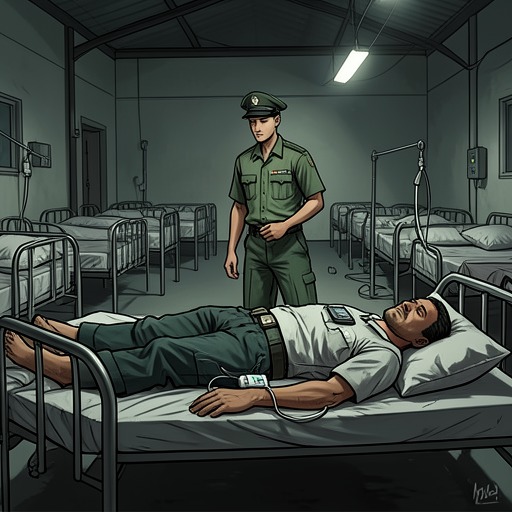
The medicine appears in more than one form. When Tucker wakes under Retro medical care, he realizes that the staff have given him the same miracle medicine previously used to heal Tori Sleeper’s gunshot wound and bring Colonel Feit back from the brink of death. He suspects that it is being delivered through the IV connected to him. His recovery is therefore inseparable from a disturbing recognition: the treatment has worked, but he is in the hands of the Retros.
A later episode suggests that the medicine can also be given in water. After a long, dehumanizing workday, Tucker washes and dresses, then notices that his hands—previously badly blistered—look and feel normal. He reasons that the shower water contained the same healing substance he has seen work before. The text presents this as Tucker’s inference rather than an independently explained property of the medicine, but the episode broadens its apparent use beyond treatment in an infirmary. Recovery can be built into the ordinary facilities of the Retro camp.
The substance is distinct from Ruby. Tucker observes that the Retros are not forcing prisoners to take Ruby and sees no sign that the people around him possess superhuman abilities. He understands Ruby as a dangerous means of enhancing capability, one whose short-term benefits are outweighed by its fatal cost. The Healing potion, by contrast, restores physical condition without being shown to grant extraordinary strength. This distinction matters in a camp where medical treatment and bodily control coexist: healing is not the same as enhancement, and neither implies freedom.
Recoveries and Limits
Tucker’s own recovery makes the medicine’s power tangible. After being gravely battered, he expects pain, dizziness, nausea, and fatigue when he stands. Instead, he finds himself physically well. The sudden contrast between the body he remembers and the strength he now feels confirms that the treatment has repaired more than a minor wound. Yet this restoration brings no certainty about his mother or friends, and his immediate need to learn what happened to them remains. The potion can restore his body; it cannot answer the questions that make him afraid to leave the infirmary.
Kent Berringer’s account shows both the scale and the limit of that restoration. Following the helicopter crash, he had a broken back and severe pain. The Retros knocked him unconscious, and when he woke again his body was sufficiently repaired that he could move. Later, after a beating leaves him struggling with pain and possible broken ribs, Tucker proposes taking him to the medical building, confident that the medicine will repair him. That expectation rests on Kent’s earlier experience as well as Tucker’s own recovery.
Kent’s account also makes clear that physical repair does not undo suffering already experienced. He remembers the intense pain before he was knocked out and says that the medicine may heal the body, but does not make the patient forget the pain. Its effect is therefore not a reversal of the whole injury as lived: the physical damage can disappear while the memory of what happened remains. This limit prevents the medicine from becoming a complete erasure of violence, even when the outward signs of injury vanish.
Tori Sleeper’s recovery offers another instance. After the crash, she wakes in the infirmary connected to an IV and discovers that she is well, including that the gunshot wound she received on a Retro plane has healed. She does not know what happened to Tucker’s mother, and the medicine cannot give her that knowledge. Across these cases, bodily repair repeatedly arrives alongside unresolved danger, loss, or uncertainty.
Medicine Within the Retro System
The Retros’ use of the Healing potion has a practical function beyond treating individual emergencies. Tucker concludes that they can use it to keep their workforce in top shape. The apparent presence of the medicine in shower water, following a day of labor, suggests a system in which restoration can support continued work as well as rescue the gravely injured. The same substance that saves a patient can help sustain the conditions that made care necessary.
That function sharpens the moral ambiguity of treatment under Retro control. Tucker acknowledges the relief of being clean, dressed in fresh clothes, and physically less sore, while also questioning how the Retros’ project could be called a positive reset of civilization. The treatment is genuinely beneficial to the people whose injuries it repairs; its benefit does not make the surrounding labor regime humane. Medical effectiveness and political legitimacy remain separate questions.
The potion thus recurs as a material sign of survival without safety. It enables Tucker, Kent, and Tori to recover from injuries that would otherwise leave them incapacitated, and it may help the Retros maintain their labor force. But it neither removes the memory of pain nor resolves the prisoners’ captivity, losses, or uncertainty. Its central significance lies in that divide: bodies can be restored even while the people in them remain vulnerable to the system providing the cure.