The Troubles
TrespassesThe Troubles is the novel’s governing condition: a conflict that appears in news montages and political upheaval, but is also felt in school corridors, at checkpoints, in family businesses, and in the boundaries between neighborhoods. Violence is neither a remote spectacle nor a single continuous battle. It becomes part of the vocabulary and expectations of daily life, while political allegiance and communal identity shape who can move safely, whom people trust, and what forms of help carry a cost.
The conflict as everyday knowledge
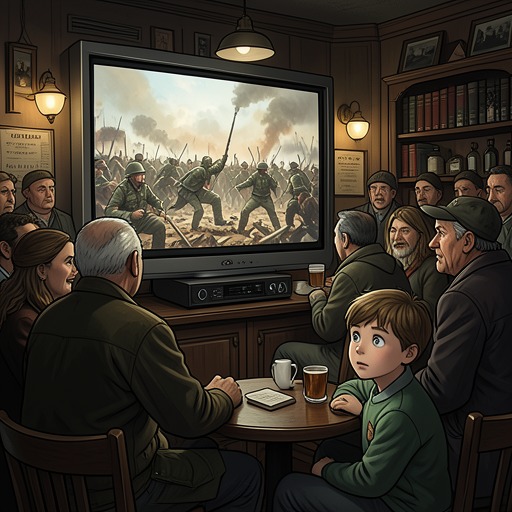
The novel introduces the conflict through repeated television images. A familiar news montage includes a riot, a young boy climbing onto a Saracen personnel carrier, a march toward Stormont, and a parked car that suddenly explodes. The sequence ends with Mary Peters holding her Olympic medal, placing a nationally shared sporting image beside scenes of political violence. The juxtaposition gives the news its routine form: alarming images recur, yet they sit within the same broadcast as familiar public occasions.
Other reports assemble the conflict from stark fragments: a police Land Rover on a country road, masked men speaking to microphones, and a damaged pub. News also brings reports of an unidentified man found dead in East Belfast and of arrests connected to an arms cache near the border. These reports do not provide a comprehensive explanation of each incident. Instead, their accumulation makes uncertainty itself part of the atmosphere: a death may be announced before the victim is identified, and an arrest may be linked to weapons without resolving the wider danger.
For children, this atmosphere becomes a practical vocabulary. The list they know includes booby traps, incendiary devices, explosives, petrol bombs, rubber bullets, armored vehicles, internment, and the Special Powers Act. The detail matters because it shows how political violence enters childhood not only through images but through learned terms. The conflict is something children are expected to recognize and name before they can understand its full history or consequences.
Political division and public space
The conflict alters the use of streets and institutions. A march proceeds toward Stormont, while later political crisis is shown through the strike that seeks to dissolve the power-sharing government. In the novel’s account of that strike, paramilitaries parade openly and the Chief Executive announces the government’s collapse. A poster opposing the political settlement precedes images of the Dublin bombings. By placing the poster and the aftermath of the explosions in the same news sequence, the narrative links political opposition to the damage that civilians encounter, without reducing the conflict to a single cause or actor.
The strike also changes ordinary commerce. Businesses and shops begin to close; pubs remain open at first, then are ordered to shut. At the Lavery family’s bar, Eamonn considers booking a band for the upstairs lounge, recalling the brief period when drinkers came from the city to escape the chaos. That trade did not last: people became afraid to go out. The family’s business therefore registers the conflict as a change in habit and livelihood, not just as a political event reported from elsewhere.
A checkpoint makes the division personal for Cushla. During the strike, a man she has known most of her life stops her at a paramilitarized roadblock and pretends not to recognize her. She is occupied afterward with an empty fuel tank and a bare larder, and only once the strike ends does she fully register what the encounter meant: she had been barred in the name of preventing people like her from participating in government. The delay between the encounter and its recognition shows how immediate practical needs can obscure the political meaning of an act until later.
Armed presence and contested authority
Military and police presence is a recurring feature of the landscape. At Gerry’s wedding reception, the hotel booked by his friends has been firebombed, so the gathering takes place at a leisure centre. Soldiers patrol nearby, and a Saracen passes through the scene. The painted anti-British slogan outside the venue makes the replacement location more than an inconvenience: even a wedding is reorganized around damage, security, and political hostility.
Police buildings and personnel are likewise depicted through security arrangements. One small station is dwarfed by a high fence and coils of barbed wire, with an officer alone in a sentry box. Cushla remembers knowing the local police, but now personnel are moved frequently for their safety and do not remain in one place for long. The change suggests an institution made less accessible and less locally familiar by the conditions in which it operates.
Responsibility for violence is not presented as belonging to one uniformed or clandestine force alone. The report of two Catholic civilians shot dead in a house in Mount Vernon attributes responsibility to the Protestant Action Force. Elsewhere, the city’s history includes the Irish Republican Army bombing the statue of a dead preacher at Carlisle Circus. These distinct episodes show political violence reaching both living residents and inherited public symbols; they do not make the actors or their aims interchangeable.
Sectarian boundaries and social consequences
Communal separation is made visible in the geography of the city. When Cushla drives Betty and Seamie toward the Catholic enclave where Seamie’s brother lives, they pass the waste ground where Seamie was left for dead. At the enclave’s perimeter, an RUC Land Rover blocks the road and shipyard cranes rise over the rooftops. The route joins a personal history of violence to a divided urban map: reaching family means crossing into a space marked by policing, communal identity, and the memory of an assault.
The conflict also unsettles trust within relationships that predate it. During the strike, Minty stands outside the locked school gates with students after Father Slattery has ignored police advice to close the school. Cushla approaches him with open arms, but he looks away. Later, she understands the checkpoint encounter with the man she has known most of her life in similarly political terms. Familiarity offers no guarantee of recognition or solidarity when communal boundaries harden.
Rumors flourish in this climate. Stories about ritual animal killings, a boy’s death, and supposed threats to girls circulate among children; Cushla finds it difficult to persuade them that some stories are false when murder has become commonplace. The novel distinguishes rumor from confirmed events, but shows why rumor gains force: repeated violence makes frightening explanations seem plausible, and children inherit anxieties whose sources they cannot readily assess.
Political violence in intimate life
The conflict’s effects extend into religion, school, and family. Father Slattery’s authority at the parish school is already resented by Cushla, who recalls that he visited her delirious father in hospital and persuaded him to write a cheque for a television. In school, Slattery tells children a story of sectarian violence as part of his religious instruction. His use of fear connects public conflict with institutional authority, while Cushla’s discomfort reflects a competing concern for the children exposed to that lesson.
Religious practice itself carries contrasting meanings. Before Davy’s First Communion, Cushla chooses a navy missal, silver rosary beads, and a St Joseph novena card. The objects recall familiar devotional customs, but she also sees them through Michael’s perspective as mass-produced religious goods and feels the moral unease of bringing them home after a secret weekend with a married man. At school, by contrast, Slattery presents First Confession through original sin, remorse, and strict penance, warning that the length of a child’s time kneeling will reveal the extent of sin. These scenes do not make faith identical with political violence; they show how religious objects and authority can provide comfort, intensify guilt, or be used to discipline children.
Political consequence reaches the Lavery family in material form. As the strike empties the streets and changes who will enter the bar, the business declines. Catholics drift away rather than appear to condone the family’s sheltering of the McGeowns; Leslie drinks where soldiers drink, and Minty no longer acknowledges Gina in town. The shrinking clientele turns assistance to a displaced family into a visible social liability. The pressure is sharpened when Cushla’s school position is judged untenable because she befriended and sheltered the family, including after one member was arrested for murder. The conflict thus makes compassion consequential: it can place both community standing and employment at risk.
Recurrence, aftermath, and narrative significance
The novel repeatedly returns to news and remembered scenes rather than treating political events as a single explanatory backdrop. In one later broadcast, footage of the strike is followed by the Dublin bombings on the anniversary of the workers’ industrial action. Cushla watches while wiping the bar counter, and the remembered sequence ends with her recognition that silence is easier than forgetting. Domestic work continues beside televised political history; the movement of a cloth along the counter does not erase what the images recall.
That pattern of recurrence is also built into the city’s physical traces: a damaged venue, a guarded road, the waste ground where Seamie was attacked, and the route to a family member’s home. In the final account of the bombing at the Lavery bar, an explosive device has been left in an empty beer keg. Police receive an anonymous warning fifteen minutes before it detonates, allowing the bar to be evacuated. Eamonn watches from between two RUC officers. The warning prevents deaths, but its unexplained timing offers no dependable security; the family can only suspect that someone has intervened on its behalf.
The Troubles therefore shapes the novel through a repeated tension between survival and exposure. News can announce another death or explosion without resolving its meaning; a checkpoint can turn acquaintance into estrangement; and a decision to shelter vulnerable people can narrow a family’s social and economic world. The conflict persists not only in public violence but in altered routines, guarded spaces, remembered routes, and the uncertain forms of protection people manage to find.