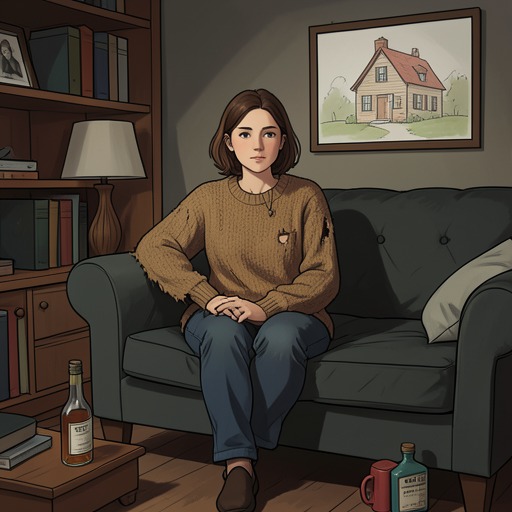
Gina Lavery’s alcoholism
TrespassesGina Lavery’s alcoholism is revealed not through an explanation of its origins but through what it leaves behind: hidden bottles, a crisis at home, and her daughter’s increasingly direct recognition of the problem. The episode in which Cushla Lavery finds and gathers the bottles makes private drinking materially visible; later scenes show how alcohol persists as a feature of their shared family life, even as Cushla is grieving Michael Agnew.
Discovery and Immediate Care
At home, Cushla first notices that Gina is absent from the kitchen. She finds her in the bath, shivering and unable to speak clearly, with a cut near her eye. Cushla closes the tap, helps her mother, and stays close to keep her conscious and settled. The scene presents the consequences of Gina’s drinking through the practical demands placed on her daughter: Cushla must assess what has happened, clean and tend to her mother, and get her into bed. The focus remains on care rather than on explaining Gina’s condition or assigning a cause to the accident.
Once Gina is in bed, Cushla sees something under it and discovers a bottle of Gordon’s gin. Searching further, she finds empty half-bottles among Gina’s clothes, small bottles tucked into handbags, and more in the spare room. Their concealment gives the search its shape: the evidence is distributed through the house and hidden among ordinary belongings, so that finding one bottle leads Cushla to look for others. The stash is not confined to one private hiding place; it has entered bedrooms and storage spaces across the family home.
The Extent of the Hidden Drinking
Cushla brings the bottles together in the hall, behind the telephone, then continues checking rooms and cupboards. She finds five bottles in the fish kettle used for cooking, three behind a pipe under the sink, and another in the toilet cistern. A bottle with some gin remaining is on the sitting-room hearth. By the time she sits on the stairs, twenty-nine empty Gordon’s bottles are gathered in the light from the fanlight, with the partly filled bottle added separately. The count makes the scale of the concealed drinking difficult to dismiss: a collection assembled from separate hiding places becomes a single, visible record.
The search also makes Cushla confront the effort involved in keeping the drinking out of sight. Bottles are hidden among Gina’s clothes and household objects, and Cushla imagines her mother going into town to buy more. The scene does not establish every circumstance of Gina’s drinking, but it does show that the bottles have accumulated well beyond a single isolated occasion. Gina sleeps while Cushla gathers them; the daughter, rather than the drinker, is left to piece together the extent of what has been happening.
Cushla waits on the stairs, smoking and trying Michael Agnew’s flat twice without reaching him. Shortly before six, she calls the pub and tells Eamonn Lavery that their mother’s drinking is out of hand. Her message is direct: there are bottles throughout the house, and Gina is frequently drunk. This is a change from private discovery to disclosure within the family. The evidence records Cushla making the call, but does not establish what Eamonn does in response.
Drinking and Family Intimacy
Later, Gina’s drinking appears in a different register. After an evening together, Gina jokes about Cushla missing work because of drink. The previous night, Gina had brought home a bottle of Teacher’s in her handbag, described as stolen from the bar, and mother and daughter drank together at the kitchen table. As they drank, Gina told Cushla stories about Michael: his arrest with her uncle at an early civil-rights march, and his buying a drink for every customer in the pub on the night his son was born. The stories briefly make Cushla feel close to Michael through her mother’s memories of him.
By morning, the intimacy of that evening has altered. Cushla sees the shared drinking and the stories differently, and her physical discomfort makes the cost of the night immediate. Gina nevertheless goes downstairs and tells Bradley that Cushla is ill, shielding her from work. The episode therefore combines care with the normalization of drinking: Gina helps her daughter, yet the situation follows a night when Gina supplied the alcohol and they drank together. The account does not present the two women’s drinking as identical; it shows how Gina’s established habit draws Cushla into a moment of closeness that feels different to her once the morning arrives.
Recurrence and Narrative Significance
After Michael’s death, Cushla recognizes Gina’s approach by her footsteps, a familiarity established since Cushla’s childhood. On this occasion, the steps are erratic, and Cushla understands that her mother is drunk. Gina enters carrying a bottle of Jameson and two tumblers, saying she has the details and identifying the whiskey as Michael’s preferred drink. The scene links Gina’s drinking to the news and memories surrounding Michael, without explaining it as a simple response to grief. It also shows how the habit returns in the home at a moment when Cushla is already struggling with her own bereavement.
Cushla’s response is to call Gerry Devlin and say she cannot stay there. That decision gives the episode a consequence beyond recognizing Gina’s intoxication: the drinking helps make the shared home untenable for Cushla at this point in her grief. Across the episodes, Gina is both a mother who comforts and protects her daughter and a person whose hidden drinking requires that daughter to search, tend, and seek help. The bottles gathered in the hall and the whiskey brought out after Michael’s death frame alcoholism as a recurring presence in family life—at once concealed in domestic spaces and brought openly into moments of intimacy and loss.