Tommy McGeown’s life imprisonment
TrespassesTommy McGeown’s life imprisonment is the legal outcome of the murder of Michael Agnew, a prominent Belfast barrister, and the point at which the novel’s account of the killing becomes an official sentence. The court convicts Tommy at eighteen after he refuses to recognise it, offers no defence, and answers no questions; the judgment settles the case in law while leaving Cushla Lavery to revisit the connections that brought the two young men together.
The case and conviction
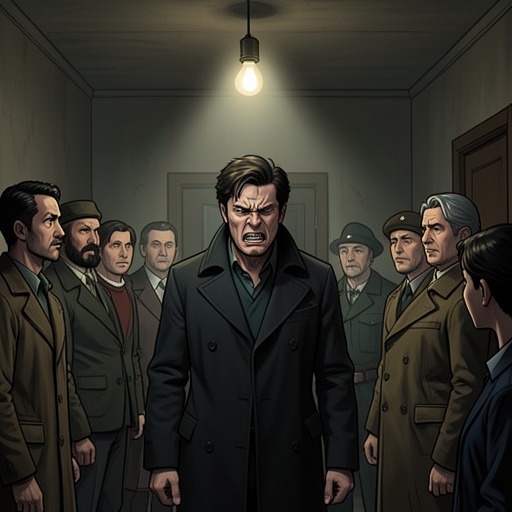
The public learns first that an eighteen-year-old has been charged with murdering Michael, who was shot at home. Later, a newspaper report gives the trial’s result: Thomas Ronald McGeown, from Hollyburn Estate, has been sentenced to life imprisonment. The report identifies him by his full name and address, and notes that he shows no reaction as he is led away from the dock. That outward stillness is recorded, not explained.
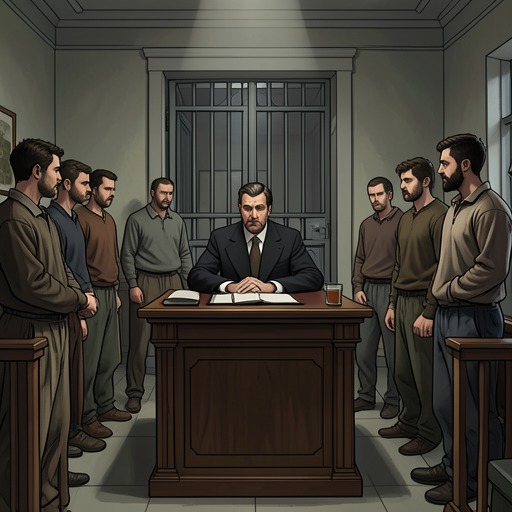
The trial account says Tommy refused to recognise the court, offered no defence, and answered no questions. He was convicted on evidence described as forensic, circumstantial, and damning. The novel does not supply a full legal transcript or specify the evidence in the newspaper report, so the official conclusion is sharply stated while the precise argument behind it remains outside the account.
Cushla reads a longer feature about the proceedings in a newspaper at a lay-by. Its coverage places Tommy’s trial beside broader concerns: judges had been shot the previous year, most people appearing in court on terror charges were under twenty, and the article condemns those who recruited teenagers rather than risk acting themselves. Tommy’s case is therefore reported both as an individual murder trial and as part of a political environment in which young people were drawn into violence.
The connection to Michael
The newspaper account gives Cushla a specific circumstance that binds Tommy to Michael before the murder. Tommy had been working on a house opposite Michael’s, repairing a path. When rain began and the family was out, Michael invited him in for tea. Cushla imagines Michael making tea, getting cups, and looking for biscuits, treating an awkward boy kindly and trying to put him at ease. These are her reconstructions, not established testimony about what passed between them.
She wonders whether Michael asked Tommy about school or mentioned having a son his age. She also considers whether Tommy saw a photograph of Michael in wig and gown and wrongly took him for a judge, or whether the opportunity occurred to him later, after he had told his cousin about the day’s work. The narrative leaves these questions unresolved. Cushla’s imagined sequence makes the ordinary invitation to tea feel newly consequential, but it does not establish Tommy’s precise motive or when he decided to kill Michael.
Cushla’s wider knowledge makes the verdict harder to separate from the surrounding institutions. She had already found Michael’s records of police torture, including statements the boys had refused to sign and accounts of their arrest and custody. Her encounter with those materials had shown her the gap between the official handling of suspects and the injuries and fear described in the records. Michael, too, had argued that Republican prisoners were treated unfairly and objected to Diplock courts, where there were no juries. The novel places that criticism beside Tommy’s refusal to recognise the court, without making the two facts equivalent or suggesting that the conviction itself is overturned.
Surveillance and interrogation
After Michael’s death, Cushla is questioned by the Royal Ulster Constabulary. The room contains a bolted Formica table, chairs, a folder, an ashtray, and a tape machine that the officer does not switch on. He tells her she has not been arrested. During the questioning, he produces Tommy’s small black notebook, which Tommy had kept in his back pocket, and asks whether Cushla gave him her telephone number. She explains that it was so he could call if the family needed shopping done. The officer points to writing on the facing page and asks whether she wants him to read it; the passage does not disclose its contents.
The interrogation also carries an explicit threat: the officer says he can keep Cushla for up to seven days and suggests that she could stand in a corner and take her clothes off. He later tells her that she is free to leave at any time. She walks out of the station and into sunlight without her basket, keys, or car, feeling stripped of her ordinary identity. The contrast between the threat of detention and the assertion that she was free to go makes the encounter’s coercive force part of the aftermath, even though she has not been formally arrested.
The notebook links Cushla’s practical kindness to the police investigation: giving Tommy her number so the McGeowns could ask for shopping help becomes material the officer can use to question her about her relationship with Michael. Cushla begins to understand that her affair with Michael and her support for Davy and the McGeown family, which had seemed separate, had become entangled in the eyes of the investigation and in the sequence of events themselves. Her questioning does not establish that she knew about Tommy’s plan or participated in the murder.
The sentence and its aftermath
For twenty-seven days after the questioning, Cushla waits for news; the interval is thirty days since she left the McGeowns at the edge of Short Strand and thirty-five since Tommy emptied a gun into Michael’s body. She has heard nothing about the trial and repeatedly imagines it as a courtroom drama, complete with television lights and tiered mahogany benches. In these private scenes she sometimes sees herself beside Tommy in the dock and more often imagines herself giving evidence before a crowd that includes Michael’s family, friends, and Betty McGeown. Michael, by contrast, appears in her imagined courtroom only through photographs, ballistic analysis, autopsy reports, and clothing kept as evidence.
When the newspaper finally reports Tommy’s conviction and sentence, the legal endpoint does not resolve Cushla’s grief or her questions about causation. She considers the possibility that Tommy’s act grew from rage and a desire to belong, but these are her attempts to understand him, not facts established by the trial account. After seeing the report, she thinks that there had been no connection after all, that it was bad luck of the kind that happened there often. That conclusion sits uneasily beside the connections she has just been tracing: Michael’s invitation, Tommy’s work nearby, Cushla’s help to his family, and the political violence surrounding them.
The murder and sentence also deepen the novel’s portrayal of Cushla’s loss. In the weeks after Michael’s death, she wakes with the pattern of his Aran cardigan printed on her skin and keeps his belongings alongside Davy McGeown’s missal and medals, a key, and a bar of soap. Her grief makes ordinary tasks—washing, eating, standing—feel difficult. The life sentence fixes Tommy’s punishment in public record, while Cushla remains among the living with objects, memories, and unanswered questions.
The case unfolds amid the McGeown family’s displacement and growing isolation. Cushla has taken them to the edge of Short Strand; afterwards, she is afraid of being watched and avoids people. The family’s earlier sheltering of the McGeowns has cost them support: Catholics have drifted away rather than appear to condone it, while some former regulars no longer visit. By the time the sentence is reported, legal closure has not restored the family’s place in the community or removed the consequences of the violence around them. Tommy’s life imprisonment is thus both a definitive judicial outcome and an incomplete answer to a killing shaped by personal contact, political conflict, and the reach of surveillance.