Joanna Agnew’s alcoholism
TrespassesJoanna Agnew’s alcoholism is revealed not through a scene of drinking but through Michael Agnew’s account to Cushla Lavery. The disclosure recasts Joanna’s poised presence at a family lunch: her illness, depression, and hospital treatment remain largely unseen, while the practical and emotional strain around them enters the story through her husband’s explanation.
Appearance and Introduction
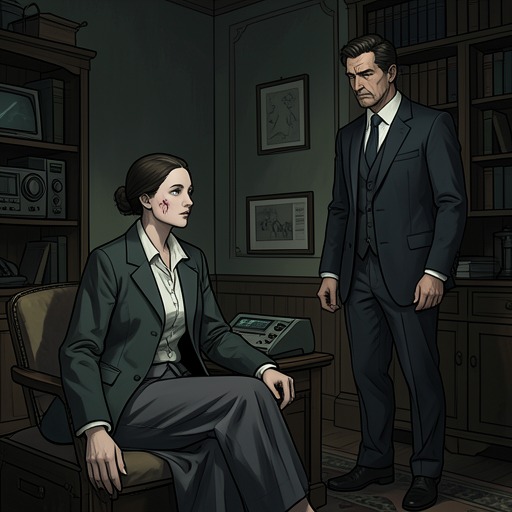
At the lunch, Cushla first registers Joanna through a mixture of expectation and surprise. She had imagined Michael’s wife as tiny, nervy, or plain; instead, Joanna has what Cushla perceives as a ghostly serenity, a heart-shaped face, straight auburn hair cut to her chin, and an expensive camel-coloured dress. A bruise with a small central hole marks the back of her hand; Cushla thinks it may be from a cannula or injection, though its cause is not confirmed.
Joanna’s composure does not mean the meeting is effortless. When Gina introduces Cushla, Joanna holds her hand with a desperate grip and tells her she has not seen her since she was little and that she resembles her father. Cushla experiences the touch as excruciating, registering both the sincerity in it and the struggle behind it. The encounter offers an outwardly serene image of Joanna, but one already marked by physical vulnerability and emotional pressure.
Michael’s Disclosure
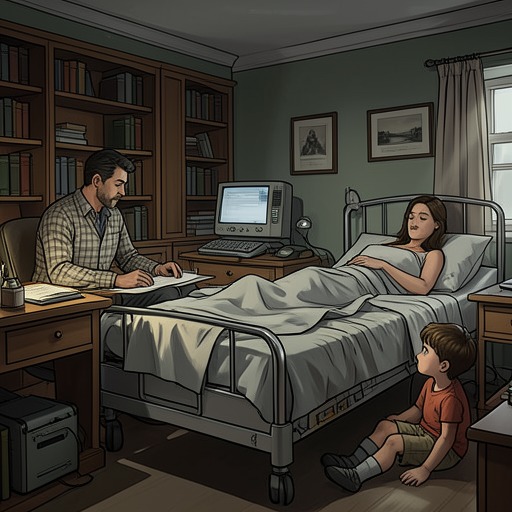
Later, Michael tells Cushla that his wife is an alcoholic and is being treated for depression. He describes coming home to find Joanna curled on the floor. He also says she had been admitted to hospital for more than a month for another course of electric shocks, and that treatment sometimes left her well enough to do things. His account establishes alcoholism and depression as distinct parts of her condition; it does not specify how they relate to one another or explain the cause of her hospitalizations.
The disclosure comes in answer to Cushla’s question about why Michael had been able to see her so often. Michael confirms that Joanna’s hospital stay and the fact that their son was at school had made those meetings possible. His admission thus connects Joanna’s illness to the circumstances of his affair with Cushla without making Joanna’s condition a full account of her life: the reader receives it through what Michael chooses to disclose, while Joanna herself is not given a corresponding explanation.
Narrative Significance
Joanna’s alcoholism is presented through a sharp contrast between appearance and private distress. At the lunch she is beautifully dressed and outwardly composed; in Michael’s recollection she may be found collapsed on the floor, and her illness has brought repeated hospital treatment. The contrast complicates any easy reading of her serenity as evidence that she is well.
The account is deliberately narrow. It supplies no direct scene of Joanna drinking and no account from Joanna about her experience. Instead, her illness enters the narrative at a moment when Michael is explaining the time and access that enabled his relationship with Cushla. That framing makes her condition consequential to the plot while also leaving a gap between the visible woman at the table and the private suffering described by her husband.