Hallucinaties en wanen
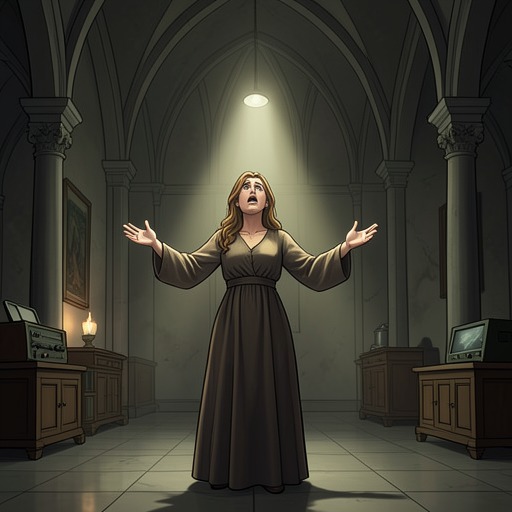
UpHallucinations and delusions are presented through a crucial distinction: a hallucination alters what a person perceives, while a delusion is a belief that persists even when perception or available facts contradict it. Emma has experienced both, though she has hidden them in an effort to seem normal. When Rajid names the difference, it helps her describe experiences that were not merely strange images or mistaken ideas, but recurring sources of fear, stress, and isolation.
Two Different Kinds of Experience
In their conversation, Rajid explains that a hallucination is a misperception of what is around someone: a person might see a wolf instead of a desk, hear voices that are not there, or feel that a body belongs to someone else. A delusion, by contrast, does not necessarily change the perception itself. Someone may see an ordinary desk but believe that its grain encodes a message or that microphones are hidden inside it. The distinction is between what is perceived and what is believed about it.
Emma initially recognizes herself in the description of hallucinations. She tells Rajid that she sometimes sees snakes. The experience first began years earlier on a narrow cycling path beside a busy road through the polder. She would see what looked like a snake, reason that it was unlikely to be an adder so far from the Veluwe, and concentrate until she recognized a branch. Yet as soon as she stopped concentrating, the branch seemed to become a snake again. The images could recur several times a week; the last period she recalls lasted three months.
The experience did not end when the image disappeared. After a storm, Emma found a branch, perhaps two metres long, lying across the same path. The snake episode had been over for months, but she could not move the branch or even kick it aside because she feared it might turn into a snake. Someone else eventually cleared it. For Emma, this lingering fear—not simply seeing something that was not there—was what made the hallucination a burden: an ordinary task became impossible, and she felt responsible for leaving an obstacle in the path.
Perception, Belief, and Conviction
Rajid concludes that Emma has regularly experienced hallucinations, which can occur within a manic-depressive picture. As they continue, he also recognizes that hallucinations do not account for everything she describes: she has delusions as well. Emma had assumed that everyone experienced similarly strange things and simply kept quiet about them. She followed the same rule, captured in the phrase “Keep the crazy on the inside,” trying to think normally and reveal nothing.
To explain a delusion, Emma compares it to being certain that keys were put on a table and then finding them missing. The person may blame a partner, child, or pet, search the house, and become angry at the thought that someone has taken the keys or is trying to make them doubt themselves. Then the keys turn up in a coat pocket. The analogy shows how a delusion involves more than an incorrect conclusion: the person can see evidence that the keys are not where remembered and still feel certain that they were put there. Emma sums up the distinction by saying that a hallucination is something one thinks, whereas a delusion is something one believes. The comparison makes the emotional force of conviction legible without treating it as a deliberate choice.
Her account of taking pills shows how consequential such a belief can become. Emma describes a state in which the fact that taking the pills would kill her had, in some way, disappeared. She did not experience the act as suicide. Death instead seemed like a beginning: she felt that everything was one, that she had reached a key to the universe, and that the feeling brought instant enlightenment, happiness, and peace. She knew that it did not make logical sense, and knew that death would not allow her to continue living, but she believed the idea deeply. The distinction between knowing and believing is not abstract here; it helps explain how a person can acknowledge a fact while remaining gripped by a conviction that points in the opposite direction.
The Cost of a Changed World
Emma resists reducing these experiences to the question of what image appears. She tells Rajid that the hardest part is not whether she sees a snake or a cat, hears people speaking Polish, or thinks she is being followed. It is the sense that the world has changed while she was not looking, like leaving a room and finding the television guide somewhere else despite being sure she was alone. The misplaced object becomes a test of memory and trust: perhaps it is only a guide, she says, but perhaps the loss is a sign that her mind itself is unreliable.
This analogy also conveys the repetition of the distress. Emma describes the shock when something seems to have changed, the strain of anticipating that it will happen again, and the anger and despair of being unable to stop it. She knows that therapists may worry that discussing hallucinations and delusions will draw a patient back into them, and that interpreting delusional images may seem outdated. But her question is practical rather than interpretive: what can someone do when the television guide keeps disappearing? Rajid replies that losing a television guide is different from having a hallucination; Emma answers that it feels the same. The exchange preserves both the limit of the analogy and the reality it helps communicate.
When Emma later explains hallucinations to other patients, she offers a dog as an example. She may see one sitting there, while knowing it is not present; it simply appears and does nothing. This differs from the key analogy: the dog is a perceptual experience she can identify as unreal, whereas the misplaced keys illustrate a belief that remains compelling despite counterevidence. The distinction gives the group concrete terms, but the attention turns uncomfortable when Iefke asks what a delusion is like once someone truly believes it. Under the others’ gaze, Emma feels exposed, as though she has become a freak show. Naming an experience can make it easier to describe, but it also risks making the person who describes it feel singled out.
Cycles, Memory, and the Limits of Explanation
The account of these experiences sits alongside Emma’s changing understanding of her mood. She once hoped each depression would be the last; now she recognizes that another low may follow a high. She describes mania as a present that breaks away from both past and future, demanding that the feeling never be released. Depression, by contrast, lets the past swallow the future until time seems to disappear and depression is all that remains. The images of distorted perception and conviction therefore appear within a life that also moves between sharply different experiences of time and mood.
That contrast begins earlier, when Emma is asked how she feels now. She reaches for images of seeing beyond a familiar sky: the moon not as a pale disc but as a vast body in space, the sky not truly blue, and the lifting of a fog that seems to reveal how everything really is. She then wonders how to explain that clarity to a psychiatrist. Her answer is simply that she feels good and clear. The scene gives the later discussion an important tension: an experience can feel like revelation from within, yet be difficult to convey to someone outside it.
The same divide appears in a memory of depression. During a night check, Emma raises a hand and offers a strained smile, trying not to feel, think, or remember. Once the nurses move toward the next room, she breaks down. What returns is not only a thought or emotion but the memory of a despair that has followed her throughout her life, leaving her feeling reduced to fragments and pulled toward the depth beyond a balcony. In this context, hallucinations and delusions are not isolated oddities; they belong to a broader account of painful states that can alter perception, belief, memory, and a person’s sense of what is real.
The concept’s significance lies in the space between explanation and lived experience. Rajid’s definitions help Emma distinguish misperception from belief, and help him recognize that both are present in her account. But a definition does not move the branch, dissolve the fear, restore confidence in a memory, or make an overwhelming conviction feel less true. Emma’s descriptions instead insist on the consequences: the ordinary path made threatening, the missing guide that shakes trust in one’s own mind, and the belief that can eclipse what one knows. Her effort to explain these experiences is also an effort to be understood without being reduced to them.