Normality and the identity of being a patient
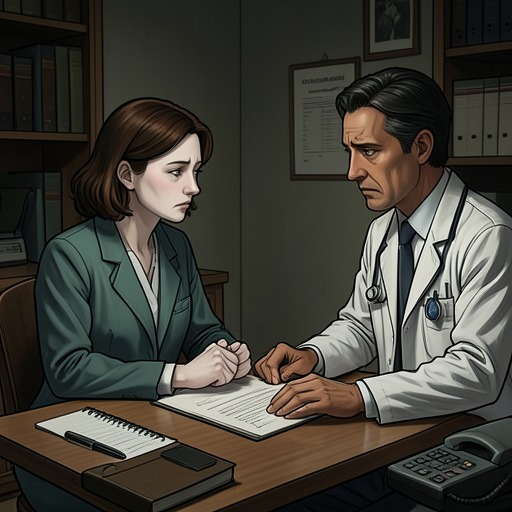
UpNormality and the identity of being a patient are never stable opposites in Emma’s account. Feeling well can seem to prove that illness is over; to other people, appearing well can make illness easy to overlook; and even when Emma recognizes the patient’s role imposed on her, she refuses to let it replace the person she understands herself to be. The tension reaches beyond diagnosis into medication, work, memory, and the terms on which other people try to protect her.
Recovery, treatment, and the promise of normality
At the beginning of the narrative, Emma approaches what she regards as her last day at the PAAZ with gratitude and exhilaration. She has come to the hospital pharmacy for her final pills before a last appointment with Dokter Visser, and describes the past two years of medication as a regimen she followed despite its side effects. The depression now seems so distant that she can barely imagine it. Her body feels full of energy, and she concludes that the pills have done their work and that she herself is now ready to take over.
Yet Emma does not describe treatment as a simple return to an untouched self. A psychologist, in her analogy, offers a small stabilizing support that can be used when balance falters; a psychiatrist equips the bicycle with multiple safeguards, including a push bar that ensures the rider gets home whether or not she wants the help. The image makes care both practical and intrusive. Medication has helped, but it has also governed how Emma wakes, sleeps, eats, and functions. Her declaration that she is no longer a psychiatric patient therefore coexists with the need to taper treatment carefully, continue psychological support, and recognize the substantial role medication has played.
That confident sense of recovery is complicated by Emma’s earlier attempts to explain how she feels. Asked about her present state, she struggles to convey a sudden clearing of the mind: what had seemed like ordinary reality now appears transformed, as if a veil has lifted and the world’s hidden scale and structure have become visible. To the psychiatrist, however, she gives a plain answer: she feels good and clear. The contrast suggests that an experience can feel like restored perception to Emma while remaining difficult to communicate in clinical conversation. Her certainty is sincere, but it is not by itself proof that her judgment is reliable.
Appearance, rules, and the patient others see
During a later admission, a staff member acknowledges that Emma has no leave privileges, yet admits that she looks as though she might be going home the next day. On her previous stay she had been severely depressed, withdrawn, and barely speaking; now she appears normal, though the staff member also notices that she is restless, easily distracted, alert, and unusually busy in her mind. Emma counters that she is normal and explains her activity through work and her desire to leave. The exchange makes appearance a poor substitute for understanding: the visible contrast with her previous depression can make the rules of her present admission seem easy to forget, even as her agitation offers evidence that something has changed.
Emma’s insistence that she is normal is also a claim about continuity. When Rajid has explained that she is behaving differently, she anxiously asks Sergei whether she is no longer the same person. Sergei answers by separating identity from mood: she remains Emma, even if she is busier than usual and experiencing a more intense version of moods she has had before. His reassurance offers a distinction between being changed in the present and being replaced as a person. But Emma remains uncertain whether that reassurance is enough; the clinical account has altered how she understands herself even when the people closest to her insist that her identity persists.
The hospital shop gives this uncertainty a more intimate form. When Emma initially cannot find Sergei, she sees him reading a newspaper among other people moving between the shelves. He appears isolated and almost anonymous, as if he were nobody. The sight brings Emma close to tears before she embraces him and tells him she thought they were meeting at the restaurant. Here the ordinary setting briefly makes the person she depends on look like a stranger. Her emotional response reveals how much the relationship helps anchor her sense of the world, without making that need identical to the patient identity she resists.
Illness remembered and time distorted
Emma’s present arguments about normality are haunted by experiences that cannot be reduced to how she looks in a ward or feels on a particular day. During a night in the hospital, she tries to hold herself together as staff pass her room, then breaks down because she is fighting not only thoughts and feelings but a lifelong memory. She recalls depression as a state that drains a person until only fragments remain, still clinging to life while being pulled deeper. The image resolves in the depth beyond a balcony. The scene places her earlier despair inside her current experience: even when she hopes to feel well, memory remains part of what the present self must carry.
Her account of time makes the contrast between depression and mania more complex than a simple opposition between illness and health. Thinking of Beatrice’s observation that depression has no sense of time, Emma recognizes a corresponding distortion in mania: the present expands into an urgent now that seems to cancel past and future. Depression, by contrast, lets the past and future overwhelm the present until time itself loses meaning. In either state, a person may be unable to use ordinary chronology to judge what will come next. A sense of immediacy or of being trapped therefore cannot safely settle the question of whether the illness has ended.
Emma’s description of her first admission likewise shows how illness can alter the meaning of an action. She recalls feeling no emotion when she learned that Dokter Visser’s husband had died; her attention instead fixed on the surprising fact that the psychiatrist had children. She explains that an immense idea had absorbed her thoughts and feelings: after months of depression, she became convinced that she had to die so she could remove herself and the troubles attached to her, then continue with work and productivity. At the time, she did not understand the thought as a suicide plan or as something frightening; it seemed simply necessary. The gap between that conviction and how others understood the danger exposes the limits of treating a person’s own feeling of clarity as evidence of safety.
Work, stigma, and competing interpretations
The patient identity follows Emma beyond the ward. In a group discussion about work, she remembers that during her first admission her employer told colleagues she was at home with burnout. What was expected to be a brief absence stretched into a five-month stay, leaving her ashamed of the uncertainty her absence had created for her boss and coworkers. Pieter interprets concealment as a form of stigma, but Emma objects that her employer meant to protect her privacy and had not known how long she would be away. Pieter’s reply shifts the question from intention to effect: stigma can operate unconsciously, including through silence or through discussing a person’s difficulties without involving them. He suggests that Emma could have been asked what she wanted disclosed.
The disagreement shows that patienthood is produced in ordinary decisions about who may speak, what may be said, and who gets to decide. Emma does not experience her employer’s explanation as hostile, yet the arrangement leaves her colleagues uninformed about the admission and makes her absence harder to understand as it continues. Her account resists a single moral reading: an attempt at protection can still shape someone’s social identity without their participation. The ward discussion makes room for Emma to describe that difference between what another person intended and what the decision meant in practice.
Dependence, responsibility, and an unfinished identity
Sergei’s reluctance to remove Emma’s accumulated medication becomes another conflict over how seriously to understand her illness. Emma says that her psychiatrist had asked him to dispose of the pills, but that he delayed for more than three weeks and only did so after two conversations with the psychiatrist. To her, his resistance suggests that he does not believe her problems are real or serious. A woman Emma is speaking with proposes another possibility: minimizing the danger may protect Sergei from confronting how close he came to losing her. The interpretation does not settle his motive, but it shows how the same behavior can signify disbelief to Emma and self-protection to someone else.
Emma eventually recognizes the weight of being seen as a patient for whom others feel responsible: someone they want to cure and may need to protect from herself. She does not deny that this is part of her life, or that Sergei, her family, Rajid, Dokter Visser, and the nursing staff have watched over her. Instead, she insists that this role is not the whole of her and that she must do the living herself. When Sergei fears that matters may worsen again, she tells him that they will. The admission refuses a recovery story in which a good present guarantees a permanently healthy future, while also insisting that the prospect of recurrence does not erase her agency.
Beatrice’s account of losing her felt connection to God offers Emma another encounter with the difference between a person’s experience and an observer’s assumptions. Beatrice says that the feeling disappeared after she first received medication; she went home hoping it would return if she stopped taking the pills, but it did not, and she was admitted again. Emma recognizes that she had not tried to understand Beatrice before. She cannot claim to share the experience, but suggests that depression might drain the energy required to feel faith, just as it can drain the capacity for laughter, happiness, or love. Her response is tentative rather than authoritative: it takes Beatrice’s account seriously without pretending to know what it is like.
The narrative’s later discharge scene keeps the distinction between clinical status and personal identity in view. Emma meets Dokter Visser in the office of the locked ward and explains that she is going home that day, carrying her bag and collecting prescriptions; she will be an outpatient again. The statement marks a real change in where she will receive care, but it does not claim that vulnerability, treatment, or the possibility of future difficulty has disappeared. Across these returns to the language of being normal, Emma’s identity is neither secured by feeling well nor exhausted by being a patient. It remains something negotiated through her own account, other people’s interpretations, and the knowledge that recovery can be genuine without being final.