Normaliteit en psychisch lijden
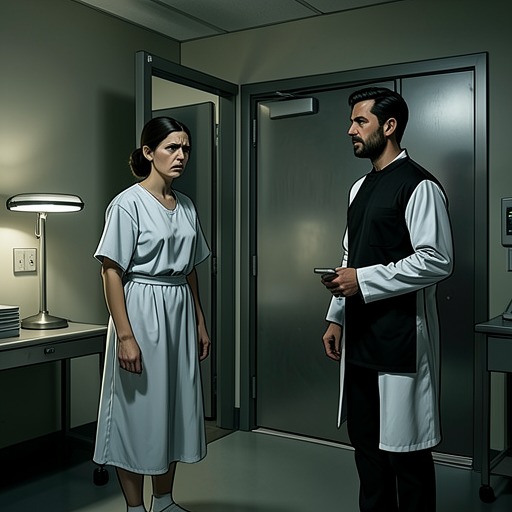
UpNormality and psychological suffering are presented not as opposites dividing healthy people from patients, but as unstable categories shaped by diagnosis, lived experience, and the assumptions people make about one another. Through Emma’s reflections on bipolar disorder, depression, and the meaning of being understood, the narrative challenges the idea that psychiatric patients possess a monopoly on suffering—or that those considered normal are untouched by it.
Normality as a Moving Boundary
Emma’s mood charts make the boundary between illness and normality visible, but not reassuring. Looking back over their long rows of marks, she sees that the line called normal was reached only occasionally, between depression and hypomania. Even then, she understands herself as passing through rather than inhabiting a stable condition. The chart therefore unsettles the comforting notion that a normal day is a secure baseline from which illness briefly departs: for Emma, the record suggests that she has rarely felt well in any lasting sense.
Diagnosis changes the language available to describe Emma’s experience, but it does not begin that experience. She objects to the implication that people can understand psychiatric suffering only after they have received a diagnosis or been admitted to a ward. Rajid has told her that an average of four years passes before a person with bipolar disorder receives a diagnosis. Emma uses that delay to expose the contradiction in dividing the world into patients who understand and normal people who cannot: during the years before diagnosis, a person may already be depressed, manic, hallucinating, or suicidal. The label may make an experience recognizable to others, but it cannot be its origin.
Her account of a depressive episode likewise resists the idea that suffering is an isolated, neatly bounded interruption. Depression can consume energy until the self seems reduced to fragments, while the memory of earlier despair returns with it. In her description of time, mania contracts attention into an urgent present, whereas depression lets the past swallow the future. These altered senses of time complicate any simple definition of normal functioning: the person is not merely having a bad day, but inhabiting a world whose sense of possibility and duration has changed.
The Limits of Diagnosis and Measurement
Emma also distinguishes between experiences that can be flattened by the questions used to measure them. In conversation with Rajid, she recalls that psychological tests in her earlier PAAZ admission asked whether she saw or heard things other people did not. She found the questions inadequate because, as she explains it, her difficulty was not necessarily in what her eyes or ears registered, but in how her mind interpreted it. The test’s ordinary-language categories seemed to assume that a person could reliably know what other people perceived.
The same difficulty appears in the distinction between hallucination and delusion. Rajid explains hallucinations as misperceptions—seeing a wolf where there is a desk, for example—and delusions as mistaken conclusions drawn from an otherwise accurate perception. Emma’s experiences resist a tidy division between what she knows and what she believes. She can know that a belief is illogical and still feel it to be profoundly true. During a suicidal crisis, death came to her not as an end but as a beginning, wrapped in a feeling of clarity and universal meaning. When she believed she could fly, she did not experience herself as suddenly irrational; she felt that reality had finally become normal. The certainty of the experience, rather than its implausibility to others, is what makes the distinction between ordinary belief and delusion difficult to inhabit from within.
These scenes do not erase diagnosis; they show both its usefulness and its limits. Naming an experience may help a clinician recognize a pattern, but a category cannot fully convey how the world feels to the person experiencing it. Emma’s conversation with Rajid makes the gap a matter of communication as well as classification: even a psychiatrist may struggle to ask clear questions about experiences that resist ordinary description, and admitting that uncertainty can itself make room for trust.
Shared Suffering and Unequal Recognition
Emma’s argument with Gwen turns on who is permitted to count as experienced. She questions why the term experiential expert should belong more readily to someone who has been a patient than to an ordinary patient, nurse, or relative who has encountered suffering in another form. Her examples are concrete: Dokter Visser has lost her husband; Karel cares for his son after an accident; Emma’s mother had three miscarriages before having Emma. None of these experiences is identical to psychiatric illness, but Emma insists that grief and frustration can be shared without being made interchangeable.
That distinction matters. Emma does not claim that everyone has undergone the same crisis or can automatically know what another person feels. Rather, she objects to using diagnosis as a gate through which empathy must pass. Pieter hears voices, but that does not make him uniquely qualified to understand Asperger syndrome; nor, in her view, does a history of one kind of treatment automatically confer deeper understanding of someone hospitalized for another condition. Shared humanity is not a substitute for attention to particular experience. It is a reason not to presume that understanding is impossible across diagnostic boundaries.
The apparent contradiction between saying that normal people do not exist and saying that normal people cannot understand patients especially troubles her. Emma resists both sides of that formula: ordinary people are not untouched by vulnerability, and patients are not separated from them by an absolute divide. Her anger becomes personal when she considers the demands placed on Sergei, her mother, and Elise. She has taken time to accept her diagnosis of Asperger syndrome and is only beginning to confront bipolar disorder, yet she feels that her family is expected to know immediately how to respond to each new diagnosis. When Gwen learns that David attempted suicide, Emma asks whether her family was wrong to withhold the news while she was hospitalized. Their choice may have been painful or imperfect, but she refuses to treat their uncertainty as proof of stigma or indifference.
Control, Care, and the Patient Identity
The distinction between normality and illness also appears in Emma’s fear that mania can preserve a feeling of control even as it alters judgment. Speaking with Iefke, she says that the frightening feature is not simply losing control, but continuing to believe that everything remains under control. Iefke asks whether people considered normal do not feel much the same way. Her question does not make mania ordinary; it unsettles the assumption that the subjective feeling of command can reliably distinguish wellness from illness.
Relationships are similarly shaped by competing interpretations of risk. Emma explains that Sergei took more than three weeks and two conversations with Rajid before he finally removed her stockpiled medication, and that he did so reluctantly. She worries that his resistance means he does not take her seriously. Another patient offers a different possibility: Sergei may be protecting himself from the fear that Emma’s condition is genuinely life-threatening. This reading does not settle what Sergei feels, but it shows how the same action can signify neglect to one person and self-protection to another. Concern does not automatically produce understanding, and love does not eliminate the strain of living beside risk.
Emma recognizes the burden of being seen through a clinical role when she notices Rajid’s hesitation. In that moment she sees herself in his eyes not simply as a person, but as his patient: someone for whom he is responsible and whom he might want to cure or protect from herself. She understands why he fears deterioration, but insists that the risk is part of the life she must live rather than a problem others can resolve on her behalf. Her request that he let her go is not a declaration that she will never worsen; she explicitly expects that things will get worse again. It is a claim to agency within continuing vulnerability, not a promise of recovery that would restore an uncomplicated normality.
Suffering Beyond the Psychiatric Ward
Beatrice’s account widens the concept beyond diagnostic language. She tells Emma that after beginning medication during her first stay, she stopped feeling God’s presence and went home hoping it would return if she stopped taking the pills. It did not; she later returned to the PAAZ feeling more alone than ever. Emma cannot claim to share this religious experience, but she recognizes the cruelty of losing a source of comfort and wonders whether depression, rather than the medication, might have made belief feel inaccessible. The exchange places two different accounts of distress beside one another without forcing them into a single explanation.
This is the concept’s central tension: suffering is neither exclusive to psychiatric patients nor identical from person to person. Diagnosis can clarify patterns and support care, while still failing to capture the full texture of an individual life. Normality can appear on a chart as a line, in conversation as a disputed label, or in a relationship as the hope that another person will remain safe. The narrative’s answer is not to abolish distinctions between conditions, but to resist turning those distinctions into a hierarchy of whose pain is real, whose understanding counts, and who is entitled to make mistakes.