Depressie als schaduw en manie als licht
UpDepressie als schaduw en manie als licht is the metaphor through which Emma first struggles to explain altered perception and later reframes her recurring mood shifts. Its decisive movement is not from illness to cure, but from fleeing depression into mania toward an effort to live in the present without being governed by either state.
A perception difficult to explain
When asked how she feels, Emma reaches for images on a scale far beyond ordinary description: the moon is not merely a pale disc but a vast body hurtling through space, and the apparently blue sky is really black, obscured by the atmosphere. The image makes her experience of clarity feel like seeing through a veil. Yet when a psychiatrist asks how she is doing, Emma reduces that expansive account to a simple report that she feels well and clear. The distance between what she experiences and what she can tell a clinician establishes an early tension in the metaphor: brightness can feel like revelation, while remaining difficult to communicate or assess from outside.
Two states, two experiences of time
Emma later distinguishes mania from depression not only by intensity but by their different relations to time. Mania launches itself like a firework out of past and future: the present becomes everything, urgent and apparently impossible to relinquish. Depression works in the opposite direction. With no present to anchor it, the past seems to swallow the future; time loses meaning, and wherever Emma looks she sees only depression. Her image of upside-down paintings while waiting outside Rajid’s room gives this distortion a physical counterpart: the world’s ordinary arrangements remain in place, but her life feels overturned, and what others regard as normal no longer appears so to her.
The shadow also carries a history that predates this reflection. During a night on the ward, Emma tries to withstand panic by refusing to feel, think, or remember. When the attempt fails, she cries and recognizes the returning feeling that has pursued her throughout her life: depression has drained her energy until she is reduced to fragments of herself, still clinging to life as they are pulled downward. The image ends at the depth beyond the balcony, linking the recurring depression to a childhood crisis rather than presenting it as a passing mood. In that scene, the metaphor is not an abstract comparison; it is bound to memory, exhaustion, and the fear that the descent must stop.
From escape to carrying the light
In a conversation with Beatrice, the metaphor becomes an account of how Emma has tried to survive. Depression is her shadow, always present and impossible to outrun, so she has run toward mania’s light, allowing its brightness to blind her and burn away the shadow for a time. The relief comes at a cost: no one can keep looking at the sun indefinitely without being harmed. The image therefore refuses to make mania a simple opposite or cure for depression. Each state has its own danger, and escape from one through the other exacts a price.
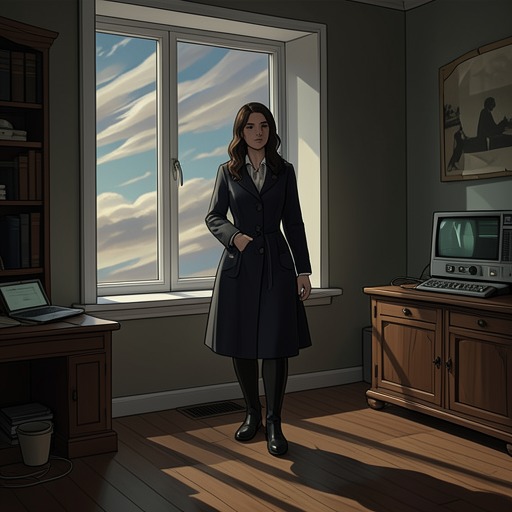
Emma cannot offer Beatrice a certain method for living with repeated depression. Instead, she describes a different arrangement of the same images. If mania shines ahead of her and depression’s shadow falls behind, she imagines keeping the light above her, in the here and now. In this altered position, mania ahead loses its glamour and the shadow behind grows smaller until it can be understood as part of her. The moods may continue, but Emma says they belong to her rather than she to them; she thinks she has stopped running. The change is a claim to ownership, not a declaration that the fluctuations have vanished.
An unfinished movement toward acceptance
The metaphor’s development holds together two truths that Emma does not resolve into a happy ending: depression can feel all-consuming, and mania can offer brightness that is itself dangerous. Its final image shifts the goal from escaping darkness to changing one’s relation to light and shadow. That shift follows an admission of vulnerability rather than a promise of control: when Rajid is reluctant to let her go because he fears she may worsen, Emma acknowledges that she will become worse again. The recognition makes her later account of carrying the light in the present more credible as an attempt to live with recurrence, not evidence that recurrence has ended.