Rapid cycling
UpRapid cycling is the term Rajid uses for Emma’s unusually frequent mood changes, and its significance extends beyond a diagnostic label: it alters the treatment he recommends and gives clinical form to a life repeatedly pulled between manic certainty and depressive collapse. The novel sets a statistical account of bipolar episodes against Emma’s own measure of time, in which several shifts in a month can feel ordinary and the possibility of a stable interval almost unreal.
Definition and Clinical Recognition
Rajid explains that bipolar disorder does not usually mean a person is continuously either depressed or hypomanic or manic. In his account, most patients experience an average of three such episodes in ten years and feel normal during the remaining time. Emma reacts by comparing that figure with her own experience: three episodes in a month sometimes occur, and even three in a year would seem manageable by comparison. The contrast makes the frequency of her mood changes, rather than the mere presence of distinct mood states, the issue under discussion.
The records Emma has brought Rajid are not completely finished, but he says they already show how often her mood shifts. He had suspected the pattern from her file, while hoping it might have been caused chiefly by the intense circumstances of her earlier admission. That hope gives way as the records support what Emma describes. Rapid cycling is therefore presented not as a passing impression based on one difficult period but as a recurring pattern that becomes legible through her history and the mood information she provides.
Rajid stresses that less frequent episodes are not necessarily easier. They may last longer and become more severe, disruptive, and destructive. His explanation complicates any simple comparison between Emma and patients who experience fewer episodes: frequency is important to her diagnosis, but it does not mean that other patterns of bipolar illness involve less suffering. The distinction allows the clinical discussion to recognize Emma’s unusually rapid changes without making episode count a measure of how much a person is affected.
Emma’s Experience of Changing Moods
The clinical language sits beside Emma’s account of how different states reshape reality. When Rajid asks how she feels now, her inward description is of a fog lifting: the world seems suddenly visible as it truly is, and understanding arrives with the force of certainty. What may appear from outside to be an altered mood can feel from inside like a revelation about reality itself. Emma answers Rajid briefly that she feels good and clear, but the gap between that compact answer and the scale of the experience she is trying to convey suggests how difficult it is to translate an episode into ordinary clinical conversation.
Her account of time makes the contrast more precise. Mania seems to break free of both past and future because the present becomes everything: an urgent now that must never end. Depression works in the opposite direction. With no sustaining present, the past seems to swallow the future, leaving an expanse of despair in which time itself disappears. These are not simply opposite labels on a chart. Each state changes what can be imagined and what feels possible: mania concentrates life into an absolute present, while depression makes every direction seem to lead back to the same darkness.
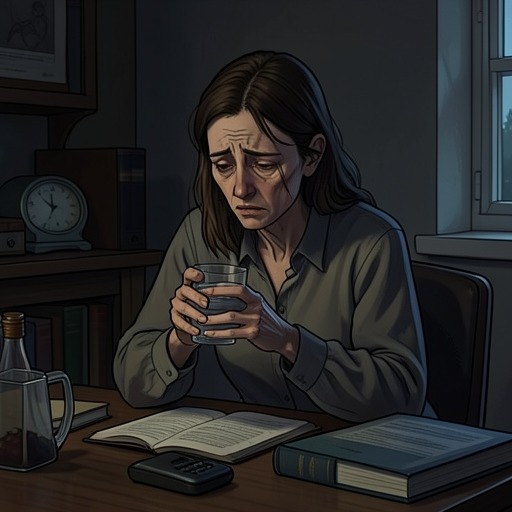
Elsewhere, Emma describes depressive depletion as being reduced to fragments of herself, still clinging to life while being drawn further down. A night-time check intensifies the difference between what she can show and what she is experiencing: she raises a hand and offers a strained smile to the nurses, then cries once they have moved on, overwhelmed by the return of a memory she has been trying not to feel. That scene does not define rapid cycling by itself, but it gives the concept its human scale. A record may register a mood change; it cannot by itself convey the effort of appearing composed while an episode and its memories return.
Diagnosis, Risk, and Treatment
Rajid tells Emma that rapid cycling is less responsive to treatment. He also says that antidepressants can turn a more typical bipolar pattern into the rapid-cycling variant, so he does not recommend them. Emma points out the uncomfortable history behind that warning: she has taken at least three different kinds of antidepressants over the previous two years and is now being told that she has this variant. The exchange leaves that concern unresolved rather than presenting the diagnosis as a neat explanation that settles responsibility or answers every question about her care.
Rajid does offer a treatment direction. He says some medications, combined with lithium, can reduce mood swings in both duration and frequency. Tegretol has caused Emma side effects, so he proposes starting Depakine, another anticonvulsant with a different action, alongside lithium. Because he wants to observe what happens as the dose is increased, he plans for her to remain in hospital for at least another two weeks, possibly longer. The proposed stay makes the diagnosis consequential in practical terms: a new medication is not to be sent home with Emma before its effects are known.
Emma responds not only to the medicines but also to the process of measuring her mood. Rajid’s forms have given him a picture of how often she changes, even though they are incomplete. Emma argues that daily recording could help patients receive the right diagnosis and medication, especially in a psychiatric ward where patients are already confronted with their problems. Her point makes the forms more than paperwork: systematic observation might help distinguish an individual pattern that has been mistaken for normal by the person living through it. At the same time, the discussion shows that collecting information does not remove the difficulty of deciding what to do with it.
Living with Recurrence
Rapid cycling also changes the meaning of recovery. The contrast between mania’s consuming present and depression’s collapsed sense of time helps explain why Emma can experience a moment of lucidity as complete truth without having gained a reliable view of what will follow. Her account of an earlier suicidal conviction illustrates the danger of that certainty: after months of depression, she experienced the thought that she should die not as a plan she could weigh from a distance, but as an overwhelming feeling that seemed to make everything clear. This episode is not itself identified as rapid cycling, but it shows why changes in state can carry consequences beyond mood and why clinicians attend to the pattern rather than treating apparent clarity as proof of safety.
When Rajid worries that Emma may worsen again, she asks him to let her go and says that she will get worse again. The exchange does not present deterioration as desirable or as a reason to abandon care. Instead, it refuses a promise of permanent improvement as the condition for recognizing Emma’s own authority over her life. The recurring illness remains real, and so does her wish to act as a person rather than only as a patient under protection.
The concept thus connects clinical classification to a larger tension in Emma’s experience: other people can observe and record a pattern that she has come to regard as normal, while she alone inhabits the certainty and collapse that each state brings. Rapid cycling names the unusual frequency of her changes and guides a cautious medication plan, but it does not turn recurrence into a simple story of cure or failure. It makes visible the ongoing work of understanding a chronic pattern while living through its next turn.