England
UtopiaEngland in Utopia is more than a place recalled by a traveler: it is the chief real-world setting for the book’s examination of how laws and economic arrangements produce the conduct they punish. Through Raphael Hythloday’s recollections and More’s framing account, England appears as a kingdom marked by political authority, harsh penalties, land enclosure, and widespread insecurity. It also enters the dialogue as a possible object of reform and as a country vulnerable to the ambitions of foreign rulers.
England in the Narrative Frame
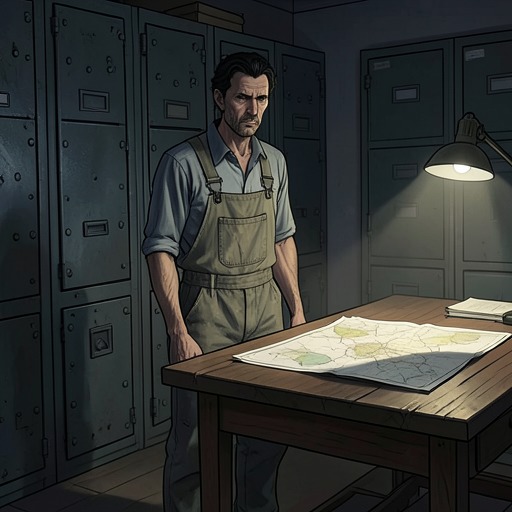
The book begins from a diplomatic mission to Flanders. More recounts that he traveled there with Cuthbert Tunstal to meet commissioners acting for Charles V; when the negotiations paused, he went to Antwerp and met Peter Giles. The narrative then moves from this historical-seeming frame into fiction with Raphael Hythloday, whose travels give him a vantage point from which to compare different societies. The movement matters: England is not introduced as an abstract example in a political treatise, but as a country brought into discussion by a traveler and by the conversation surrounding his account.
Raphael says that he had spent several months in England not long after the suppression of the western rebellion, in which many poor people were killed. His recollection places political unrest beside the social conditions that, in his view, help create it. The country’s problems are discussed at John Morton’s table, where Raphael remembers an argument about thieves and punishment. England thus becomes the setting for a test of whether public policy can be called just when it addresses the visible crime but ignores the conditions that make people desperate.
Political and Legal Background
England is also associated with More’s own early public life. At twenty-one, he entered Parliament; in 1503, he opposed Henry VII’s proposed subsidy for the marriage portion of his daughter Margaret. His opposition was forceful enough that the House of Commons refused the grant, and the king was reportedly told that a beardless young man had frustrated his expectations. More consequently incurred Henry VII’s displeasure and considered leaving the country. This biographical episode gives the book’s later suspicion of royal counsel a political resonance: resistance to a ruler’s proposal is not merely theoretical in the life represented around the work.
Under Henry VIII, More established a substantial legal practice and was said to refuse cases he considered unjust and to take no fees from widows, orphans, and the poor. The contrast between such scruples and England’s severe law against theft sharpens the dialogue’s question of what justice requires. At Morton’s dinner, an English lawyer praises the execution of thieves and reports that as many as twenty could hang on one gibbet. Raphael answers that severity has not ended theft, and argues that taking a life for the theft of property is both disproportionate and ineffective. The law’s spectacle of punishment, in this account, stands against its failure to prevent the crime.
Poverty, Enclosure, and Theft
Raphael’s explanation shifts attention from individual offenders to the economic pressures surrounding them. He points to men disabled in civil or foreign wars who can no longer perform their former trades, as well as to noble households that maintain large numbers of idle retainers and then dismiss them when a lord dies or falls ill. Without work, shelter, or the means to learn another livelihood, such people may turn to theft; the ensuing punishment treats the result as if it had no social cause.
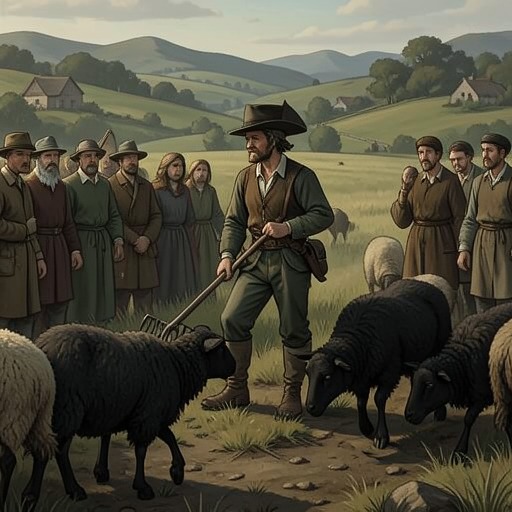
The most distinctive English example is the conversion of arable land and inhabited settlements into pasture. Raphael describes sheep raised for valuable wool as displacing people: landowners enclose extensive tracts, demolish houses and villages, and force tenants and owners from their homes. Families must sell their household goods for little, then choose between begging and theft. Beggars, despite their willingness to work, may be imprisoned as vagabonds when agricultural employment has disappeared. Pasture needs fewer workers than ploughing and harvesting, while higher wool prices make cloth unaffordable to some who once produced it. Raphael also warns that expensive cattle, rising grain prices, luxury spending, and gambling intensify hardship. His proposed remedies include rebuilding villages, limiting the engrossing of land, restoring agriculture, and regulating wool manufacture so that work is available.
This account makes England’s landscape part of its political argument. Enclosure is not simply a change in land use: it links private accumulation to the loss of homes and livelihoods, and then links that loss to criminalization. The contrast with Utopia is not an uncomplicated opposition between a coercive England and a just alternative. Utopian settlement policy also claims authority over land deemed unused, and permits force against inhabitants who resist its colonies. Read together, the passages make the political meaning of land use less settled: both societies connect cultivation, possession, and the right to remain, though Raphael presents the English enclosures as a direct source of impoverishment.
England as a Political Object
The dinner debate does not end with Raphael’s argument. A counselor prepares to answer him by repeating his points in the form of a formal debate, but Morton postpones the reply until the following day and asks instead why theft should not be punished by death. Raphael invokes the difference between theft and murder and argues that human law should not treat them as equivalent. He also maintains that punishment cannot be separated from its consequences: if the penalty for robbery is already death, a robber has little reason to spare a victim who might identify him. Morton listens to the proposal for a less severe approach and suggests that an experiment could be tried by reprieving a condemned thief. The company’s later approval of the idea, after dismissing Raphael’s contribution, exposes how authority can affect which arguments receive a hearing.
England also appears in Raphael’s hypothetical account of counsel to the King of France. In the imagined council, ministers debate how to secure territory and manage rival powers; England is treated as a possible ally that should also be suspected, with the Scots kept ready to attack and a banished nobleman supported as a claimant to the crown. Raphael counters this logic with the example of a people who found that acquiring a second kingdom brought taxes, continual warfare, disorder, and little benefit to ordinary subjects. He argues instead that a ruler should govern and improve the kingdom already held. England is therefore not only a society criticized from within the Morton episode, but also a country exposed to the destabilizing calculations of princely ambition.
Significance and Limits of the Critique
The book makes England concrete through particular institutions and consequences: the gibbet, the enclosed field, the emptied village, and the laborer left without a trade. These examples support Raphael’s central contention that harsh punishment cannot repair conditions that policy itself has helped create. They also connect domestic injustice to political choices about war, land, and the use of royal power.
Yet England is presented through a layered conversation, not as a complete or neutral survey. Raphael’s speeches make the case for structural reform, while the framing More admires the account but reserves judgment about parts of Utopia, especially its common life without money and its practices concerning war and religion. His closing response praises the commonwealth in general while acknowledging that he does not agree with everything Raphael has related. England consequently serves both as the object of a pointed critique and as the measure against which an imagined alternative is considered, without the narrative declaring that every feature of that alternative should be adopted.