Antwerp
UtopiaAntwerp is the hinge between the diplomatic world of Thomas More’s mission to the Low Countries and the philosophical travel narrative that becomes Utopia. More’s account anchors its opening in the city: during a stay there, he renews contact with Peter Giles and meets Raphael Hythloday, whose reports of distant societies lead the conversation toward the laws and customs of Utopia. Antwerp thus supplies more than a place-name; it gives the book a credible point of departure for moving from reported experience to political invention.
Diplomatic Setting and Personal Circumstances
In May 1515, Thomas More joined a royal commission to the Low Countries with Cuthbert Tunstal and others. They were to confer with representatives of Charles V about renewing an alliance. After negotiations in Bruges, the opposing commissioners went to Brussels for instructions; More, whose business allowed him to travel separately, went to Antwerp. He was away from England for six months, and the account places his stay in the middle of a mission shaped by diplomacy rather than by a search for fictional material.
More’s absence also gives the city a personal dimension. In the narrative, Peter Giles’s company helps ease the longing More feels for his wife and children after four months away from them. Giles was born in Antwerp and served as secretary to its municipality. More presents him as learned, modest, courteous, and exceptionally devoted to his friends; the friendship formed in the city is consequently both a historical connection and an important condition of the book’s opening conversation.
The Meeting That Begins the Dialogue
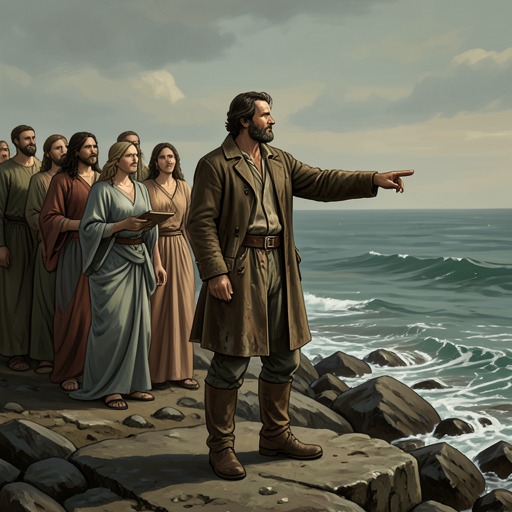
The narrative locates the decisive encounter in an ordinary return from church. More has been to mass at St. Mary’s, described as Antwerp’s chief and most frequented church, when he notices Giles talking with a stranger. The man’s tanned face, long beard, and carelessly hanging cloak make him look like a seaman, but Giles corrects that first impression: Raphael Hythloday has traveled as a philosopher, not as a sailor. The accidental meeting turns Antwerp’s streets into the threshold of a much wider account of travel and political life.
Giles introduces Raphael as a Portuguese, a learned man especially accomplished in Greek, and a traveler who had shared three voyages with Amerigo Vespucci. Raphael had remained in New Castile rather than returning on the final voyage. After traveling through many countries with five Castilians, he reached Ceylon and then Calicut, where he found Portuguese ships that carried him back to his native country. More and Raphael exchange the courtesies customary between strangers, then go with Giles to More’s house and sit together in the garden. The passage from public street to garden establishes the conversational setting in which distant experience can be examined at leisure.
From Travel Reports to Political Comparison
In the garden, Raphael recounts how he and his companions gained the trust of local people and a prince who supplied provisions, boats, wagons, and a guide to other rulers. Their travels took them beyond parched regions near the equator to more temperate lands with towns, cities, and active trade. Raphael describes the vessels he encountered, from flat-bottomed craft with sails woven from reeds and wicker to ships with round keels and canvas sails. He also taught some sailors the use of the magnetic needle. Their adoption of it made navigation possible in all seasons, but Raphael warns that an invention welcomed as an advantage might bring harm if used imprudently.
The account’s authority rests on observation, conversation, and comparison rather than on marvels. More and Giles ask about the countries Raphael has seen, especially the institutions that might offer useful examples; they are less interested in monsters than in the difficult question of how societies are governed. Raphael has observed both errors and sound practices abroad, and he speaks about the customs and governments of the nations he visited with striking assurance. This movement from travel detail to political judgment prepares the dialogue’s central contrast between European arrangements and alternative forms of social organization.
Antwerp as the Frame of Utopia
The discussion turns toward Utopia when Giles asks why Raphael does not enter a king’s service, arguing that his knowledge could benefit rulers, friends, and the public. Raphael rejects the suggestion that serving a king would differ substantially from making himself a slave. More’s narrative then develops a dispute over whether a philosopher can be useful at court, while Raphael’s account of social injustice and better institutions opens the way to his description of the Utopians. Antwerp is the setting for this transition: a diplomatic mission and a chance introduction lead into an extended debate about political counsel and the organization of society.
The frame also preserves a distinction between Raphael’s confident praise and the narrator’s final reserve. After Raphael finishes describing Utopia, More acknowledges that aspects of its customs, religion, warfare, and common ownership trouble him. Rather than contradicting a weary speaker, he commends the constitution in general and postpones fuller discussion. He says that there are many features of the commonwealth he would rather wish to see adopted than expect to see adopted in existing governments. Antwerp’s opening frame therefore supports both the imaginative reach of Raphael’s travel testimony and the qualified judgment with which More closes it.