France
UtopiaFrance is presented in Utopia as a political example rather than as the setting of a sustained, independent narrative. Raphael Hythloday invokes it to show how military institutions and royal ambition can damage a country even in peacetime; later, he imagines a French royal council whose advisers turn statecraft into a programme of conquest, manipulation, and extraction. The two portraits connect France with the book’s central question about whether learned counsel can improve government when rulers and their ministers are committed to other ends.
France as a Political Example
Hythloday introduces France while answering the claim that noble households need idle retainers because their birth supposedly makes them valuable soldiers. He argues that keeping such men without useful work encourages robbery and leaves the country with people trained for violence but unsuited to ordinary livelihoods. France, he says, has a more dangerous version of the same practice: soldiers remain in service even in a condition called peace, on the theory that the state must always have experienced troops ready. In Hythloday’s account, this standing force is not simply defensive. Those who promote it sometimes seek opportunities for war so that their soldiers can practise fighting rather than lose their military skill through inactivity.
The argument makes the maintenance of soldiers a political choice with consequences beyond the battlefield. Hythloday invokes the destruction of the Romans, Carthaginians, Syrians, and other states by standing armies as a warning against treating a permanent military establishment as a guarantee of safety. France’s policy therefore becomes part of a wider critique: a government that keeps a class of men in readiness for violence may help create the conditions in which violence becomes useful to its own institutions. War is not portrayed as an unavoidable interruption of peace, but as something that political arrangements can encourage.
Hythloday also contests the assumption that experienced retainers necessarily make better fighters. He observes that French trained soldiers can find themselves outmatched by less professionally trained English opponents. Mechanics in towns and rural labourers, he argues, can fight without fear when they have not been weakened by physical misfortune or extreme want. His comparison reverses the social hierarchy used to defend military retainers: men made strong through useful work may be more capable than those whom noble households have softened through ease. France thus serves as a pointed counterexample in a dispute about both military preparedness and the social value assigned to different kinds of labour.
The French Council and the Limits of Counsel
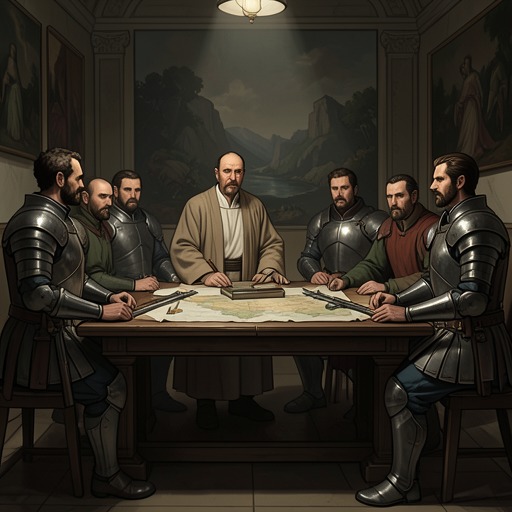
France becomes the setting for Hythloday’s principal thought experiment about political advice. Thomas More urges him to enter a prince’s service, arguing that a counsellor might guide a ruler toward good actions and thereby benefit an entire country. Hythloday rejects the proposal by imagining himself summoned to the French king’s council. The scene is hypothetical, not a report of an actual meeting: it gives a concrete form to his claim that court advisers generally serve the monarch’s designs rather than question them.
In this imagined council, the discussion is organized around territorial expansion. Advisers consider how Milan might be retained, Naples recovered, and the Venetians and the rest of Italy subdued. They propose adding Flanders, Brabant, Burgundy, and further kingdoms to the French king’s dominions. Their plans treat neighboring states as possessions to be acquired or bargaining pieces to be used. The scale of these ambitions makes Hythloday’s alternative—to leave Italy alone and govern the kingdom already held—appear radically out of place in the council’s terms.
The imagined advisers’ methods make the political problem more specific. One recommends an alliance with the Venetians that would last only while useful, with a share of the expected gains offered until France could dispense with them. Others propose hiring Germans, securing the Swiss with pensions, and winning over the Emperor with money. To manage relations with England, they would pursue a peace treaty while continuing to suspect the English as enemies, keep the Scots available for attacks, and secretly support an exiled nobleman with a claim to the English crown. In Hythloday’s account, diplomacy is thus not a path to trust or stable peace: it is a means of arranging advantage while concealing hostile intentions.
Hythloday sets against this programme the example of the Achorians, a people near Utopia. After conquering a kingdom claimed through an old alliance, they found that holding it required continuing wars, drained money and lives, and brought little benefit to their people. The comparison supplies a practical answer to the French council’s expansionism: conquest can increase the ruler’s burdens without improving the governed population’s condition. Hythloday suggests that a French king should remain with the realm already in his care, but he and More agree that such advice would not be well received. The point is not merely that the counsel is sound; it is that the court’s priorities make it politically unusable.
Revenue, Law, and Royal Power
A second imagined council concerns the enlargement of the prince’s treasury. The proposals expose another form of government detached from public welfare. One adviser would alter the value of money according to whether the king was paying debts or receiving revenue, allowing him to pay less in real value and collect more. Another would raise money on the pretext of war, then make peace once the funds had been secured, presenting the scheme as an expression of the prince’s religious concern for his subjects.
Other proposals turn law into a revenue instrument. Advisers would revive neglected statutes and collect penalties from subjects who had long ceased to remember or observe them. They would prohibit practices under severe penalties, then sell expensive dispensations to people who found it advantageous to break the rules. Judges, meanwhile, would be brought to court and manoeuvred into supporting the royal prerogative; disagreement among them could make even a clear legal question seem uncertain, creating room for the king to press his own interpretation. In this account, law does not constrain power. Its complexity and selective enforcement give power plausible cover.
These proposals extend the French portrait beyond a critique of military ambition. The same courtly logic governs both foreign policy and domestic administration: subjects and neighboring states become resources to be managed for the ruler’s benefit. Hythloday’s imagined counsellor would have to oppose not one misguided measure but an entire pattern of advice, in which financial manipulation, legal pressure, and expansion are treated as competent government. His reluctance to enter royal service follows from this institutional obstacle, not from a belief that political decisions are unimportant.
Narrative Function and Interpretation
France’s role is sharpened by the form of Utopia. The book begins from a frame of travel and political discussion, then uses Hythloday’s reported experience and imagined examples to examine contemporary institutions through comparison. More’s introductory account notes that he sometimes presents a case as concerning France when he means England. That warning makes France’s speeches and policies more than a straightforward national portrait: the French setting can provide distance for criticism whose implications reach across the Channel.
The distinction between the narrative frame and Hythloday’s hypothetical council also matters. The French advisers’ schemes are presented within a philosophical argument about service to princes, not as a documented episode or a neutral description of a particular administration. France gives that argument a recognizable political arena, while the imagined debate tests what happens when a counsellor proposes restraint among ministers devoted to acquisition. Its significance lies in the contrast between the public good invoked by More and Hythloday and the court’s practical measures: conquest abroad, coercive revenue at home, and a political order that treats candid advice as an obstacle rather than a resource.