Amaurot
UtopiaAmaurot is the chief city of Utopia, centrally placed, foremost in precedence, and the seat of the island’s supreme council. Its importance is political, but its physical design matters just as much: the river Anider gives it access to shipping, a second stream and rainwater cisterns protect its water supply, and walls, towers, and a dry ditch strengthen its defenses. Because Raphael Hythloday lived there for five years, he presents Amaurot as the city he knows best and uses it to describe a wider pattern: the cities of Utopia are built and governed in much the same way.
Central City and Common Pattern
Utopia has fifty-four cities, all large and well built, with the same manners, customs, and laws. They are laid out as similarly as the ground allows; even their distances belong to an organized island-wide arrangement. The nearest cities are at least twenty-four miles apart, while the most remote are close enough that a person can walk from one to its nearest neighbor in a day. Each city’s jurisdiction covers at least twenty miles, and may extend farther where settlements are more widely spaced. The cities do not seek to expand their boundaries, since their inhabitants regard themselves as tenants rather than landlords.
Amaurot stands near the island’s center, making it a convenient place for common business as well as the natural seat of authority. Once a year, each city sends three of its wisest senators there to consult about matters affecting the whole island. Its precedence over the other cities is therefore not simply a matter of size or appearance: it is the place where local communities meet to deliberate together. Raphael’s choice of Amaurot also reflects the limits and authority of his account. He says that knowing one Utopian city is nearly equivalent to knowing the rest, but selects this one because it is the most eminent and because his five years there made it especially familiar to him.
Setting, River, and Defenses
The city occupies a rising slope beside the Anider. Its plan is almost square: one side rises nearly to the top of the hill and then descends for two miles toward the river, while the other side is somewhat broader along the bank. The Anider begins as a small spring about eighty miles upstream. By Amaurot, after receiving other brooks—including two notably larger tributaries—it has widened to half a mile; it continues to grow before reaching the ocean sixty miles downstream.
The river’s changing water gives the city both an advantage and a natural limit. The tide moves strongly between the sea and the stretch below Amaurot, advancing roughly thirty miles and forcing salt water upstream; above that point the water becomes brackish, but where the river passes the city it is fresh. A bridge of stone, raised on many arches, crosses the river at the part of town farthest from the sea. Ships can lie along the city without being obstructed by it, joining the town’s position on the river to the broader commerce of the island.
A smaller stream rises from the same hill, runs through Amaurot, and joins the Anider. Its spring lies just outside the walls, so the inhabitants have fortified its source against an attacker who might try to stop, divert, or poison the supply. Earthen pipes carry water to the lower streets; where the stream cannot reach, large cisterns collect rainwater. The city is enclosed by a high, thick wall strengthened with towers and forts. A broad, deep dry ditch, densely planted with thorns, protects three sides, while the river serves as a ditch on the fourth. The river is thus at once a route for ships, a source of fresh water, and part of Amaurot’s defensive perimeter.
Streets, Houses, and Civic Life
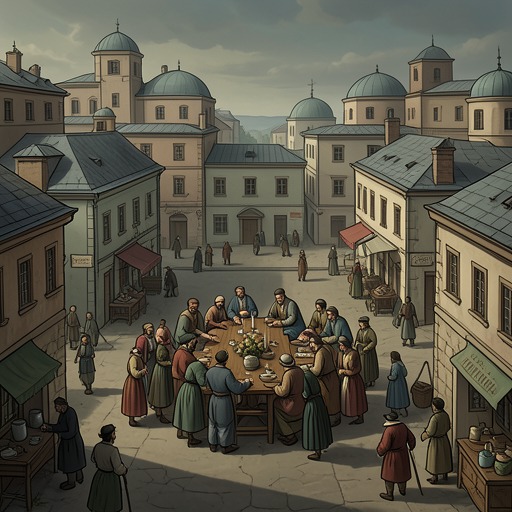
Amaurot’s streets are arranged for convenient carriage and sheltered from the winds. They are twenty feet wide, and the buildings are so uniform that an entire side of a street appears like one house. Behind every house lies a large garden, enclosed by buildings that face the street; each house has a street entrance and a rear door opening onto the garden. The city’s repeated forms make its architecture legible as a shared arrangement rather than a display of individual distinction.
This urban order supports the social organization common to Utopian cities. Families are grouped by kinship: grown women marry out, while male children and grandchildren remain in the household under the authority of its common parent, unless age has weakened that person’s judgment, in which case the next oldest takes the place. A city may contain no more than six thousand families, apart from the surrounding country families, and each household must have between ten and sixteen people, excluding children too young for a fixed count. Children may be moved between households when one family has more than another, while growing cities can be supplied from those with slower population growth.
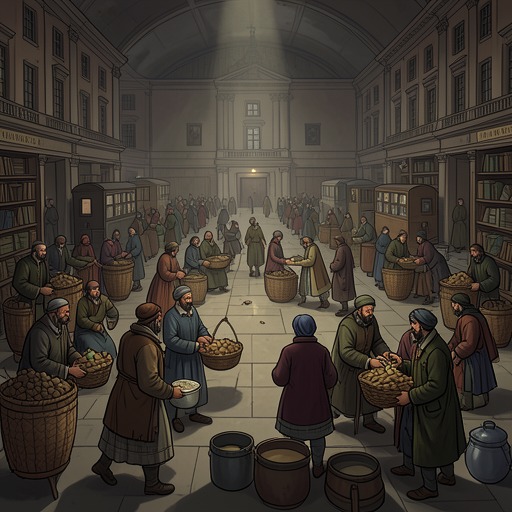
Each of the city’s four equal divisions has a marketplace at its center. Goods made by the families are brought to designated storehouses, where like items are kept together. A father of a household takes whatever he or his family needs without paying or leaving goods in exchange; the system assumes abundance and removes fear of being refused. Markets also provide food, including produce, bread, fish, fowl, and cattle. These arrangements show how Amaurot’s streets and districts belong to a larger system of provision: the city is not only a place to live and govern, but an organized point of distribution.
Elections and Deliberation
Amaurot’s local government links families to island-wide authority. Every year, thirty families choose a magistrate, formerly called a Syphogrant and now called a Philarch. For every ten such magistrates and their families, another magistrate—formerly the Tranibore and now the Archphilarch—presides. The two hundred Syphogrants choose the Prince from four candidates named by the people of the city’s four divisions. Before voting, they swear to choose the person they judge most fit, and they cast their votes secretly. The Prince serves for life unless suspicion arises that he intends to enslave the people; the Tranibors are chosen anew each year, though often retained, while other magistrates serve annual terms.
The city’s role as the setting for political business is bounded by strict protections against private conspiracy. The Tranibors meet with the Prince every third day, or more often when needed, and two Syphogrants are called into the council chamber, with the pair changed daily. No public question may be concluded until it has been debated in council on three separate days. Matters of great importance are passed to the Syphogrants for discussion with the families in their divisions before they report to the senate; on the greatest occasions, the question goes to the council of the whole island. The council does not debate a proposal on the day it is first raised, leaving time to reconsider it rather than letting the heat of the moment or attachment to an initial opinion determine policy. Amaurot’s prominence therefore rests not only on its central position, but on the deliberate procedures that make it a meeting place for representation, scrutiny, and common rule.