New Castile
UtopiaNew Castile is the remote point in the New World where Raphael Hythloday and other members of Amerigo Vespucci’s expedition were left behind, and the point from which Hythloday’s independent travels begin. In the frame narrative, it is less a fully mapped setting than a threshold: separation from the expedition sends Hythloday into new societies, while his later account of those journeys makes distant places material for political comparison in Europe.
Place in the Voyage
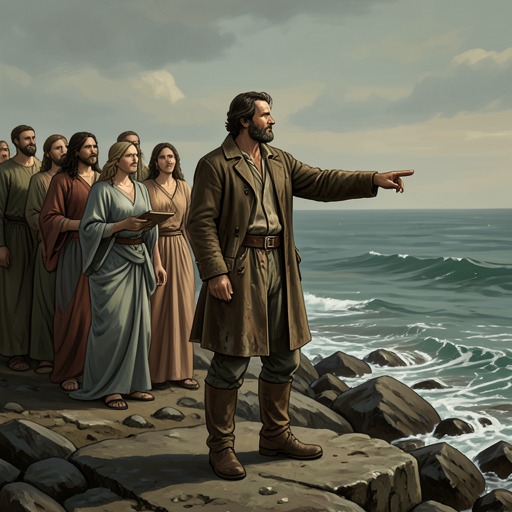
Hythloday, a Portuguese traveller devoted to seeing the world, joined Vespucci on three of the four voyages then published. He did not return with Vespucci on the last voyage. Instead, he obtained leave, almost by force, to remain among the twenty-four men left at the farthest place the expedition reached in New Castile. The separation marks a decisive change in his journey: rather than turn home with the expedition, he stays behind and continues travelling.
The text gives New Castile this specific role in the expedition’s route, but does not provide a detailed description of the place itself. Its narrative importance comes from what follows the departure: Hythloday and his companions must make their way through unfamiliar countries without the expedition’s continuing presence.
Encounters and Passage Beyond
After Vespucci sailed away, Hythloday and his companions gradually won the local people’s affection by meeting with them often and treating them gently. They came to live among them without danger and to converse with them familiarly. Their progress depends not on force but on repeated contact, which opens a path from being stranded outsiders to being accepted travellers.
Their relationship with one prince turned that acceptance into practical assistance. He supplied them with necessities and travel equipment, including boats for journeys by water and wagons for travel overland. He also sent a trusted guide to introduce them to other rulers and recommend them. With this support, they travelled for many days and reached towns, cities, and commonwealths described as populous and well governed. New Castile is thus the beginning of a route sustained by hospitality, transport, and local connections.
From New Castile to Europe
Hythloday’s account follows the journey beyond New Castile rather than presenting that place as its final destination. After travelling through many countries with five Castilians, he eventually reached Ceylon and then Calicut, where he found Portuguese ships and returned to his native country. The narrative does not identify New Castile as the location of every landscape or society encountered along the way; it establishes it as the point of departure for the wider travels.
Those travels explain how Hythloday acquires the experience that Peter Giles later values: he can report on countries unfamiliar to his European listeners and compare their customs and institutions with those at home. In the dialogue, his journey becomes the route by which observations of distant societies enter a debate about political life. New Castile therefore matters not as a fully described geography, but as the place where expeditionary travel gives way to independent encounter and, eventually, to testimony.