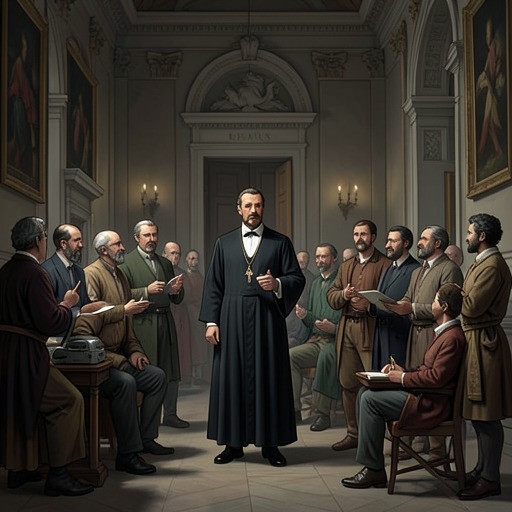
Thomas More and Cardinal John Morton’s patronage relationship
UtopiaThomas More and Cardinal John Morton’s patronage relationship began in More’s boyhood and connected household service with education, advancement, and lasting personal regard. Morton provided a place in his household and helped More progress in the world; More, in turn, remembered him not merely as a powerful patron but as the generous and discerning head of the family in which he had been raised.
Background and Patronage
More, son of a justice of the King’s Bench, was born in 1478 in Milk Street, London. After attending St. Anthony’s School in Threadneedle Street, he was placed as a boy in Morton’s household. Such arrangements were customary among influential families: a young client wore his patron’s livery and added to the household’s state, while the patron might later use wealth or influence to advance the client’s prospects. The relationship therefore had a public and practical dimension as well as a personal one. More’s early association with Morton brought him into the orbit of a senior churchman and statesman at a formative point in his life.
Morton’s own standing helps explain the weight of that patronage. He had been the Bishop of Ely whom Richard III sent to the Tower, later opposed Richard, and became a chief adviser to Henry VII. Henry made him Archbishop of Canterbury in 1486 and Lord Chancellor nine months later. When More entered his household, Morton was thus not simply a wealthy guardian but a central figure in the government. More’s service in his household placed the boy within a world where political authority, learned conversation, and a patron’s personal judgment could shape a young client’s prospects.
Affection and Recognition
Morton took pleasure in the quick wit of the boy waiting at his table. His prediction that the child would prove “a notable and rare man” was an explicit expression of confidence in More’s promise. The moment gives the relationship a personal texture: Morton’s attention was not limited to the formal obligations of patronage, but included a discerning interest in the qualities of the young person in his care. His praise also anticipates the public distinction More would later achieve, while remaining grounded in the ordinary household scene of a child serving at table.
The relationship was not depicted as a simple exchange of service for advancement. The account of customary patronage explains the structure around More’s placement, but Morton’s response to his wit suggests individual regard within that structure. The patron’s influence could open paths; his recognition also gave More a powerful early affirmation. The evidence presents that recognition as Morton’s judgment of More’s character, rather than as proof that every later success followed directly from a single intervention.
Education and Advancement
At about nineteen, More was sent to Canterbury College, Oxford, by Morton. There he learned Greek from William Grocyn and Thomas Linacre, described as among the first to bring Greek studies from Italy to England. This educational opportunity gives the patronage relationship a concrete consequence: Morton’s support extended beyond providing a childhood home and helped More enter a course of study that included the new humanist learning of the period. The connection between household placement and education is particularly clear because the account identifies Morton as the person who sent him to Oxford.
In 1499 More left Oxford to study law in London at Lincoln’s Inn. Morton died the following year. The sequence marks the end of the direct period of patronage, but not the disappearance of its influence from More’s life. More had moved from a boy in Morton’s household to a university student and then to legal study; the relationship had accompanied the beginning of that trajectory, even though the evidence does not make Morton responsible for every subsequent step.
Memory and Narrative Significance
More’s later recollection confirms that the household bond endured as an emotional attachment. When Raphael Hythloday described dining with Morton, More said that the story made him imagine himself back in his own country and young again, because it recalled the Cardinal with whom he had been raised from childhood. He also explained that Raphael was dearer to him for honoring Morton’s memory. The episode makes More’s affection explicit: respect for Morton was not an incidental biographical detail, but a point of intimacy between the two speakers.
The recollection also joins the private history of More’s upbringing to the book’s debate about political counsel. In the reported dinner conversation, Morton presides over a discussion in which Raphael challenges the severity of punishment for theft and argues for measures that would prevent people from being driven to steal. More’s response to Raphael preserves both his attachment to Morton and his continued disagreement with Raphael about whether a wise counselor should serve rulers. The remembered patron thus occupies two roles in the narrative: he is the person whose household formed part of More’s youth, and the historical host whose conduct becomes central to a philosophical exchange. More’s affection does not settle the argument; instead, it lends personal significance to the scene in which Morton’s judgment and political world are recalled.