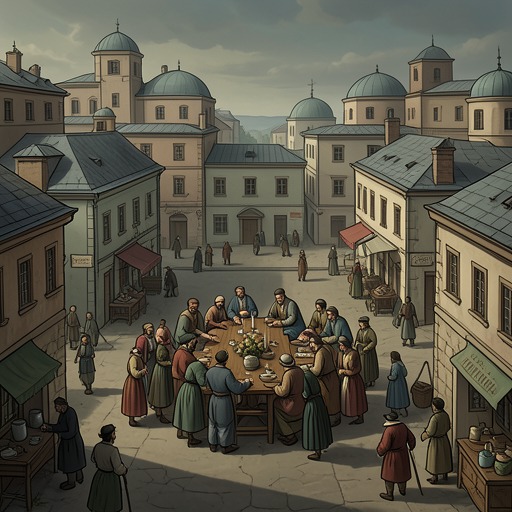
Utopus and the original inhabitants of Utopia
UtopiaThe relationship between Utopus and the original inhabitants of Utopia is founded on conquest: Utopus seized Abraxa, separated it from the mainland, and reorganized its people under a government that Raphael Hythloday presents as exceptionally successful. The founding account makes the island’s physical transformation inseparable from its political one. It credits Utopus with raising the inhabitants from what the narrative calls uncivilized conditions, but also records that both conquered people and the conqueror’s soldiers were compelled to dig the channel that remade their territory.
Conquest and the Making of an Island
Before it was Utopia, the territory was called Abraxa and formed part of the continent. Utopus conquered it and then ordered a channel fifteen miles long to be dug, intending to bring the sea around the land and make it an island. The work was completed quickly because he set a great number of people to it. His subjects were not the only laborers: he required his own soldiers to work alongside the inhabitants, explaining in the account that he did not want the conquered people to feel they were being treated as slaves. That qualification does not remove the compulsion; it shows how the founding story frames collective labor as a means of binding ruler and ruled to a shared undertaking.
The new boundary had a practical as well as symbolic effect. Utopia’s approaches became difficult to navigate: the entrance to its broad bay was obstructed by rocks and shallows, and the safe passage was known only to native pilots and marked from the coast. Other harbors were protected by natural defenses and human works. The channel therefore stands at once for Utopus’s capacity to alter the land and for the security of the polity that followed his conquest. The account says neighboring peoples first mocked the project, then regarded its completion with admiration and fear.
From Subjection to Political Incorporation
Raphael’s account describes Utopus as having brought the original inhabitants into a good government and a degree of refinement that, in his judgment, surpassed that of other peoples. This is the narrative’s central transformation: conquest is represented not only as the taking of territory but as the start of a reformed society. The island keeps its conqueror’s name, while Abraxa survives as the name of its earlier condition, making political change legible in the place’s altered identity.
The account gives no individual voices or specific acts of consent from the conquered inhabitants. Instead, their incorporation is narrated from the perspective of the traveler who reports Utopian history. The one concrete founding measure it describes is the channel, whose construction required their labor under Utopus’s order. The claim that the project did not treat them like slaves rests on the fact that the soldiers labored too; it does not establish that the inhabitants chose the work or the new government. The resulting society is praised for its institutions, but the account leaves the original inhabitants’ own experience of the conquest largely unrecorded.
The Founding Legacy in Social Organization
The order associated with Utopus is presented as more than a change of ruler. Utopia’s cities share the same customs and laws, and their representatives meet annually at Amaurot to deliberate on common affairs. The society is organized through households and families, with authority assigned by age and kinship. These arrangements depict a population integrated into a stable civic structure rather than a conquered people governed only by military force.
That stability also depends on managing where people live and how land is used. Cities are kept within limits on the number of families; growing populations can be redistributed among towns, while excess inhabitants may be sent to colonies on the neighboring continent. If plague leaves a city severely depleted, settlers can be recalled from those colonies rather than allowing the island’s towns to decline. The founding narrative thus leads into a system that treats population and territory as matters of collective administration, extending the political ordering begun under Utopus beyond the original conquest.
Expansion and the Limits of Incorporation
The later colonial policy repeats the founding relationship on new ground, but distinguishes between willing and unwilling neighbors. Utopians may invite local inhabitants to join their society; when those inhabitants accept, they are brought into Utopian ways of life, and the land is said to support both populations through careful cultivation. If local people refuse to conform, however, the Utopians drive them from the territory they have marked out and use force if they resist. The account calls a nation’s refusal to let others occupy land it leaves uncultivated a just cause for war.
This policy makes the founding story’s moral tension explicit. Utopus’s conquest is remembered as a civilizing and political achievement, while later territorial claims are defended through the promise of productive land use and common welfare. Yet the same account recognizes that Utopian expansion can displace people who do not consent. Its contrast with the English enclosure described by Raphael is instructive: he condemns landlords for enclosing farmland, destroying houses and towns, and driving residents from their homes, after which many are left without work or pushed toward theft. The Utopian rationale differs in its stated aim and in its offer of incorporation, but the right to occupy land is still asserted over the objections of its existing inhabitants.
Narrative Framing and Significance
The founding history reaches the reader through Raphael Hythloday’s report of Utopian customs and laws to Thomas More and Peter Giles. Raphael says he lived in Utopia for five years and urges his listeners to judge its institutions through what he saw there; his account of the conquest supplies the historical premise for the society he describes. The narrative presents Utopus’s rule as the origin of a more orderly commonwealth, but it also preserves details—forced labor, conquest, and the threatened expulsion of resistant neighbors—that complicate that ideal.
Utopus and the original inhabitants are therefore linked by a founding act whose consequences outlast the battlefield: the territory is remade, its political identity changes, and its people are incorporated into a celebrated order. The story’s praise of collective administration does not erase the coercion at its origin. Nor does the later promise of shared prosperity settle the question of who has the authority to define land as unused and claim it. The relationship reveals both the reach of Utopian political design and the force used to establish and extend it.