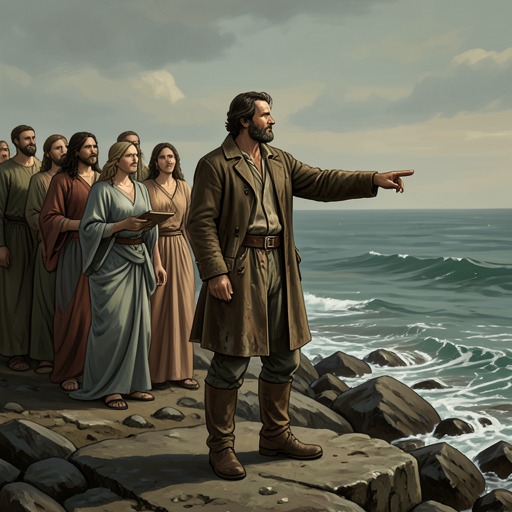
Raphael Hythloday and Amerigo Vespucci’s voyages
UtopiaRaphael Hythloday and Amerigo Vespucci’s voyages form the travel history behind Hythloday’s authority as a witness to distant societies. Hythloday joins three of Vespucci’s four published voyages but does not return with him from the last; instead, he remains in New Castile and continues travelling. The separation turns an expedition into a longer independent journey, through which he encounters unfamiliar peoples, learns how trust and patronage can open routes across foreign lands, and gathers the observations that later inform his account of Utopia.
Joining the Voyages
Hythloday is a Portuguese traveller and philosopher who has divided his estate among his brothers before setting out, choosing travel over settling at home. The book’s introductory account associates him with the three last of Vespucci’s voyages to the newly discovered world; in Hythloday’s own introduction, he is said to have taken part in three of the four voyages then published. Both accounts establish that his travels are not a brief detour from an established life, but a deliberate choice to see the world at considerable personal risk.
His course diverges from Vespucci’s when he obtains leave, almost by force, to remain among the twenty-four men left at the farthest point reached on the last voyage to New Castile. Vespucci sails away, while Hythloday and the others stay behind. Hythloday’s separation from the expedition’s leader is therefore the decisive change in the relationship: the voyage supplies his point of departure, but his subsequent movements are no longer made in Vespucci’s company.
The Journey After Separation
Hythloday and five of his companions travel through many countries after Vespucci’s departure. They gradually win the inhabitants’ confidence by meeting them repeatedly and treating them gently. Their survival and mobility depend not on conquest but on the relationships they build: a prince comes to favor Hythloday’s group, provides supplies and travel equipment, and assigns a faithful guide to introduce them to other rulers.
That assistance makes a long itinerary possible. The travellers move by boat on water and by wagons over land, eventually reaching towns, cities, and commonwealths described as populous and well governed. The narrative moves from hot, desolate regions near the equator toward milder climates and greener country, where settled societies trade with neighbours and distant lands by sea and overland routes. Hythloday’s access to ships bound for different destinations lets him and his companions continue their observations across a wide area.
Exchange, Navigation, and Risk
The voyages are also a story of uneven exchange in knowledge. Hythloday describes early vessels with flat bottoms and sails woven from reeds and wicker, while some use leather; farther on, the travellers encounter ships with round keels and canvas sails, like those familiar to Europeans, whose sailors understand astronomy and navigation. The contrast places Hythloday in the role of a comparative observer, moving among societies with different technologies rather than encountering a single uniform foreign world.
In one consequential exchange, Hythloday demonstrates the use of the magnetic needle to sailors who had not known it. Before this, they sail cautiously and only in summer; with the lodestone, they begin to regard every season as suitable for sailing. The innovation brings greater freedom of movement, but the account immediately qualifies that benefit: their reliance on it may make them more confident than safe, and the discovery could become a source of harm through imprudence. The episode complicates the idea that technological knowledge is automatically beneficial; what matters is how people use it.
From Travel to Testimony
Years later, Hythloday’s travels are recalled in Antwerp, where Peter Giles introduces him to Thomas More after noticing More’s interest in unknown countries. Giles presents him as an unusually rich source of information; Hythloday’s weathered appearance initially suggests a seaman, but Giles identifies him instead as a traveller and philosopher. The expedition history thus helps explain why a meeting in a garden can become an extended report on distant customs and political arrangements.
Hythloday’s authority rests on sustained observation as well as travel. He says that he lived in Utopia for five years and was so pleased with its institutions that he would not have left but to make the discovery known to Europeans. His earlier voyages supply the broader comparative frame for that account: he has seen different forms of government and can set their practices against those of Europe. Yet the account is mediated through Hythloday and More’s narration, and its details are not uniformly complete; More notes that Hythloday had forgotten the name and country of the prince who aided the travellers.
The relation between the voyages and the book’s political argument is therefore central but not conclusive. Hythloday uses what he has seen to expose errors in European society and to propose foreign institutions as possible lessons. At the close, however, More distinguishes his respect for Hythloday’s learning and worldly knowledge from agreement with everything reported, especially Utopia’s common property and rejection of money. The voyages give Hythloday the standing to compare societies; the framing narrative leaves readers room to assess both his conclusions and the limits of his testimony.