Thomas More and Peter Giles’s friendship
UtopiaThomas More and Peter Giles’s friendship, formed in Antwerp during More’s 1515 embassy to the Low Countries, joins the human warmth of the book’s opening with its philosophical invention. Giles offers More welcome companionship during an absence from his wife and children, then introduces him to Raphael Hythloday, whose account of distant societies opens the way to Utopia’s central debate.
Origins in Antwerp
In May 1515, More was sent to the Low Countries with Cuthbert Tunstal and other commissioners to negotiate with representatives of Charles V. He spent six months away from England; while in Antwerp, he met Giles, a scholarly young man serving as secretary to the municipality. The historical account describes the two as becoming friends there, and the dialogue’s opening gives that connection a personal measure: More has been away from his family for four months, and Giles’s company substantially eases his longing to return home.
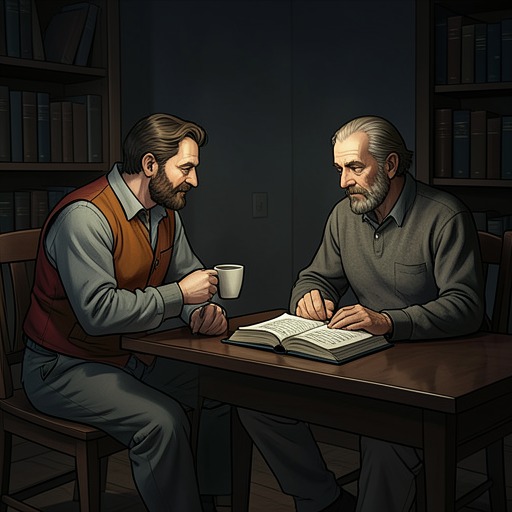
The book makes that friendship legible through an encounter rather than a formal introduction. Returning from mass at St. Mary’s, Antwerp’s chief church, More finds Giles talking with a weathered stranger in a careless cloak. Giles greets More, draws him aside, and points out the stranger, explaining that this is the very person he had been thinking of bringing to More. The meeting rests on Giles’s knowledge of More’s interest in unfamiliar countries and on his confidence that the stranger’s conversation will appeal to him.
Giles as Friend and Intermediary
Giles’s importance in the scene is both social and intellectual. He does not merely present two acquaintances: he recognizes what each may offer the other. He knows More’s curiosity about distant peoples, and he vouches for Raphael Hythloday as an unusually rich source of knowledge about unknown nations. His introduction converts a chance conversation in Antwerp into the book’s principal exchange of ideas.
The narrative also establishes why More values Giles beyond this practical role. Giles is presented as learned, courteous, modest, candid, and warmly kind to his friends; his conversation is pleasant and cheerfully innocent. These qualities make him more than a device for bringing Raphael into the story. His ease with More supplies an intimate frame for the philosophical discussion that follows, while his presence keeps that discussion rooted in the ordinary circumstances of hospitality and friendship.
Friendship and the Making of Utopia
The friendship belongs to both the narrated encounter and the history of the book. More’s account begins with his diplomatic commission and his time in Antwerp, then moves from the factual setting into the fictional discovery of Raphael Hythloday. Giles is the hinge between those layers: a historically situated friend within the embassy narrative and the person who brings the invented traveller into More’s company.
Giles’s connection to Utopia also continued beyond this introduction. The book was first printed at Louvain late in 1516 under the editorship of Erasmus, Giles, and other of More’s friends in Flanders. The evidence thus associates Giles with the work not only as a character in its conversational frame but as one of the people involved in its first publication. The friendship’s literary consequence is visible in both the structure of the dialogue and the book’s early production.
Significance and Limits
Giles makes the opening’s transition from public affairs to imaginative political inquiry feel socially grounded. More arrives in Antwerp as a royal commissioner; through his friend, he encounters a traveller whose experiences prompt discussion of well-governed states and, eventually, Utopia. Friendship here enables the passage from diplomacy to speculation without erasing the difference between the two: the meeting is placed in the account of More’s embassy, while Raphael’s reported travels and the commonwealth they disclose belong to the book’s fictional design.
The surviving account supports a close intellectual and personal association, but does not detail the friendship’s later private course. Its clearest evidence is concentrated in Antwerp: Giles’s companionship during More’s separation from his family, his discerning introduction of Raphael, and his participation in the first edition’s editorial circle. Together these acts give the friendship a defined place in the creation and framing of Utopia.