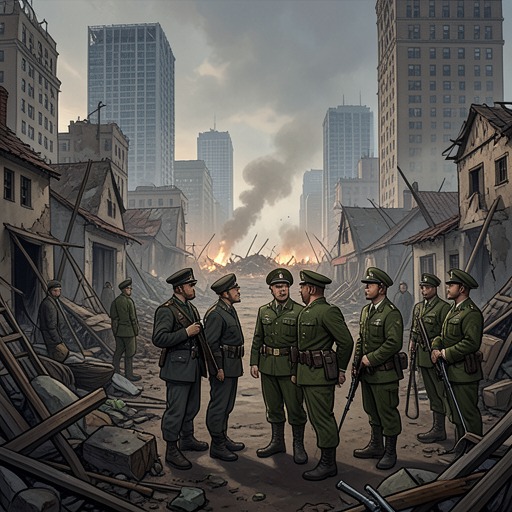
The Utopians and the Nephelogetes
UtopiaThe Utopians’ alliance with the Nephelogetes against the Aleopolitanes is presented as a test of their claim that war is justified only under stringent conditions. They entered the conflict after deciding that Nephelogete merchants had suffered grave injustice and that demands for reparation had been refused. The campaign ended in the conquest and enslavement of the Aleopolitanes, but the Utopians took no share of the spoils. The episode sets their restraint in profiting from victory beside the far-reaching consequences of their military intervention.
Grounds for Intervention
The Utopians detest war as brutal and regard martial glory as inglorious. Although they train both men and women in military exercises, they say they resort to war only to defend themselves or their friends against unjust aggression, or to help an oppressed people escape tyranny. Their assistance to an ally, whether defensive or offensive, depends on prior consultation: they must be satisfied with the reasons for going to war and find that demands for reparation have been rejected, making conflict unavoidable.
The Nephelogete case arose not from a reported invasion but from commercial grievances. The Utopians judged that merchants from the Nephelogetes had been treated unjustly in Aleopolitan territory, either under unjust laws or through the perverse application of good ones. In their account, injuries inflicted under the appearance of legality could be an even stronger cause for war than open depredation. The text leaves open whether the merchants’ claim was objectively right or wrong; what it establishes is that the Utopians considered the grievance serious enough, and redress sufficiently exhausted, to justify intervention.
The Campaign and Its Cost
The Utopians’ decision to join the Nephelogetes drew in many neighboring states. Their military strength helped sustain the campaign, which shook some flourishing states and badly afflicted others. After a prolonged course of damage, the war ended with the complete conquest and enslavement of the Aleopolitanes. Though the Nephelogetes had been inferior to their opponents in other respects before the conflict, they prevailed with Utopian assistance.
That outcome complicates the Utopians’ self-image as reluctant participants in war. They describe intervention as a means of securing justice, not pursuing fame or territorial gain; nevertheless, the chosen remedy escalated into a broad and destructive war and ended in the subjugation of the people whose state had wronged the merchants. The account records both the stated cause and the scale of the result without claiming that the consequences were limited to those responsible for the original grievance.
Restraint, Victory, and Military Practice
The Utopians say they would be troubled and ashamed by a bloody victory, preferring success achieved through judgment and skill without loss of life. Their ideal is to obtain by force what, if granted in time, would have prevented the war; if that cannot be achieved, they seek to deter future injury. They present security and the prevention of further harm, rather than fame, as the purpose governing their military designs.
Their general methods include measures intended to end wars without a decisive battle. At the opening of a conflict, they distribute sealed notices in conspicuous places in enemy territory, offering rewards for the capture or killing of the prince and other leading figures, and for defections. If such offers fail, they try to foment internal divisions or encourage neighboring powers to revive old claims, supplying those powers with money but sparingly with troops. These practices are described as Utopian policy, not as specific episodes in the Nephelogete campaign; they reveal how the desire to spare their own people can coexist with bribery and political subversion abroad.
Their rules of conduct in war likewise set limits on some forms of destruction. They observe truces, avoid laying waste to enemy land or burning crops, and protect people who are unarmed unless they are spies. A town that surrenders is taken under their protection; when a place is captured by storm, they distinguish between those who resist surrender and the rest of its garrison, while sparing other inhabitants. They distribute rewards from the estates of those they condemn and allocate remaining spoils to auxiliary forces, but claim no share for themselves. The refusal of spoils after the Aleopolitanes’ defeat is thus consistent with a broader distinction between intervention and private enrichment, though it does not undo the conquest or enslavement that followed.
Significance of the Alliance
The alliance makes the Utopians’ theory of just war concrete: intervention is conditional on a claim of injury, prior consultation, and the failure of reparation, with commercial injustice treated as a serious public cause rather than a merely private loss. The same episode also exposes the tension within that theory. The Utopians can reject the material rewards of victory and condemn war’s pursuit for glory while using their strength in a conflict whose consequences extend to neighboring states and culminate in the enemy’s enslavement. Their restraint concerns the grounds, methods, and spoils of war; it does not make their intervention bloodless or its aftermath mild.