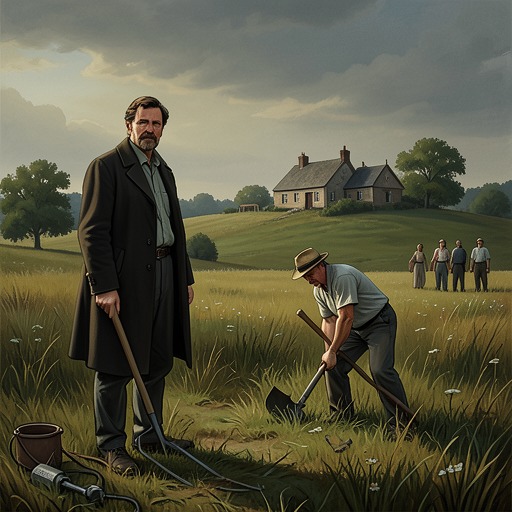
Baker Farm
WaldenBaker Farm is both a real local landscape and a point of encounter between Thoreau’s ideal of deliberate simplicity and the material pressures of another household. Its woods and meadow frame his meeting with John Field, while the later loss of trees makes the farm’s surroundings part of the book’s record of a changing countryside.
Setting and Approach
The farm lies beside Pleasant Meadow, which the narrative identifies as an adjunct of Baker Farm. Thoreau passes through the meadow on his way to Fair Haven, setting out to fish because he wants to supplement his scant fare of vegetables. The route brings him from his chosen woodland life into the orbit of a working household, making the farm less a detached pastoral view than a place reached through ordinary need and labor.
The meadow carries a literary association as well as a practical one: a poet has sung of the retreat, and the poem imagines a humble cabin bound for destruction. Thoreau counters that poetic framing with the plain fact of present occupation. John Field, an Irishman, lives there with his wife and several children; the family’s circumstances replace the imagined ruin with an inhabited home and a household at work.
John Field and the Household
The encounter makes Baker Farm a setting for a class contrast. Thoreau arrives with vegetables as his scant fare and intends to catch fish; Field’s family, by contrast, is seen through its work and the children who belong to that working household. The farm thus anchors the book’s meditation on how people secure daily subsistence, though the evidence here gives only a brief glimpse rather than a full account of the family’s life.
Before Thoreau reaches the pond, a fresh impulse has already brought Field out, and by that sunset he has let go of bogging. The change is reported as a momentary alteration of mind, not as a lasting conversion or a settled outcome. Its brevity matters: Baker Farm enters the narrative through a small opening toward a different course, while the account leaves the longer consequences unstated.
Woods, Seasons, and Change
Baker Farm belongs to a landscape whose condition is not fixed. Thoreau remembers that after he left the shores, woodchoppers further laid the woods waste; for years, he says, there would be no rambling through wooded aisles and occasional openings onto the water. The disappearance of the trees changes both access and view: a landscape once experienced by wandering is diminished by cutting.
Yet the surrounding country is not represented as lifeless. In midwinter, Thoreau finds a warm, springlike swamp where skunk-cabbage remains green, and a hardier bird awaits spring’s return. This seasonal persistence stands beside the damage to the woods without erasing it: the landscape can renew itself in small signs, even as human use removes the shaded paths and vistas that made it familiar.
A Working Landscape
Elsewhere in the book, the pond’s shore is described as a steep belt of smooth, rounded white stones, interrupted by one or two short sand beaches. In the winter of 1846–47, a hundred men of Hyperborean extraction arrive on the pond with carloads of farming implements; for sixteen days, a hundred men work there with teams, horses, and tools. These observations place the region around Baker Farm within a larger landscape of labor and alteration, where rural equipment and organized work reach even the waterside.
The narrative’s attention to land also moves between close observation and interpretation. On a passage through a railroad cut, thawing sand and clay form flowing shapes that give Thoreau particular delight; he reads the fresh designs as evidence of the earth’s generative force. That image does not describe Baker Farm alone, but it sharpens the contrast running through its landscape: wooded ground may be cut and altered, while seasonal processes continue to shape and renew the land.
Narrative Significance
Baker Farm gathers several scales of attention into one place-name: a route through meadow, a family’s home, a fleeting change in Field’s conduct, and woods whose remembered character is threatened by cutting. Its pastoral associations are checked by habitation and work, while the narrator’s personal account of simplicity is set against a household living under different material conditions.
The farm’s significance therefore lies not in a single dramatic event but in the tensions the setting holds open. It is poetic retreat and practical land, a scene of subsistence and a landscape subject to change. The book neither turns the family into a complete social portrait nor resolves the contrast between its ways of living; instead, Baker Farm makes that contrast visible within the ordinary passage from meadow to pond.