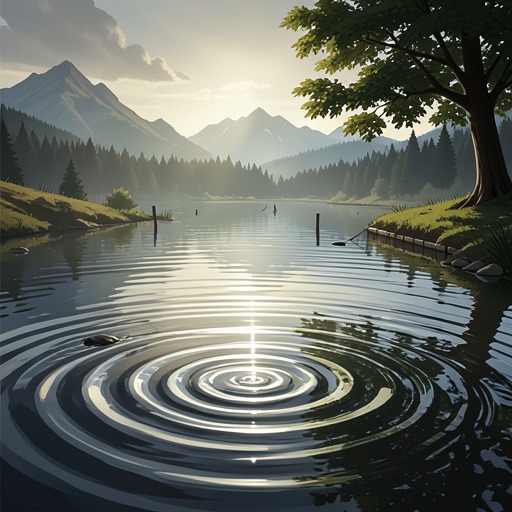
Walden Pond
WaldenWalden Pond is the lake at the center of Henry David Thoreau’s account of his life in the woods: the shore where he built his cabin, the setting for sustained observation and daily work, and a landscape through which the book considers nature, memory, and human change. Its physical character is described with precision, yet the pond is never merely scenery. Its depth, clarity, stillness, and changing surface make it both a natural subject in its own right and an image through which the narrator tests what it means to see and live deliberately.
Setting and Physical Character
Walden Pond lies in Concord, Massachusetts. Thoreau places his self-built house on its shore, making the lake the immediate setting of his experiment in independent living. The book also situates it in relation to other local waters: White Pond is described as a remarkably similar pond, while Fair Haven is reached on a fishing excursion. These comparisons place Walden within a broader landscape without diminishing its distinctiveness.
The scenery is modest in scale, but the pond is notable for its depth and purity. Its shore is a belt of smooth, rounded white stones, a visible edge that gives the water a sharply defined boundary. Such observations establish Walden as a real, particular place, apprehended through material details rather than grand scenery. The descriptions invite close attention: scale, transparency, shoreline, and depth matter precisely because the landscape is humble enough to reward looking.
That close attention also shapes how the book treats natural history. Thoreau observes seasonal phenomena and changes in the water, seeking to recover the pond’s long-lost bottom through measurement. Observation here is both bodily and intellectual: the lake is not simply contemplated from a distance but investigated as a place with depths and features that may be discovered. His delight in forms that appear through natural change extends that attentiveness beyond the pond’s outline to the designs produced by seasonal processes. The movement from description toward analogy is part of the book’s method, but the observed landscape remains the ground from which interpretation proceeds.
The Pond as Home and Working Landscape
Walden is inseparable from the practical life Thoreau establishes beside it. He builds his own house on the shore and describes returning to morning work with an axe and pail. The lake’s setting is thus not a retreat detached from ordinary activity: it is the scene of a deliberately arranged life in which shelter, labor, and observation belong together. The pond gives that life a stable geographical center, while the daily routines around it make the place familiar through repeated use.
Its shore is also a human landscape, altered over time. Thoreau recalls former occupants of the woods, and notes that woodcutters have further laid waste the shores. The old trunks visible at the bottom and an old log canoe preserve traces of earlier use within the water itself. Walden’s apparent natural stillness therefore coexists with evidence of habitation, extraction, and abandonment. The landscape is not presented as untouched; its history remains legible in the woods and beneath the surface.
Thoreau’s recollection that Walden is the same lake he has known daily for more than twenty years gives this setting a longer personal and local history. Repeated familiarity does not make the pond merely ordinary. It allows continuity to register against change: the water persists, while the surrounding woods and the people who have used them come and go. The lake becomes a point of comparison between remembered landscapes and the present view.
Work, Commerce, and Environmental Change
The changes around Walden are not only remembered. The woodcutters’ clearing diminishes the wooded shores, while commercial use transforms the frozen pond into a workplace. In the winter of 1846–47, a hundred laborers arrive to cut ice. For sixteen days Thoreau watches a hundred men at work from his window. The view from the cabin makes this episode especially striking: the place of quiet observation becomes a vantage point on organized labor, and the pond’s winter surface becomes material to be extracted and carried away.
The ice harvest joins the pond to activity beyond its banks. Walden is at once a local natural feature shaped by seasonal freezing and a resource sought by people who come to work it. The scene adds a temporal layer to the landscape: the winter pond that appears still is, for a short period, crowded with human effort. Thoreau’s observations keep both aspects in view—the lake’s seasonal life and the labor that turns it into a commodity—without making the human presence erase the natural processes on which that work depends.
The pond also appears within ordinary movement through the surrounding region. Thoreau sets out to fish at Fair Haven, passing through the landscape of local waters, and records going to Flint’s Pond on a cold night in February 1850. Such journeys make Walden part of a lived geography rather than an isolated emblem. The adjacent ponds and routes give the reader a sense of the wider territory through which he walks, while Walden remains the central site to which his observations return.
Water, Memory, and Reflection
Walden’s depth and clarity support more than physical description. Thoreau treats the pond as a kind of character, distinguished among the lives and presences he has known. That comparison gives the water a force beyond its role as backdrop: Walden’s continuing identity is measured against the instability of human life, while its familiar surface invites renewed attention rather than exhausted recognition.
The comparison with White Pond enlarges this reflective quality. The two waters are presented as great crystals on the surface of the earth, a figure that joins their material clarity to their power of reflection. The image does not cancel their physical reality; it intensifies it. Water reflects the world above while drawing attention to what lies beneath, and the two ponds make that double relation visible on a regional scale.
The old logs and canoe at the bottom deepen the connection between memory and observation. What is submerged remains part of the pond’s present, even when it belongs to an earlier landscape or a vanished use. In this way Walden’s depth becomes both a measurable feature and a structure of perception: the visible surface does not contain the whole history of the place. Thoreau’s interest in recovering the bottom turns looking into an effort to perceive what ordinary sight leaves hidden.
Seasonal Transformation and Significance
Walden’s most forceful change is seasonal. In 1845 the pond is first completely open on an early date, and Thoreau tracks such changes as evidence of the close relation between water and weather. His attention to the forms produced by seasonal processes brings delight as well as information: the pond’s transformation is something to watch as it happens, not simply a calendar fact.
In spring the frozen surface begins to break apart. A canal two rods wide forms along the melting ice, marking the advancing change in concrete dimensions. Thoreau describes the contrast as one between winter and spring, between a pond that was dead and one that is alive. The seasonal passage is therefore at once observable and interpretive: a physical thaw becomes an image of renewal, grounded in the visible alteration of the water.
Walden Pond holds together the book’s different ways of attending to place. It is a home shore, a subject of measurement, a remembered landscape, a site altered by woodcutting, and a resource worked by laborers. Its familiar waters invite repeated scrutiny, while the seasons make clear that familiarity does not mean sameness. The pond matters because it remains materially specific even as it gathers meanings: a real lake in Concord whose changing surface teaches the narrator—and the reader—to look again.