Concord, Massachusetts
WaldenConcord, Massachusetts, is both the inhabited town around Walden Pond and the larger landscape through which Henry David Thoreau examines work, poverty, memory, and the changing natural world. The narrator builds his cabin on the pond’s shore, about a mile from a neighbor, and supports himself by hand; from this deliberately chosen vantage near town, he studies Concord’s social conditions as closely as its woods, water, and seasons.
Setting and Walden
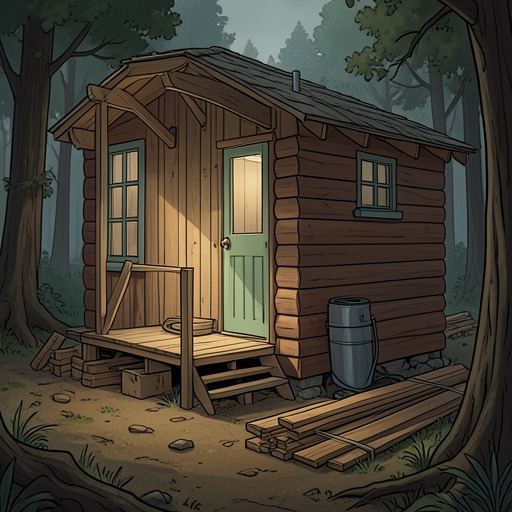
The cabin stands on the shore of Walden Pond, in Concord, Massachusetts. Thoreau describes living there alone for two years and two months, at a remove from immediate neighbors but not outside the orbit of the town. That distance lets the book set self-sufficient woodland life against the routines of Concord without treating the two as separate worlds: the narrator travels through the town and considers its shops, offices, fields, and inhabitants.
The pond is not presented as grand scenery. Its scale is humble, and its beauty, the narrator says, becomes most meaningful through prolonged familiarity with the shore. He records a steep shoreline of smooth, rounded white stones, broken by a small number of short sand beaches; in places, one leap reaches the water. This close attention makes the landscape a lived place rather than a panoramic backdrop.
Work, Poverty, and Social Criticism
Thoreau’s survey of Concord’s inhabitants turns the town into evidence for his critique of conventional work. In shops, offices, and fields, people seem to him to be doing penance; he asks whether the outward circumstances of life in town must remain so poor or could be improved. His judgment is not confined to a single class. He observes that farmers who are at least as well off as other groups may spend twenty, thirty, or forty years toiling, while asking what becomes of people with far less security.
The account draws attention to the degraded poor, including people living in shanties along the railroads. The railroad appears as a sign of improvement, yet its margins expose how little material security that progress guarantees to everyone. Thoreau’s contrast between outward civilization and deprivation makes Concord a setting for testing the human cost of what society calls advancement.
A Landscape Layered with Human History
The woods around the cabin carry traces of earlier inhabitants. Within the memory of townspeople, a road near the house had resounded with residents’ laughter and conversation; the former roadbed now lies beneath a dusty highway. The narrator’s woodland solitude is therefore also a walk through a landscape from which earlier domestic life has receded, though its paths and remnants remain legible.
That history includes slavery and the unequal ownership of land and shelter. Across the road from Thoreau’s bean-field lived Cato Ingraham, enslaved by Duncan Ingraham, a gentleman of Concord village, who built a house for him and permitted him to live there. Down the road on Brister’s Hill lived Brister Freeman, formerly enslaved by Squire Cummings. The names and locations anchor the town’s past in particular houses, roads, and planted trees rather than leaving slavery as an abstraction. They also complicate the narrator’s account of solitude: the woods had been inhabited, and the conditions under which people lived there were sharply unequal.
Natural Observation and Seasonal Change
Concord’s landscape is also a field of continuing natural processes. In midwinter, the narrator finds a warm, springlike swamp where skunk-cabbage remains green, and occasionally sees a hardier bird awaiting spring. Such observations distinguish the season’s apparent stillness from the persistence of life within it; the town’s natural setting is not merely scenery but a changing environment whose details reward repeated attention.
Thoreau’s work on Walden Pond makes that attentiveness especially concrete. Before the ice broke up early in 1846, he surveyed the pond’s long-lost bottom with a compass, chain, and sounding line. Later, passing a deep railroad cut, he takes delight in the shapes made as thawing sand and clay flow down its sides. He interprets the fresh forms as designs scattered by the maker of the world, an image that moves from observed geological change toward metaphysical reflection. In Concord, the railroad cut and the thawing earth meet in the same view: human construction exposes land whose materials continue to shift and form anew.
Significance
Concord gives Walden its essential double perspective. It is close enough for the narrator to examine town labor, poverty, and local histories, yet its pond and woods offer a setting for a life organized around direct work and sustained observation. The book’s movement between settlement and wild ground refuses a simple divide between civilization and nature: the old road survives under the highway, the railroad cuts through thawing earth, and the woods preserve the memory of residents who once lived there. The town thus becomes not just a geographical reference but the ground on which social critique, historical remembrance, and attention to natural change converge.