Hector’s psychonic teleportation ability
WatchmenHector’s psychonic teleportation ability is the decisive technological breakthrough produced by the dueling machine’s interaction with a natural telepath. What begins as an unexplained power drain and a seemingly impossible movement between booths becomes a form of physical transport: first local and experimental, then capable of crossing the distance between Kerak and Acquatainia in less than a second. The ability changes the dueling machine from a device for simulated conflict into a possible infrastructure for interstellar travel, while simultaneously making Hector a strategic asset whom governments may seek to control.
Discovery Through the Dueling Machine
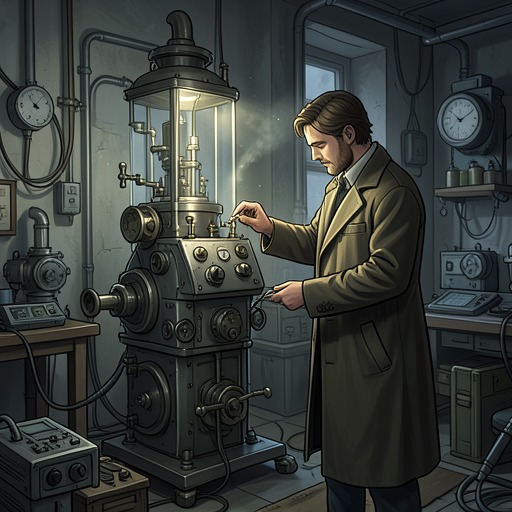
The possibility of teleportation arises from the machine’s known capacity to amplify natural telepaths. Leoh reasons that some telepaths have reportedly moved small objects without apparent physical force, and asks whether the same amplification might extend that talent into spatial displacement. The hypothesis is initially presented as farfetched, especially because it would require an enormous drain on the building’s power, but it is the only explanation Leoh can find for what has happened between the machine’s booths. The uncertainty is precise rather than merely mystical: Leoh wants to know how quickly Hector arrived and wonders whether the movement occurred within four picoseconds, or even four-trillionths of a second.
The discovery depends on the machine’s unusual relation to thought and personality. In earlier experiments, Leoh and Hector use the booths to project shared environments and to test combat abilities. The machine reproduces and amplifies thought patterns with strict fidelity, yet Leoh realizes that it projects personality as well as thoughts. That distinction matters for teleportation: the machine is not simply transmitting an image or constructing a dream, but magnifying a person’s psychonic capacities until they can affect physical location. The ability therefore belongs to the interaction between Hector and the machine rather than to either one considered in isolation.
Initial Limits and Measurements
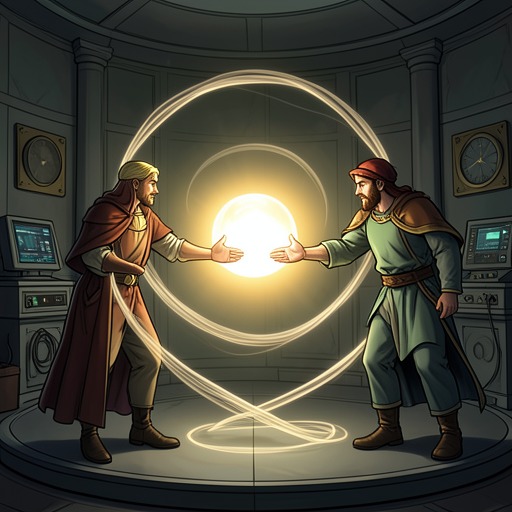
Hector’s first deliberate trials are cautious and repetitive. He teleports himself from one booth of the dueling machine to the other twelve times on the first day while Leoh measures both transit time and power consumption. The average transit takes four picoseconds. The speed is so extreme that ordinary movement becomes almost irrelevant, but the energy cost prevents the feat from being treated as effortless: the power drain is approximately equal to that of a starship’s drive engines pushing a mass equal to Hector’s weight.
The experiments then extend beyond Hector’s body. For several days he moves inanimate objects while remaining seated in one booth, first lifting weights without touching them and then transporting Geri from one booth to the other. These trials establish that the power is not limited to self-displacement. At the same time, they expose its first firm boundary: Hector can move objects only inside the dueling machine. The achievement is therefore both astonishing and incomplete. Leoh can imagine an interstellar transport mechanism, but such a system would require another dueling machine, or something comparable, at the destination.
The machine’s safety architecture also becomes relevant to the ability’s development. After earlier abuses in which Major Par Odal actually killed people through the apparatus, Leoh adds three circuits, including one that psychonically isolates duelists from the outside world while the machine operates. This isolation prevents contact with the external world during ordinary duels, but it also underscores the controlled conditions under which Hector’s teleportation is discovered and tested. The machine is simultaneously a safeguard, a laboratory, and the limiting enclosure in which the new power first becomes usable.
From Local Experiment to Interstellar Transit
The decisive expansion occurs when Hector succeeds in jumping between Kerak and Acquatainia. Sir Harold Spencer initially remains unconvinced that the feat has occurred, but Leoh reports that Hector covered 450 light-years in less than a second. The distance turns the earlier booth-to-booth experiments into something qualitatively different. Teleportation is no longer merely a curious psychonic trick within a laboratory; it has become a method of crossing interstellar space at a speed that conventional starship travel cannot match.
Even after this achievement, the mechanism remains unexplained. Hector asks whether he is traveling in subspace as a starship does, but Leoh can offer only a guess. They do not know how the process works, how fast Hector can ultimately travel, how far he can teleport, or what limits govern the phenomenon. The narrative preserves this uncertainty while grounding the power in measurable results: four picoseconds for a local jump, a starship-scale energy drain, and 450 light-years crossed in less than a second. The ability is thus scientifically investigated without being reduced to a fully understood technology.
Strategic Consequences
The military implications are immediately apparent. Spencer warns Leoh about the military potential of the teleportation and points out that Chancellor Kanus must know about it as well. The concern is not abstract. Hector is being held somewhere in Kerak, and Leoh fears that he may already be under the control of those who understand what his ability could accomplish. A person able to cross interstellar distances almost instantaneously could move personnel, objects, or weapons past ordinary barriers, making possession of the ability a matter of political and military power.
This danger changes Hector’s status. He is not merely a participant in experiments or a skilled duelist whose psychonic talents can be studied. His body becomes the carrier of a capability that can connect distant worlds, bypass conventional transport, and alter the balance between governments. The fact that the power initially requires a dueling machine at each end does not remove its strategic importance; instead, it suggests the possible construction of a network whose terminals would make distance newly negotiable.
Narrative and Technological Significance
Hector’s teleportation ability reverses the apparent purpose of the dueling machine. The apparatus was designed to settle aggression without mental or physical harm by allowing opponents to fight within a shared projection. Its controlled unreality gradually produces a real physical consequence. The machine first reproduces thoughts, skills, and imagined weapons; then it amplifies personality; finally, through Hector, it appears to move matter itself. The progression makes the technology an active participant in discovery rather than a passive setting for human conflict.
The ability also joins intimate bodily experience to vast political consequence. A single person’s psychonic capacity is tested through repeated jumps, measured in picoseconds, and demonstrated by moving weights and Geri between booths. Yet the same capacity ultimately spans 450 light-years and draws the attention of military authorities. The contrast between the small enclosed booth and the scale of interstellar space gives the breakthrough its central force: a power learned within confinement threatens to make confinement, distance, and strategic separation obsolete.
Hector’s psychonic teleportation ability therefore remains both an achievement and a danger. Its operational limits are still unknown, its energy demands are immense, and its dependence on specialized machinery restricts its immediate use. Nevertheless, the jump from Kerak to Acquatainia proves that the dueling machine has opened a path toward interstellar psychonic transport, while Hector’s captivity demonstrates that the discovery has already entered the sphere of coercion, military calculation, and political crisis.