Shinar under Terran imperial rule
WatchmenShinar under Terran imperial rule is the political and material condition of Oran VI after its incorporation into the Terran Empire. The planet is presented as both a strategic possession and a society whose internal pressures the Empire fails to understand: Imperial authority brings administration, military protection, and technological development, but also turns land, food production, and local political choice into matters of colonial policy. The resulting contradiction drives the Shinar Rebellion and forces the Empire to confront the limits of rule by proclamation, garrison, and force.
Imperial Incorporation and Colonial Status
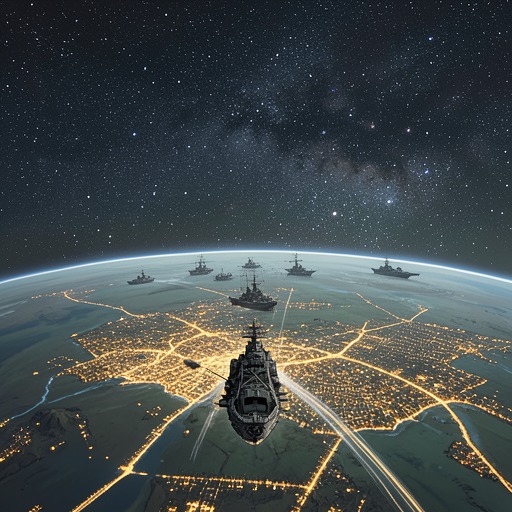
Shinar occupies a peripheral position within an immense imperial system. The Terran Empire stretches across half the Milky Way galaxy, with Earth as its capital and Mars as the headquarters of the Star Watch, the Empire’s military arm. From that centralized structure, the Star Watch maintains bases across the Terran domain, including the distant regions surrounding Oran. Imperial records classify Oran as a system of eight planets, only one of which, Oran VI, is terrestrial. The planet’s native name is Shinar, and its location near the territory of the Komani nation gives it additional strategic importance.
Imperial administration reduces Shinar to a set of measurable resources and developmental categories. Oran VI has a radius of 1.04, a density of 0.91, gravity of 1.025, and an atmosphere almost identical to Earth’s. Three major continents occupy a world that is 80 percent covered by sea. Its estimated native human population is 3.4 billion, while its economy remains primarily rural and agricultural, with an underdeveloped industrial base. The Empire places it under Imperial Development Plan 400R, priority 3C. Such statistics make the planet legible to distant officials, but they do not explain how its inhabitants experience imperial rule or why an apparently developmental policy becomes politically explosive.
Shinar was formerly a colony of the Masters and was incorporated into the Empire immediately after the Galactic War of the previous century. Terran conquest therefore appears initially as liberation: the Terrans defeated the Masters and freed Shinar from an older domination. Yet the end of one imperial order does not create political independence. Shinar changes rulers rather than escaping the structure of external rule, and the language of liberation becomes inseparable from the continuation of imperial authority.
Population, Land, and the Development Crisis
The roots of Shinar’s crisis lie more than a century before the rebellion. Under the Masters, the population had been held at approximately 500 million, and the planet remained a stable agricultural supplier to the worlds within fifteen light-years. Shinar was not prosperous, but its economic relationship with the surrounding region was balanced: it fed itself and exported food to neighboring worlds, while its population remained relatively fixed. The Masters’ domination was oppressive, yet it had imposed a material equilibrium that later developments would destroy.
After the Terrans defeated the Masters, Shinar was left to manage its own affairs within the Empire. Population growth accelerated gradually and then explosively. When Clanthas’s son, Merdon, was the same age as the younger man is during the rebellion, Shinar had about two billion inhabitants; it now has about three billion, with Imperial records estimating the total at 3.4 billion. The agricultural system that once supported both Shinar and its neighbors can no longer maintain the same export capacity. Nearly all food production is needed for the planet’s own population, and trade with nearby worlds is collapsing. Shinar is consequently becoming a bankrupt nation even before open rebellion begins.
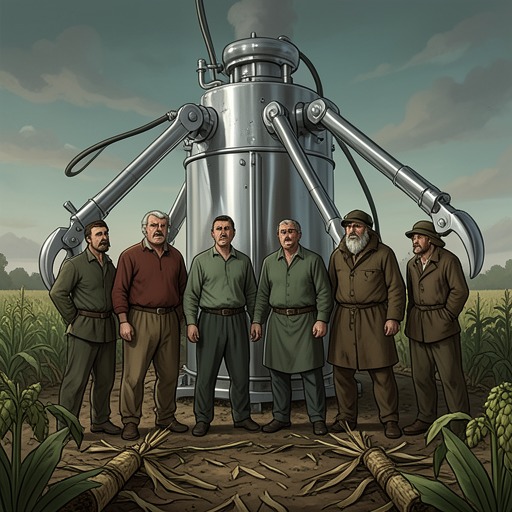
The Empire responds with nutrient-processing plants intended to multiply food production and restore the planet’s ability to trade. The policy is materially rational from the Imperial perspective, but it requires farmers to leave their land so that factories can be built. The first farmers who arrive in Katan report that Terran authorities drove them from their own soil for this purpose. The immediate experience of the policy is therefore not increased abundance but eviction, uncertainty, and the visible replacement of farms by foreign industrial installations.
The failure is also communicative and cultural. The governor issues a proclamation explaining that the plants will allow food output to increase and trade to reopen, but little effort is made to explain the change to the farmers whose entire way of life is being disrupted. To Imperial officials, the plants are an obvious technical answer. To the displaced population, they signify the power to redefine necessity without local consent. The conflict thus arises from both material pressure and a failure to make development socially intelligible or politically acceptable.
From Resentment to Rebellion
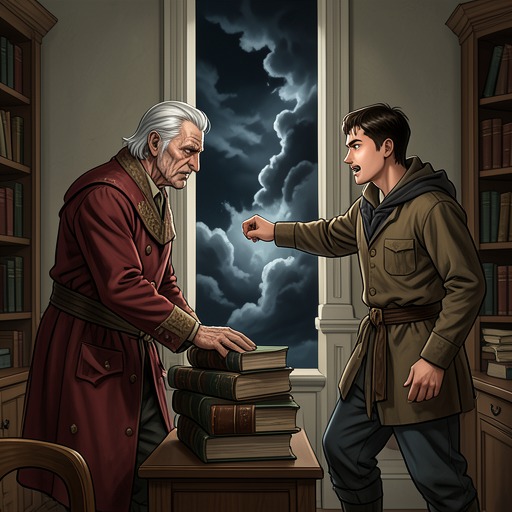
Clanthas becomes the clearest local interpreter of how imperial rule turns structural pressure into political anger. Before the rebellion, he is an ordinary merchant in Katan, distinguished from his fellow merchants mainly by quick intelligence and good fortune. His house overlooks the harbor, and his life is comparatively comfortable until farmers begin arriving with accounts of dispossession. Rather than quietly accommodate the worsening situation, he recalls a statement from his son’s university studies: “A man is free because he has the brains and the courage to stand on his own feet and go his own way. And for a man to remain free, he and his fellow men must be strong enough to resist those who would enslave them.”
The statement is especially ironic because its speaker, Geoffrey Knowland, was a Terran conqueror who defeated the Masters and established Terran rule over Shinar. Clanthas accepts the principle while turning it against the people who originally proclaimed it. In this reversal, Terran political language becomes a resource for anti-Terran resistance. Imperial ideology supplies the vocabulary with which imperial domination is condemned; the demand for freedom is no longer confined to the Empire’s own historical self-image.
Clanthas organizes the farmers and stages a demonstration in Katan, then coordinates similar demonstrations in the major cities. Some of the larger gatherings become riots. Troops are sent in, shots are fired, and unarmed civilians are killed. The killings intensify public anger, violent men take action, and the Terran governor is murdered. The Imperial Marines then arrive, while Komani warriors land on the planet. What began as opposition to land seizure and a development program expands into a multi-sided crisis involving local rebels, Imperial forces, and an external warrior society.
The Empire’s military presence reveals the coercive foundation beneath its claims of orderly development. Terran forces control the major cities through garrisons, while the wider conflict depends on negotiation, raids, prisoners, sanctuary, and competing authorities. Emil Vorgens is ordered to negotiate with the chief of the Komani raiders, offering the Komani a peaceful return to their homeworld if they immediately stop raiding Shinar. He is also to invoke the loyalty sworn by the Komani clan chieftains to the Terran Council and the old alliance between the Komani and the Terrans during the Galactic War. The very need for such a mission shows that Imperial sovereignty is contested at the edges: military possession does not guarantee obedience, and historical friendship has become an instrument of diplomacy rather than a settled political bond.
Competing Authorities and the Limits of Force
Imperial rule on Shinar is challenged not only by rebellion but by rival systems of law and obligation. Okatar Kang, speaking in the Komani camp, identifies Vorgens as a Terran prisoner who attempted to escape and invokes a Komani custom: prisoners who reject Komani hospitality are traditionally executed. His claim places local warrior law above the expectations of Imperial custody and makes cultural sovereignty a practical danger for the Terran officer.
A different authority appears when the Komani attempt to claim Terrans sheltered as prisoners. Sittas, a priest, rejects the claim with emphatic force. Later, he acknowledges that he exercised the authority of a Star Watch officer, while admitting that whether he had the right to take that authority into his own hands would eventually be decided by a Star Watch court. His position embodies the unstable overlap of religious sanctuary, military jurisdiction, emergency action, and local protection. Even those who serve or assist the Empire cannot rely on a single uncontested legal order.
Vorgens’s later conversation with Clanthas makes the political diagnosis explicit. Clanthas says that the rebellion’s real cause is not merely the nutrient-processing plants. Shinar’s people already resent the Empire because population growth has overcrowded and impoverished the planet, while Imperial policy has failed to address the problem in a way that preserves dignity or agency. The factories are only the trigger. Vorgens recognizes that people cannot change their whole way of living overnight, even when the change is materially necessary; Clanthas answers that necessity does not make such a transformation desirable.
This exchange exposes the central failure of Terran rule. The Empire sees a regional food crisis that threatens Shinar’s neighbors as well as Shinar itself, and therefore treats intervention as urgent. Shinarian society experiences the intervention as an imposed reorganization of land and labor. Both perspectives contain a material truth, but they operate at different political scales. The Empire speaks for interplanetary supply and stability; the inhabitants speak for place, livelihood, and consent. Because the imperial system cannot reconcile those scales, its technically corrective policy becomes evidence of domination.
Historical and Narrative Significance
Shinar under Terran imperial rule is defined by a persistent contrast between liberation and dependence. The Terrans overthrow the Masters, yet Shinar remains incorporated into an empire whose officials classify its economy, relocate its farmers, garrison its cities, and decide how its food system must be rebuilt. The planet’s rebellion is therefore not presented as a simple rejection of progress. It is a demand that progress not be separated from self-government, communication, and local control.
The condition also gives the wider story a political counterpoint to its technological imagination. Elsewhere, machines can project thought with exact fidelity, isolate duelists psychonically, monitor contests for rule violations, and eventually allow Hector to teleport from one booth of the dueling machine to another in an average of four picoseconds. On Shinar, by contrast, the decisive failure is not a shortage of advanced technique but the inability of an advanced empire to translate technical solutions into legitimate social change. The contrast makes technology politically ambiguous: it can solve physical problems, but it cannot by itself settle questions of authority, memory, land, or freedom.
The history of Shinar also turns imperial rhetoric into a contested inheritance. A Terran conqueror’s words about independence become the moral basis for Clanthas’s demonstrations, while the Empire’s insistence on order leads to troop deployments and deaths among unarmed civilians. The same civilization is thus represented as liberator, administrator, military power, and unwitting source of the resentment it seeks to suppress. Shinar’s significance lies in this reversal. It shows that an empire may possess the resources to intervene everywhere in its domain and still lack the political understanding required to rule without producing resistance.